Spotlight on Innovation with AI and Communications Technology - May 2025 Episode Transcription
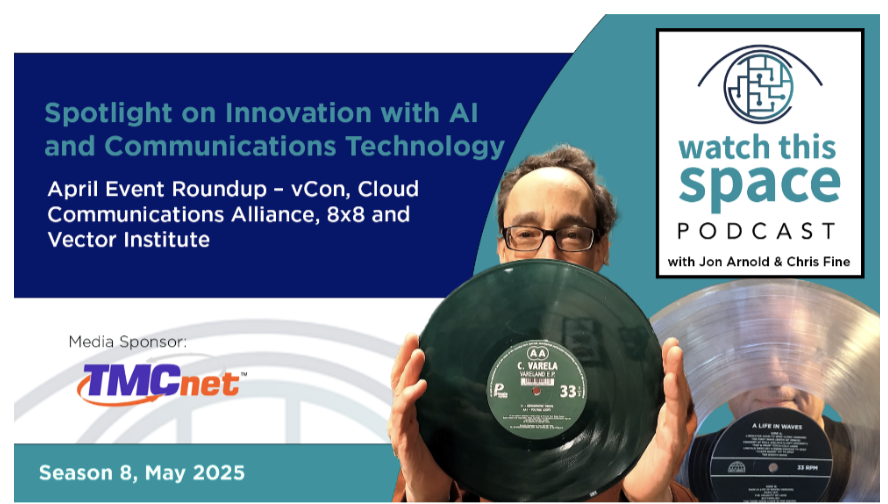
Transcription: Spotlight on Innovation with AI and Communications Technology
Jon Arnold
Welcome to Watch This Space, the podcast about future of work. Every month, we bring you insider perspectives on how digital transformation and emerging tech and generational change are shaping the future of work. We are two analog guys finding the groove for all of this in today's digital world. I'm Jon Arnold, and these trends are my focus as an independent technology analyst in my company, J Arnold and Associates.
Chris Fine
And I'm Chris Fine. I'm an independent consultant and strategist specializing in workplace technology, IoT, and security. My company's Integrative Technologies. Hi, Jon. Hi, everybody. Jon, how are you doing? Did you have a good month?
Jon Arnold
Pretty good. Yes, yes. The travel continues, so I've gotten out to a few events, all of them interesting, as have you. So I'm glad to say as well, though, my run of travel is easing up finally. It's been almost constant since February. I've gotten to see a lot of great events, a lot of the world, actually, which is pretty cool. And I'm looking forward to a quieter May, let's just say. But glad to be here. And it's always good to be with you here. And as much as we are a virtual team, Chris, you know, it's too bad our paths didn't quite cross when I happened to be in New York this week. And, you were at the vCons event, which we'll hear about in a moment, but our paths will cross again later in May when I get to go back to New York again.
Chris Fine
Well, I hope so, Jon. I was sorry to miss you, but I know you had a nice day in New York.
Jon Arnold
Yeah, it was almost a beach day. It was that nice. It was pretty good.
Takeaways From Jeff Pulver’s vCon Event
Chris Fine
That was a warm day. Yeah, well, I was up in Hyannis on Cape Cod at a conference called the vCon Conference. And it was really interesting. The person who put the conference together is our friend Jeff Pulver, who is sort of a tech guru of long standing, very good at spotting trends and getting communities together. That's really his forte. And Jeff, as you may know, was one of the original evangelists for voice over IP, which has revolutionized the entire communications business. He was the force behind an FCC order that protected that business. You know, one of the few sort of just normal people to go and manage to get an FCC order done, not an industry group or anything like that. So that was pretty historic.
And then Jeff was very early in the days of Twitter and short form messaging and in chat bots and a whole bunch of other things. And so, a couple of years ago, now, geez, it's been almost two years, Jeff started to get interested in some work that one of our other friends, Thomas McCarthy Howe, was doing with the idea of encapsulating conversations in a new way, conversations being interactions that involve voice and video and notes and all the other things we might associate with, let's say, a customer service interaction or a video conference, which if you look at it right now, the data behind all of these things is typically stored in a very ragged way and very proprietary for a lot of vendors. And this is all open source and getting standardized, the vCon.
A vCon allows you to not only encapsulate whatever was captured, but for example, to add AI processing for things like translation. So the vCon object can just be shipped off to an engine that will then come back, let's say, with a translation or notes or whatever, offline from the original conference or whatever the event was.
It's a very promising thing. It's sort of simple at its base, but I've gotten very intrigued with it as well, and this conference was quite a step up from where it was a year ago. You had real companies here, people investing money and building technology around this. And I think that among other things we saw at this conference was there's been a standard type of engine developed that this data can be put into. And then the engine can connect to any external data storage or processing steps. It's called a conserver. That is going to be defined as a standard.
All of this is going to be brought in front of the IETF, the Internet Engineering Task Force, that basically sets the standards for the whole Internet. That's where, for example, the SIP standard for voice over IP got codified and became a worldwide standard. You know, all of the things we use like email and everything else and how web servers work and everything went through that. So, I felt it had a lot more traction. The last day, I wasn't able to get there because it was really for the vendors only and who were involved, but they had an interop lab, you know, to test all the different components that people were working on.
There were nine companies there, apparently, which is a relatively serious amount for an early technology. So, Jon, I think the takeaway is that, you know, companies in your space of unified communications really ought to take a look at this. I think if this keeps going within a year or so, it's going to be visible, you know, really have traction. I think the power of it is quite good. It seems like a simple thing on the surface, but it had its birth in a very practical set of circumstances. Thomas Howe works for a company that does customer service across a wide range of auto dealerships. and they wanted to improve how all the systems work, and that's where this started.
So it had its base and it has its funding and its backing from end users, which is very different from where these things generally start. That's kind of it in a very small nutshell, but I feel like it's gaining traction, these vCons, and that we'll see more from it. Do you see it as relevant to your space potentially?
Jon Arnold
Yeah, for sure, Chris. I want to break this down a little bit because even for me, it's still pretty esoteric. I know you got to speak there and if I if my schedule had lined up, I would have been there as well. If folks don't know, Jeff's been, as you said, Chris, he's been running various types of events for the past few years. And we have both been regulars at his events, speakers contributing to the community. And just to amplify what you said earlier, Chris, Jeff, he's always had that kind of visionary vibe about him. And he usually bets right.
In this case, having gone through what all of us have lived through with the evolution of VoIP and internet communications. When you've seen what works and doesn't work at this stage of the game, I think you'd agree, Chris, there's a little more, I think, gravitas to when Jeff gets behind something like this at this stage of the game, having done what he's done and seen what he's seen, I think there's a probably higher chance of success that this is going to be for real. Like you say, it's looking like a serious thing now. And as you say, the kind of attention he's drawing to this now, it does remind you a bit of the earlier days of VoIP. And once the vendors get in, it becomes a thing, right?
Chris Fine
Yeah, and I would say, so Jeff is very good at envisioning trends and he'll kind of get involved at the very early stages of something and try to form a community and get ignition for it. And I felt that that was what was going on here because there were some serious people there, people who are operating businesses that can either use this or can create tools or services for the ecosystem that's growing. And that's what really gets something going. What I spoke about was where else could you use this and how do you go to market and what would make companies interested in this? What's the kind of big picture?
I think the big picture here is the idea of unstructured data, which is a bane to anybody in the IT business, right? Where you have all this stuff laying around. And very often there's no way to combine things that are related, but not, let's say, the same vendor or the same system, the same type of key to match one thing with another.
This uses a very well-known kind of thing called JSON, which is a way of combining data in a standard way. But the structure that it creates allows you to take all the different piece parts of an interaction and combine them in something that can be secured, it can be verified. There's a protocol called SCITT that's similar to the blockchain where you can sign and verify and secure and encrypt a vCon so that, for example, if you need it for compliance or you want to go back and you need a canonical version of something and things don't disappear, you can do that too.
My point was that there's all kinds of interactions in the world that maybe this would apply to, that started out maybe as just an e-mail or something or a message or something, but then it starts incorporating all this other stuff. And it's not really combined together.
So one area that I think about is the security business, where let's say you want to track a visitor, right? You've empowered a visitor to come visit. Let's say it's a technician, whoever it is, a visitor. And now you're probably going through four separate systems to kind of keep track of what they're doing and enable them to access whatever they have to access. Your records are kind of fragmented if you want to go back and do anything forensic, right? You have to go assign somebody to investigate the case. And I envision, you know, an experiment where there are certain triggers that cause a vCon to be created. And then once it is, that's it. That's the bundle.
I think from the point of view of security, that would be really powerful because it would basically then you put it in a database that's optimized for this and you can search it a million ways or put it on dashboards. It's much faster than going back and try to put together a bunch of pieces. There are other instances that I could name, but in your world, contact center interactions are definitely one of them. Like let's say you had a system that managed the day-to-day interaction, and then you had another super-duper AI system out there that was going to analyze everything. This is a way of sending the whole package over to the AI and getting it back in the same way. And so it's all standard, right?
Much less complexity, much less integration, much less code. That's the promise that it has. And so I know I'm going on, but I'm trying to kind of identify what the core of this is. When you apply a standard or set of standards to something, it starts to get really empowered. That's what I think this is addressing.
The Opportunity for Virtualized Conversations
Jon Arnold
Yeah, there's a lot there, Chris, for sure. Let's break this down a little bit, because I think for anyone who is not familiar with any of this stuff, let's just start with the term vCon. What do we actually mean by that?
Chris Fine
It means virtualized conversation. So, the virtual means that it combines all elements in a single data structure. And the conversations, it means that it's designed to track and encapsulate all elements of a conversation. Conversation to me being an interaction that involves multiple piece parts, multiple media, multiple participants who can be identified, and takes place over a period of time. Whether that's a call to a call center, whether that's a sequence of responses to a tech ticket, whatever it is, you know, phone call, that's a conversation. And that's what it means.
Jon Arnold
Yeah, and just to clarify for the audience, because it's easy to kind of interchange the words, con as conversation and comm as communication.
Chris Fine
Right.
Jon Arnold
Just to clarify, this is not strictly just for voice conversations. It could be text-based conversations too, like emails and messaging.
Chris Fine
Sure. Either way, it's not a protocol, right? It's not a standard way of communicating, let's say like voice over IP, right, or SIP. It's more a data structure. So, you know, there are probably instances where something is so simple that you don't really need it. Like just a plain email, Hi, Jon. Hi, Chris. Right? But what's happening is that fewer and fewer things are actually really like that. You know, so I would say conversation expands to interaction. And there are fewer and fewer interactions that are just some simple, only one medium transaction. You know what I mean? There's something greater than a transaction, and that's what this addresses. Does that make sense?
Jon Arnold
Yeah, and in fact, transactional types of interactions now are becoming much more automated, again, by AI, which you mentioned earlier, right? And so that's kind of the rise of these better bots that we have that are built around conversational AI that can handle unstructured things and basically, as you say, automate fairly routine interactions where humans don't have to be involved. I just want to again, step back and say, we are talking here primarily about conversations, which to me is also communications between people, right? This is people to people. Is that kind of the universe we're talking here?
Chris Fine
Yes, involving people, at least at this point. Yeah. And you actually raised a really good point, which I neglected to mention, which Thomas Howe says this makes robot food, which essentially means that using this structure or discipline creates artifacts, digital artifacts that are much more easy for AI to digest because everything's in one place. Their standard definitions of the data, as we would say taxonomy, right.
So, one of the things that Jeff always says is that if you go back and try to retrace something, I don't know if you've ever tried it, especially like something that has a whole bunch of pieces or documents or recordings or videos or whatever, whatever around it, it's very often hard to go back and even read. Like if you ask the AI the same question that involved that data a month later and the AI hadn't already committed all of that. it might not even find it. And this provides a record of it. And it also formats everything into a way that's much easier to feed to an AI processing engine.
AI and the Power of Remembering Everything
Jon Arnold
Yeah, but on that note as well, I think the attraction for a lot of the AI use cases is the fact that it does have full and total and permanent recall of anything it tracks. Right? Like you say, if you and I came back a month later and said, what the hell did we just talk about, Chris? Neither of us would really remember. It'd be hard. But AI, when it captures everything structured or unstructured, it will have, it will cover everything. It doesn't matter if it happened yesterday or a year ago. Memory is not an issue.
That is, when you talk about things like compliance, you know, all of a sudden, this kind of uplevels things quite a bit to say in terms of the accuracy of our records when you start talking about whether it's financial transactions or medical advice, right? You know, these kinds of things where the content of the communication or the conversation is very relevant or important or could be in the legal world, he said, she said, whatever, it's all there. Right. And I think that's where this could be a superior form of, I guess, representing data. Yeah, retention, documentation.
Chris Fine
Right. Because what you said is true, but then think about how does the AI, I mean, let's even think of it as a fancy version simplified, right? This is oversimplification, but a fancy version of Google search, right? If you go, Google has access, it's crawled everything, it has everything, right? All of you, anything that happens to still be on the web, it's out there, right? But how do you know what's real and how do you know what was the canonical or final result of something from a search? You don't really, right? Because most things are stored in directories, files, that could be modified in any time.
You can go back and look at snapshots, but that's a complex process, particularly if it's backup systems. And so how do you know? Like if you ever try to search for any information, you know what you have to go through to find out what's actually real, and or current, right? The AI has some ability to sort that through. Like, if you have an answer from 2024, it may be more relevant than from 2020. But you know what I mean? There's not really any tagging on a global level that says this is this is, you know, for lack of a better way to say it, the source of truth, you know?
Jon Arnold
Yeah, boy, this gets us through a lot of rabbit holes.
Chris Fine
It does. I'm trying to be simple. I know it's hard to. Let's just think of it as a way of storing kind of unstructured data around conversations and then manipulating it and processing it, attaching it to subsequent follow up steps in a standard way.
Jon Arnold
So, to whatever level our listeners are interested or understand what the hell we're talking about, just again, watch this space in capitals. This is again, when Jeff has had a couple of kind of iterations with this vCon thing now for the last probably year and a half. He wouldn't be sticking with it if he didn't think there was something there, because Jeff tends to move on quickly when things aren't taking hold or have run their course.
As you know, Jabberwocky as some of this stuff might sound right now, as you say, Chris, it's an emerging idea that is going to take shape. When you start hearing terms like blockchain, you start looking at these other worlds that are not normally associated in communications technology. But when you piece them together in a certain way, they start to make a lot of sense.
That's kind of what I'm seeing coming out of this little digital swamp that's being created right now. Some life form is going to emerge from all of this because we know Chris, Thomas Howe is like an 11 on the scale of smart guys. He knows what he's working with and working with the right people to get behind it. this will start to take shape. And so we'll look at this a little bit foggy right now, but I think you and I both know that there's enough pieces there that are worth working on and evolving this into something a little more tangible.
Chris Fine
Yes, I think so. I think this is a definite watch this space, Jon. And I agree with you about Thomas, but to his great credit, he has really surrounded himself with smart people who are enthusiastically involved in this all over the place. And he's been very generous. And the company he's working for, the auto company Strolid, they've really backed him. And there's nothing like an end user business that could come out and say, this thing's great. My CTO did something that's great, and it's helping my business. And he had the business guys there saying that.
A lot of times new technology has to go on and on and on before it gets into an end-user environment, or it's an esoteric IT project that started in an end-user environment, but didn't have somebody visionary behind it who saw the big picture, so it's hard then to make it into a product. I think that we'll see. We'll see. But it's also not super expensive to get involved with it. It's going to be standardized, but there's a lot of opportunity, I think.
Jon Arnold
And I think it's early and esoteric enough that it's too soon for the Amazons and Googles and Azures to jump in; the hyperscalers, because once they do, it's over, they'll own it. But those guys weren't there, right, Chris?
Chris Fine
Not at this point, no. But I will say, though, Jon, that there are companies like those companies and companies like Walmart, FedEx, who will sometimes grab hold of something in a very early stage, like Walmart did with RFID and EDI and a bunch of other stuff. Basically, when they say, you're going to do this, then their whole vendor ecosystem is going to have to conform. We don't have that yet, but we'll see. I also think if one of the major companies in your sector that you talk about all the time and we need to get to that. But I think if one of them adopts it or starts working with it or becomes compatible with it, that's going to be a major boost too.
Jon Arnold
Yeah, I think so. And as I say, before the Amazons of the world get in on it, this is why you do it now, because you can. Like I should say, if Walmart can kind of rule the world with this kind of thing, on their terms, you're damn right they're going to do this because it's too late once those other guys start to get involved and kind of set the terms and control the whole ecosystem and the distribution of data and everything.
Just to cap this off, Chris, I've always been not concerned, but wondering, and I've asked Jeff and Thomas about this. A lot of this seems to be things that a lot of what the comms vendors are already doing with their AI initiatives in terms of capturing all the conversations with NLU, NLP, NLG, getting a handle on unstructured data, putting it in a form that AI engines can read and build into their learning models. It strikes me that they're already doing a lot of these things, but I don't understand it well enough to know what it is that they're not doing.
Because that's what I'm trying to get to, see what is it that's happening here, all of the big players, whether it's contact center players or unified communications players, you know, Zoom, Cisco, all the big guys, you know, Genesys, NiCE, the contact center players, that they're not already doing. And I don't know what that is yet. So that's why I need to get a little deeper on this and we'll just kind of keep this conversation going.
Chris Fine
Yeah, Jon, I think that's a good idea. Let's see how this develops. Let's see where the deltas are compared to where the industry is, or whether this is just an easier way for them to do it, right? And to be more interoperable and less complex integration, which may in itself be justification for it.
Jon Arnold
Yeah, because as you say, the key to all of this for the listeners is that it's going to become standards-based, and that's what makes it real.
Chris Fine
And open source. A lot of open source, being an IETF standard.
Jon Arnold
Yeah, and as I said with Jeff, having done this with VoIP, having done this, as you say, with the FCC, people who know how this stuff works know how important that is. Once it becomes a standard, then it has legitimacy. Then you can build an ecosystem around that, and that's where the business model starts to take shape, right?
Chris Fine
Right. And when you get people, you know, maybe it's not AT&T yet, but when you get people to stand up or come to something like this and say, you know what, I run a big customer service operation, or I run a phone company, or I run a, you know, an ITSP, Internet telephony service provider, or I run whatever it is, and I'm interested in this, that's a real step.
Jon Arnold
Yep, for sure. Okay, well, we've seen this movie before.
Chris Fine
We'll see.
Jon Arnold
VoIP World, and we shall see.
Chris Fine
Yes, I know I have a bit of geek enthusiasm about this, but I really do feel it's something to it.
Jon Arnold
And for our listeners, we'd like to say you heard it here first, right?
Chris Fine
Absolutely. Well, yes.
Jon Arnold
For the most part, I think that's largely true.
Chris Fine
So what about you? I've said enough.
Recap of Jon’s Events – Cloud Communications Alliance, 8x8 and Vector Institute
Jon Arnold
Yeah, no, this is good. And we, this is a conversation we have to keep moving for sure. But from my side, I had several events over the course of, well, since our last episode. I'll just touch briefly because we are on a hard stop today. I was recently at CCA, which is the Cloud Communications Alliance, which is not that far removed from the vCon world in certain ways, because it is about, you know, you could just change the words, Chris, from Cloud Comms to Cloud Cons conversations, because that's the gist of what it's all about.
Mike Tessler, who many of us know very well. The CCA Cloud Comms Alliance is basically the ecosystem that came from the BroadSoft world. So, most of the MSPs and carriers who had again, Chris, standardized their comms platforms around BroadSoft. That community is still alive and well. For those who don't know, BroadSoft was kind of one of the very first ones to come up with this kind of integrated platform idea. And in time, they were very successful. Anyways, Cisco acquired them and it's been just swallowed up into that bigger brand. But Mike is still very active through his True North partnership that he is an investor and an advisor to several emerging companies in the space.
So he's still very active. Anyways, he gave, I think he gives a keynote there every year. This was in St. Petersburg, Florida. The big takeaway I want to share, Chris, is he talked about how with AI that almost all of the public domain information that has basically, you know, all the search conversations, has pretty much all been absorbed now by AI and all the machine learning models, et cetera, et cetera. So all the public data has now been captured, digitized, standardized, structurized, whatever you want to call it. There's really nothing to compete, sorry, to differentiate on competitively. Everyone has access to that now.
But the flip side, private conversations, like what we're having here that aren't indexed or search engined out there, he says he feels that's more like 2% of all the volume of traffic and discussions that are out there has not yet been captured by, you know, in the AI realm. And that would equally apply here to vCon.
So that's where kind of like the gold rush is. And that's why, and we've talked about this before, how companies now are really embracing AI because they recognize there's a lot of value potentially in that data, if it can only be captured and harnessed and put to work to help optimize workflows, you know, and automate processes, all the things that AI is built to do so.
That's the kind of the big opportunity, right? How do we capture? It's also referred to, I think, as dark data, things that just are ephemeral conversations. But if you can somehow capture all of that and we have the tools to do it now and analyze it and draw predictions and learnings from it, that's kind of where AI can really take things forward. And because it's not been done, there's still a lot of potential there. For enterprises, this is also a land grab to almost have a proprietary, like a small language model of their own internal conversations that become the basis of their own internal knowledge bases, which, you know, that's a form of proprietary information.
There's a lot of opportunities here to do these things. And yet, Chris, everything you've been saying about vCon, I think it's pretty relevant to what Mike was getting at here and kind of where the opportunities are for these new companies.
Chris Fine
Yeah, yeah. I also I think you're going to see much more use of sort of the equivalent of Microsoft Copilot, where it's very integrated into the enterprise data as well as the outside data. And we're, you know, obviously subject to the normal levels of security and everything else. But when you're fully integrated with something like Copilot, if you ask it for some information, it may be able to draw on internal sources too. But again, to your point, those sources have to be organized in a way that AI can understand it and understand that it's relevant, you know?
Jon Arnold
Yep, totally agree.
Chris Fine
I think the small LLMs that are the smaller that are just absorbing all the internal data and not for external consumption are going to really grow. I think a lot of companies are working on that right now with the available tools.
Jon Arnold
Yes, I agree on that point. So we're going to hit time today, Chris. And so I'm just going to very briefly mention two other events that I have been to recently that are worth talking about or referring to. One would be 8x8. I attended their analyst event in Southampton, England, believe it or not, earlier in the month. 8x8 is really coming along with a very good story now. Their management team is well in place.
Their portfolio has kind of been expanded and right sized for the market that they're after, which is mostly mid-tier sized businesses and a strong focus on CX, contact center, customer experience, not trying to compete with teams in the UCaaS space. They've got a good story, and I really like what I see there, and can refer you to some of the write-ups I've done about the event. So there's places to go to learn more. But that's all I'm going to have time to mention about that today.
I also took part very briefly, remotely, in another very research-focused event called Vector Institute, or that's the source of this. where they have an annual event called Remarkable here in Toronto, but it's a very closed community. It's very research oriented. So I wasn't allowed to attend in person, but I could participate remotely and follow some of the presentations. And it was fascinating to see close up some of the real theoretical type of research that they're doing with AI, all of which, of course, from these academic environments will translate into private sector applications and real-world applications. But it's really refreshing to see the kind of level of energy and research dollars that are going into developing these things.
The big takeaway from that, folks, is that when AI starts to become part of the research and development process, the innovations happen a lot faster. because AI can kind of learn and build on previous experiments faster than humans can do it. And that's a big takeaway to me is that the pace of change and innovation is only going to increase the more AI becomes part of the groundwork for doing all of the initial research.
Chris Fine
Boy, I don't know. Is it going to be another enlightenment or is it going to be Black Mirror? We'll just have to watch this space, right?
Jon Arnold
Yes, so as a parting thought on all this stuff, for folks who know how to find me, I document a lot of this stuff on my blog and my various articles that I write, like for No Jitter or BC Strategies. So it's out, the stuff's out there and you can always contact me directly if you want sources and links to these things, because they are there. But unfortunately, we're just on a hard stop for time today. Okay, so with that, Chris, we have to wrap up.
So, thanks everybody for listening today and hope you enjoy the podcast and you'll continue with us as we explore the future of work here on Watch This Space. You can access our episodes at www.watchthespace.tech, or wherever you subscribe to your podcasts. And by all means, leave us a note if you like what you hear or suggestions for future episodes. And with that, I'm Jon Arnold.
Chris Fine
And I'm Chris Fine. Thanks again for listening. And we will be back with another episode of Watch This Space.
Companies mentioned:
8x8, Amazon, BroadSoft, Cisco, Genesys, NiCE, Strolid, Zoom