Future of Work Expo Review - March 2025 Episode Transcription
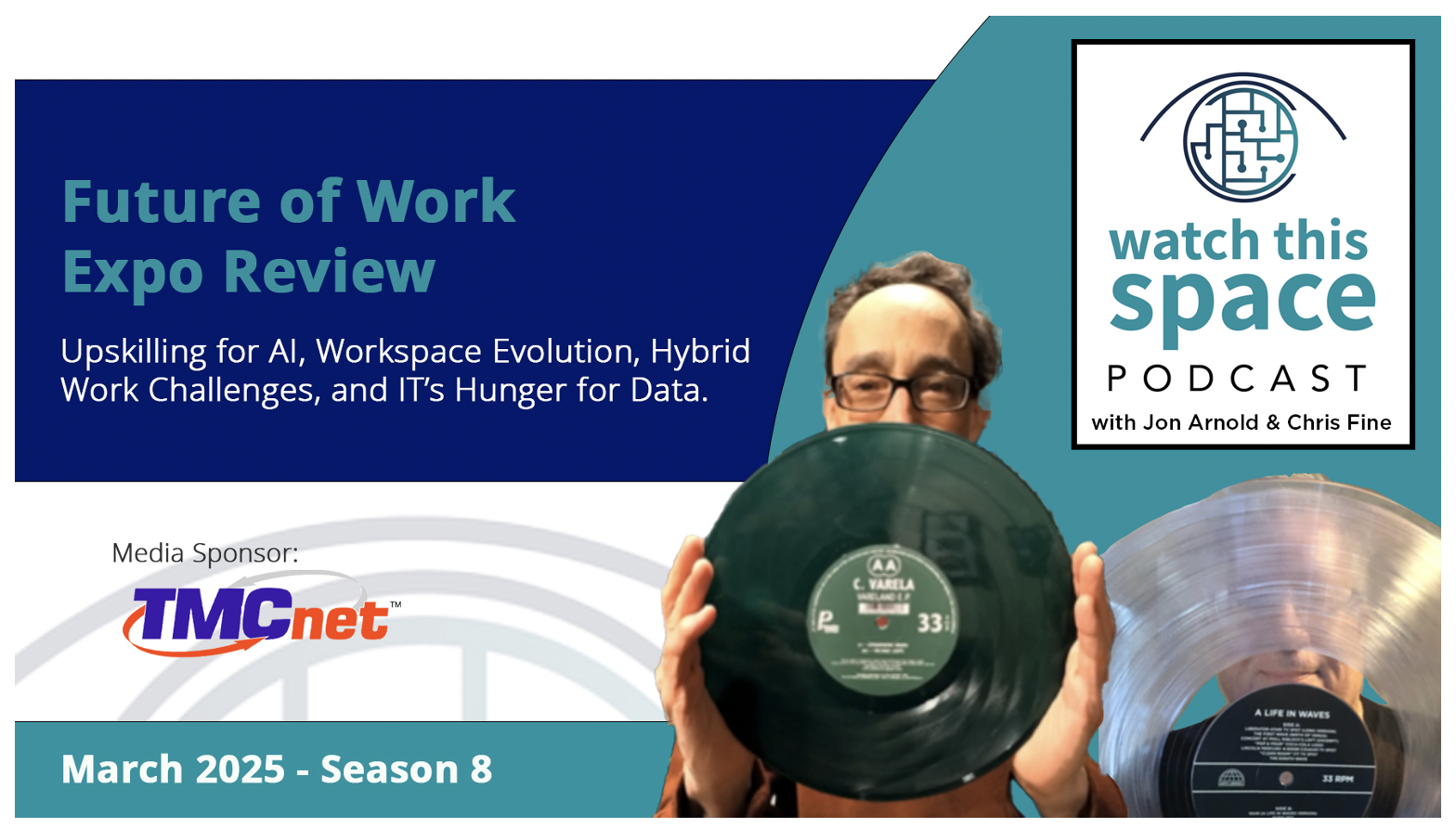
Transcription: Future of Work Expo Review
Jon Arnold
Welcome to Watch This Space, the podcast about future of work. Every month, we bring you insider perspectives on how digital transformation, emerging tech, and generational change are shaping the future of work. We are two analog guys finding the groove for all of this in today's digital world. I'm Jon Arnold, and these trends are my focus as an independent tech analyst in my company, J Arnold and Associates.
Chris Fine
And I'm Chris Fine. I'm an independent consultant and strategist specializing in workplace technology, IoT, and security. My company is Integrative Technologies. Hi, everyone. Welcome to another Watch This Space. Hi, Jon. Great to be with you again. I actually realized that I found the scrap of paper that had my little intro script there. I'm really lucky. I kind of knew where it was after the big move this month, you know?
Jon Arnold
You moved out and up. 38 stories up, right?
Chris Fine
Moved into the city, yeah. The empty nesters.
Jon Arnold
Wow, well, this is something we're all looking forward to at some point, folks. It's going from the big house to a smaller space is a whole other thing. But the upside is you're moving from a sleepy suburb to midtown Manhattan. It's pretty exciting.
Future of Work Expo Recap
Chris Fine
Yeah, thanks. It's good. But I got my office set up finally. You know, most of the boxes are unpacked, so that's good. But anyway, big news in Jon Arnold land, right? Because you just came back from your showcase Future of Work, which I was very sorry to miss this here, but hope I get invited back because I know it's always a terrific program. So, I think today you really ought to be the focus because we're dying to hear what you the takeaways from this. So, kick it off.
Jon Arnold
Well, okay. Thank you. Thank you, Chris. And yeah, right off the top, of course, yeah, your move had to happen. So unfortunately, it wasn't going to be able to work for you to get there. So next year is next year, and you will definitely be settled by then. Unless, of course, you choose to move again. But I don’t see that.
Chris Fine
I can't face it, Jon. I can't. I literally can't think about that. And besides, even so, I'm not going to miss two in a row.
Jon Arnold
No, there you go. Your vinyl wouldn't be happy. It doesn't travel well, right?
Chris Fine
It sure is heavy, I'll tell you that.
Jon Arnold
Oh, digital folks, you have no idea what we're talking about. But yes, we love our vinyl, but boy, a milk crate does weigh a lot. Yes, it's a lot of schlepping.
Chris Fine
Yes, well, what are you going to do?
Jon Arnold
Exactly. What are you going to do? Life goes on.
Chris Fine
I want to have at least my core vinyl with me, wherever it is.
Jon Arnold
Wherever it is, because it's still the best. Anyways, yes, we digress a lot here.
Chris Fine
Yes, I know we can't. There's a lot to cover here. So, let's not digress anymore.
Jon Arnold
Okay. All right. So here we are. The Future of Work Expo event is an annual show, and it runs in February, usually the second week. And if you don't know by now, it's part of the IT Expo, which is run by the folks at TMC, Technology Marketing Corp, led by Rich Tehrani and his team. And I've been doing things with them for 20, 25 years. So very familiar group and very loyal group. It's mostly the same people. And they continue to run their IT Expo big tent Show. It's going strong as ever. And within that kind of milieu, they support these sub-events, these specialty events. And mine is one of them, called Future of Work Expo, where I partner with TMC to put the program together and bring an audience to the floor and to the show.
It's a pretty stable format, Chris, you've been with me on this for quite a while now. And I think we have a good setup to the way we do it. The format for this particular show is moderated panel sessions. For this year, we concentrated all the tracks into a two-day period, the Tuesday and the Wednesday. And then the Thursday was, we had also opportunities to present on the show floor. They have these theaters that are set up there, and I did my keynote talk on the show floor on the Thursday. So, I got to do that one two times.
The kind of draw for this event, for those who've never been - and there's a reason why I'm saying that in a second, is really, Chris, there's two reasons. One is because it's a big tech show and it's mostly a trade show. So, it's a lot about the buyers and the sellers generating traffic on the show floor, show, you know, the vendors showing what they have and the customers and partners coming to see what's on tap. And around that, yes, there are all the programs of the content and mine being one of them. It's a pretty good mix. I'd rather we had more time to do sessions, but that's how they run their show. And you know, the second draw for folks like us, Chris, is it's Florida in February. I mean, why wouldn't you want to be in Florida?
Chris Fine
It's always good. It's nice, nice weather, right?
Jon Arnold
Yeah, right. It it's You know, I wouldn't want to do this show there in August, but this time of year, yeah. And of course, the week I go is the week we get hit with a giant blizzard in Toronto, which we haven't had this kind of snow in at least 10 years. And it's old school snow, folks. You don't want a piece of it, but it took me six hours to shovel up my house when I got home, so I paid for it later.
Chris Fine
Oh, man. But you're all good now.
Jon Arnold
All good. And you don't care. You don't have to shovel anymore. So, you're up in the sky and different world, right?
Chris Fine
No, that's a bit harsh. I do care. I don't want you to hurt yourself.
Jon Arnold
No, not me, but you don't have to worry about snow shoveling.
Chris Fine
Not as much, certainly. Yes.
Jon Arnold
Yeah. Well, good.
Chris Fine
I put in my ears, Jon. I put in my ears shoveling.
Jon Arnold
Exactly. Folks, we don't do everything forever. Sometimes change is necessary and generally always good. Okay, so that's the backdrop to the show. And maybe before I go on a little bit more about what we actually did there, maybe you could maybe add some color to what you have kind of seen over the past few years in terms of the kind of audience that we have and the vibe?
Chris Fine
Yeah, well, I'm happy to. Jon, he's a relatively modest fellow, but he does put together a great program. with lots of good speakers who come to give various perspectives over a couple of days and the venue is pretty comfortable. The format of the of the panels is really good because you get a lot of extemporaneous discussion. It's not you don't get killed with slides. And it isn't all a vendor fest either. Jon always gets perspectives that are not just people trying to sell things, although the vendors do come and they do a good job. Jon keeps it pretty tight about no real selling. You have to talk more about the concepts that you're involved with and sort of the markets that you address.
And I would say the other thing about the show, which I always enjoy, is that there's really a lot of shows if you're interested. For example, I always focus on IoT, so there's a good IoT program there. It's pretty well moderated and organized. Similarly, there are vendors out on the show floor that are in that space, sensors, etc. So, I find it to be pretty a pretty worthwhile event. And if you're interested in the future of work and different perspectives on that and some of the technologies around that, I would say Jon's program is good to go to and I always enjoy participating in it.
Jon Arnold
Yeah, very good, and thanks for the good words. It's always good to hear. As you say, Chris, being an analyst, you know, that's my stock and trade of having the relationships with a lot of the vendors and they seem to be more than happy to come and say their piece. Absolutely, you know, I think the secret sauce is bringing in these, as I say, other voices that you wouldn't normally see at tech events. Certainly, drawing from the academic community, sometimes a government agency coming out to speak, and also, you know, consultants, people with specialized expertise. So, we try to keep that blend going. Also, companies that are not in the core area of what we do, they might be kind of peripheral businesses to communications technology, so it makes for a pretty rich mix of companies that we know and companies that we don't know. That way, as you say, we keep it, not totally vendor neutral, but certainly not vendor heavy. And there's plenty of room there for new ideas.
To be fair, a couple of things on this. Yes, we had some pretty, household name type of companies with speakers on panels. For example, we had companies like Nice, Zoom, HP, Cognigy, Verint, Mitel, Jabra, and I'm sure a few others will come to mind as we go along, Chris, but certainly leaders in the industry getting some of their people to come out and speak. CDW was another good one. and others from communities that we wouldn't be as familiar with.
Anyway, it's a good mix, a good healthy mix of people. I should also mention when I started off talking about the TMC relationship and how they run this show in support of our future work event, as you know, our podcast here has a heavy focus on future of work. So, to kind of support and align all of that.
We do have, I should mention, that TMC is also a media sponsor of this podcast. This is kind of a way for us to put a spotlight on them and they in turn socialize this podcast in their broader ecosystem of readers. It's kind of a good trade there and keeps our podcast to the regular reach that we generate organically, but also to theirs. That works out well.
I'll get your take on this in a sec too, Chris, is what does future of work mean now in 2025, right? This is the eighth year I've been chairing this event with developing the programming, and a lot of the core themes, Chris, as they're fairly steady, like we talk a lot about things like cybersecurity, the role of IT, the role of the challenges around hybrid work, how workspaces are evolving. These types of themes are fairly common, but what's working more its way into the program now, of course, is AI-related topics. So, the newer areas this year were about the impact that AI is having on various parts of an organization related to work.
That's going to lead us to a bit of a discussion of the keynote that I had where I presented some trends based on industry data. And one of the reliable partners that we talk about here a lot is Leesman. I did cite some of their data in my own keynote, and I'll get to that in a moment. But I just wanted to maybe step back and maybe you can add a little bit too about what Leesman brings to the conversation.
The Leesman Index and the State of Hybrid Work
Chris Fine
Well, Leesman, their basic franchise is a very large database of what you might call worker and management satisfaction data, studies conducted because they're hired by companies to conduct studies of the quality of the workplace and the quality of work and, you know, how people feel about where they work. And they have, last I talked to them, well over a million data points going back years and relatively statistically consistent studies they come out every quarter or so with some new data, and it's always really interesting because if they tell you for example that occupancy rates are X it's pretty reliable because it's based on a lot of input data and their data analysis is pretty good. We talked about a study they did it for one of my clients a year and a half or two years ago, and it turned out that a lot of what they said ended up being true. So, they're a good source of data, Leesman Index.
Jon Arnold
Yeah, and I reiterated at the event that this is not our data, and we're not pretending it is our data, but Leesman has been very supportive of what we do. And not only are they giving us blessings to cite some of their data, but I even spoke to, was in touch with the author of their current hybrid future report or future of hybrid work, I think it's called. Anyway, so the author, the lead author of the research there, Peggy Roth, we had some dialogue about this. In fact, she provided a quote that I included in my presentation to kind of reflect her overall view of the research. So, it's not just me interpreting their data, but it's actually, you know, coming from them as well. That's just a little bit more credibility, I think, for the research.
This is really important stuff to talk about because when we think about future of work, ultimately it's, yes, it's about people, it's about us, employees, what's the experience like? But also, in the context of this event, the IT Expo is a technology conference. So, Chris, we certainly bring that technology lens to all of this and say, okay, well, what technologies do we need and what role can they play to make this new world of work work?
So, the data that they present and a few other sources that I cited, tells the story at face value. Then we kind of add our own perspective to that to say you know, this is what the trends are telling us. One of the really notable things that I did cite in their research is when you look at the reasons people come to the office and you look at the reasons why workers work at home, interestingly, Chris, the factors are fairly similar, but they just occur in different order of kind of like ranking of being mentioned. You know, things like work-life balance, comes into play. The fact that hybrid work is being mandated. In other words, they don't have a choice, but that seems to be one of the main reasons for each work setting.
Other things have to do with managing their time, social interactions. It's just interesting that the themes aren't that different, but the kind of the priorities of them are. What this means is for organizations and business leaders who are kind of trying to solve this hybrid work dilemma, I have to realize that, you know, there's different sets of needs and expectations for home work and office work. And you got to kind of manage not just the happy ground in between, but there's just a lot of factors. That's another thing that came out of the research. There's a whole laundry list of things, so it's not like you got to get one thing right. That's why, as we've always talked here, hybrid work is really hard to do because there's many factors that go into making that balance work, right?
Chris Fine
Right.
Jon Arnold
What it comes down to is two big themes, and one is the need for social interaction to make it work. Obviously, that's a real driver for going to the office to be in person, but when you're at home, to address that need for social interaction, this is where the technology comes into play a lot more, right? You've got to have the right tools and not just having a meetings platform like Teams or Zoom or Webex, whatever, but also, you've got to have the right hardware around you. You've got to have the right pieces, physical pieces that make that experience good.
So, this isn't really new. The pandemic kind of forced us to learn how to do this stuff. But the data from other sources, aside from these one that I cited in my talk, points to this about the importance of technology to make a better work environment. I talked about a CBRE survey, Chris, and I know you can weigh in on this as well for corporate real estate.
They talked about the importance of what technologies they need in their offices to draw people back to the office. And far and away, the biggest consideration was video conferencing technology. So, if you're going to invest money in retrofitting your office, yes, it's got to have whatever that kind of friendly environment that makes it more social for people to come in. But you've got to have the right toys in that meeting room or those meeting rooms and huddle spaces, etcetera, that make those meeting experiences really, really good.
That was an important piece I found in the research and also the need for things like touchless experiences. And that did definitely follow from the pandemic of not, handling anything physically. But they want to have more and more things that are touch-based and sensor-based, right, to monitor things like, you know, temperature, air quality, lighting. In short, you're right, smart office. Not too many people, I think, have smart homes per se, so it's not like they're going from one smart space to another. But if the office can have really kind of cool smart space features, that's another draw that can bring people back to the office, right?
Chris Fine
Yes, yes. And on the office management side, did you guys talk about occupancy analytics? Because that is a huge topic right now.
Jon Arnold
Yes, it was all about monitoring the usage of the spaces to see what, as you say, to optimize the types of spaces, how they're being used. That guides their decisions about how much real estate space they need to function properly. Another really fascinating piece that came out of this was not only is the physical environment of the office space itself important, but so is everything around the office environment.
This CBRE research pointed to the importance of things like, well, if you're going to draw people from their homes to come to an office environment, you've got to have amenities around that office that help them with their work-life balance. Obviously, you want to have restaurants and local shopping and things for, when they go out for lunch, there's got to be nice places to go. Daycare centers for young kids, it's nearby. On the commute side, you’ve got to have access to good public transit. You’ve got to have charging stations for EVs, things you wouldn't normally think about as a future work kind of driver.
It's the stuff around that physical environment that kind of factors into the bigger picture of, well, if future work is going to be office based, it's got to be more than just the physical space. In other words, when you're making decisions, if you're leaving your expensive grade A space downtown and say, okay, we got to do it differently now, don't just make your decision based on getting the cheapest rent, right? Or getting it into a location that might be kind of in the middle of nowhere. That's just not going to cut it, right?
Chris Fine
Yeah. I mean, I would say that what I'm seeing is the opposite, at least in the major urban markets is companies are looking to grab really premium space, right? Because then they abandon the older, not quite as advanced, not quite as cool to be in kind of space. You've got these areas of the cities that have really been developed in recent years where they're attracting the tenants and the companies are kind of starting with a blank slate in the new space and they're saying, you know, whom can I hire and what can technology can I use to make this really sort of next gen and attract people? We do see that out there.
I would say more than renovating older space to do the same thing, if that if that makes any sense. That actually surprised me. I thought coming out of the pandemic, we would see more just renovation of space, because that's a time-honored way to upgrade things, right, without a big move. But I think a lot of a lot of especially sort of Fortune 500 type of companies said, why don't we just think more out of the box? We can either find or build a new headquarters that really is the way we want it, rather than just upgrade the existing space. There's a lot of change happening and a lot of upgrades, which are an opportunity for, you know, an open ceiling that you can put different technology in that you wouldn't do to necessarily if you were just kind of doing an incremental upgrade. You see what I mean?
Jon Arnold
Yeah, yeah. Opportunities up and down the whole ecosystem, right? It's an opportunity for municipal governments that are trying to attract investment to their area, right? They could be a partner in developing these kinds of new modern spaces that check a lot of these boxes that I was referring to here and just getting it right. As we've always been saying, to get people out of their homes, you got to give them a better experience that they can't get at home. I think there’s a lot of latitude here for out of the box, to look for different ways and do it on their terms, right? Talk to employees. What do they want, right? Then you'll hear, well, I've got the two-year-old kid, I need daycare to make this work. Okay, well, you got to find a way to, you know, make that part of the equation.
So yes, technology is a big part of the story, but these other things are a part of it too, of course. Catering to that work life balance. We can go on and on about the research, but we need you to have a reason to come next year too, folks, so I'll move on.
I did want to say when I did my opening keynote at the event in our presentation space, I'd be remiss to not mention, of course, Jeff Pulver. I was determined to get him somehow on the program. just because it's so important for him to be part of this conversation. The only space I could work him in was on the keynote. So, I had Jeff as a special guest, and because you couldn't be there, Chris, he kind of took your spot and he added his comments as I was sharing all of this industry data. And it was great to have his perspective there. It was also timely, Chris, you may have noticed this too. During the event, he noted that it was marking the 30th anniversary of one of his VoIP milestones. I can't remember which one it was.
VocalTec and VoIP Being the Big Bang of Telecom
Chris Fine
VocalTec.
Jon Arnold
Well, yes.
Chris Fine
It was the first company that really had voice on the net and IP-based voice. Essentially everything we use all the time, including how we're recording this now. is derived from that original research. And that those early days, it's like, all the internet evolved from some of the work that led up to that in those decades. So, 30 years, right? 30 years of voice over IP. And remember, when that started, nobody thought that it would detonate the entire telephone industry, right? Telephones have been around for 100 years - they worked really well. And look at where we are now.
Jon Arnold
Yeah, it's truly, for folks who weren't there, it was the big bang in the telecom industry. And VocalTec was the first company that kind of brought it to life in a way that businesses could see value in. And well, so the direct line from there to the show was Ari Rabban, who I know you know, from Phone.com. He and I crossed paths many times there - he worked at VocalTec early on, and of course, his boss, Alon Cohen.
Yeah, he was supposed to come to the event, but I think he had a sore back or something and couldn't come. For those of you folks who need to know, kind of connecting the dots of this history, Alon was the founder of VocalTec and certainly one of the pioneer innovators and inventors - probably inventor is the better word of the technology that came to be VoIP and has come to, as you say, Chris, kind of displaced. legacy telephony and putting it into a packetized form so it can run over data network instead of a voice network.
That truly is the big bang that changed everything in telecom. So, there's a real through line here, not just future of work stuff, but the people who are in this TMC ecosystem and the remnants of Jeff Pulver and his VON community are alive and well and still doing things. This space just continues to kind of evolve with the new technology, so it never gets boring.
Chris Fine
No, it doesn't Jon. So, as we think about winding down, what would be a couple of takeaways that you think people should really hear from your sessions? Like, what really came out of it that people should know and would help them?
How AI is Reshaping the Future of Work
Jon Arnold
Technology is obvious, but the AI piece, as we know, it changes every five minutes. One of the big messages is the need for employees to be able to upskill. One of the catch phrases I said at the event was, if you're not thinking about AI, you're not thinking about future of work. You need to filter future work through what AI is doing. A couple of sessions talked about the AI use cases and innovations that are working into the workforce, impacting, you know, everything from knowledge management, workflows, communications, et cetera. If employees are going to thrive in this new environment, they're going to have to get some level of skills that are specific to AI, how to use it, how to manage it, how to orchestrate it. And of course, the digital generation, I think, will come to this natively.
But for older employees who you really want to keep, you're going to have to develop some form of skills base to help them adapt to AI. I think that's a really important theme. In fact, one of the other slides I quoted from another survey from Stanford talked about the impact AI is going to have on the workforce. Yes, they expect some headcount reductions through automation, but they also expect net new growth from new jobs that will be created that will be kind of AI-based. And a very high percentage of respondents to this particular survey expected a pretty high level of upskilling to be required for their employees. So, this isn't just me talking, but the data supports this. I think that's a big, maybe an HR-related kind of aspect of future work that I think is a big takeaway from the event.
Chris Fine
Interesting, because that kind of supports what we said last couple of times, which was like every technology evolution, there's reskilling. People do learn new skills, and they become able to work in the new environment.
Jon Arnold
Yeah, and that's just going to be a constant with this stuff. And not just work itself. But as we've talked about earlier episodes, Chris, is the organizational kind of structure itself. How are businesses of the future going to be organized and managed? Is it going to be a flatter structure? Is it going to be a decentralized approach? AI is going to reshape a lot of this stuff. So that's one.
The second big takeaway is because AI is becoming so prevalent and there's a hunger for data now. Businesses are recognizing, feed the AI machine and make it work really well, it just needs an endless stream of data. And now they've discovered that data in the workplace from our everyday communications and interactions has value. That's why this is so central to our world of communications technology. Now they are investing, mandating that IT develop capabilities to capture as much data as possible from our everyday communication. That means that all of our calls, all of our texts, all of our emails, because they're all digital now, create these new forms of data that have never been really tapped.
When Jeff Palver talks about vCon and what he and Thomas Howe are doing, this is exactly what they're talking about - for emails to find a way to access, pull out relevant data from these bottomless pits of communication that we've been doing forever. This represents kind of like a bit of a gold mine of potential data that we can be using to make our organizations smarter, more agile, etcetera. That's a very big picture, and it might be a little kind of grandiose and maybe a little too overreaching, but it's very clear, certainly from our sessions, this is a new reality that organizations are seeing. I think it's going to be a key driver for what future of work becomes. It's going to be really about data and knowledge management, because we now have the capabilities to do that with AI.
Chris Fine
Yeah, it's going to be interesting to watch what happens with the vCons because there's two aspects to that that are really intriguing. Number one, it puts some structure around unstructured data.
Jon Arnold
Yes.
Chris Fine
And then the other is it provides a level of security. As I understand it, and it's getting better all the time, to enable you to block off certain elements of data that you might or might not want vacuumed up into the AI. If you have a policy or there's compliance, you know, or other things, it allows you, because it has some structure to separate elements of conversation out, right?
Jon Arnold
For sure. Yeah, and this is gonna seed a lot of what we do for next year, right? Future of work. I think, Chris, as we wrap up now, I'll just give people just a bit of a trailer here to say if you were there, you saw most of the sessions. I did several informal polls during the sessions, and it's clear that most people who were there were first timers, so that's great to see. But because the sessions are not recorded, if you weren't there, you weren't there.
What I will say to you is if you're interested to catch a little bit more of the vibe of what we did during the event, I can point to three things for you. First, if you follow me on LinkedIn, I was posting throughout the show with some commentary and photos in the moment. So that's there to be tracked if you're interested. Secondly, the Future of Work News is a newsletter that's part of the TMC family. They wrote articles about a few of the sessions, and they're publicly available. I also did a blog post a couple of days ago, which is on my website, where I kind of centralized most of the photos I had from the event and links to those articles that covered specific sessions. at the event.
So that's all there. You can check that out on my blog anytime. And of course, what we're talking about here on the podcast. That's the closest I think I can give you for what was going on there. My buddy, Thomas Brannen, a fellow analyst, he videoed my keynote and he's going to release and share some snippets of that fairly soon. So, stay tuned. That'll come on my LinkedIn channel. That's pretty much the story. With that, Chris, we'll wrap up and maybe get you thinking about next year, 2026, February. We'll do it all over again and just keep fine tuning as we go.
Chris Fine
Looking forward to it, Jon.
Jon Arnold
Thank you. Me too. All right, we are definitely at time. So, thank you all for listening today. We hope you enjoyed our podcast here and that you'll continue with us as we explore the future of work here on Watch This Space. You can access all of our episodes at www.watchthisspace.tech or wherever you subscribe to your podcasts, and we're on all the major platforms. Anything that you like from listening to us, we'd love to hear your thoughts or review or rating, and certainly suggestions for future topics that Chris and I can cover here for your interest. And with that, I'm Jon Arnold.
Chris Fine
And I'm Chris Fine. Thanks for listening, everyone, and always thank you for following the podcast. And we'll be back next month with another episode of Watch This Space.