2025 Outlook - January 2025 Episode Transcription
Transcription: 2025 Outlook - January 2025 Episode
Jon Arnold
Welcome to Watch This Space, the podcast about future of work. Every month, we bring you insider perspectives on how digital transformation, emerging tech, and generational change are shaping the future of work. We are two analog guys finding the groove for all of this in today's digital world. I'm Jon Arnold, and these trends are my focus as an independent technology analyst in my company, J Arnold and Associates.
Chris Fine
And I'm Chris Fine. I'm an independent consultant and strategist specializing in workplace technology, IoT, and security. My company is Integrative Technologies. Hello, everyone. Welcome to another episode of Watch This Space. Hi, Jon. Always great to talk to you again. Things are still busy, winding down at the end of the year?
Jon Arnold
Yeah, same here, Chris. Same here. What I will say is we are heading into a new month, new year, and new season. This will debut our season #8 for Watch This Space, and as they say, we keep rolling along here.
Chris Fine
Yes, and we both hope that everybody had a happy and healthy holiday season and New Year. That you got to relax or spend time with family or go away or whatever you chose to do that wasn't just the same as all the rest of the year. Right, Jon?
Refresh Update for Watch This Space
Jon Arnold
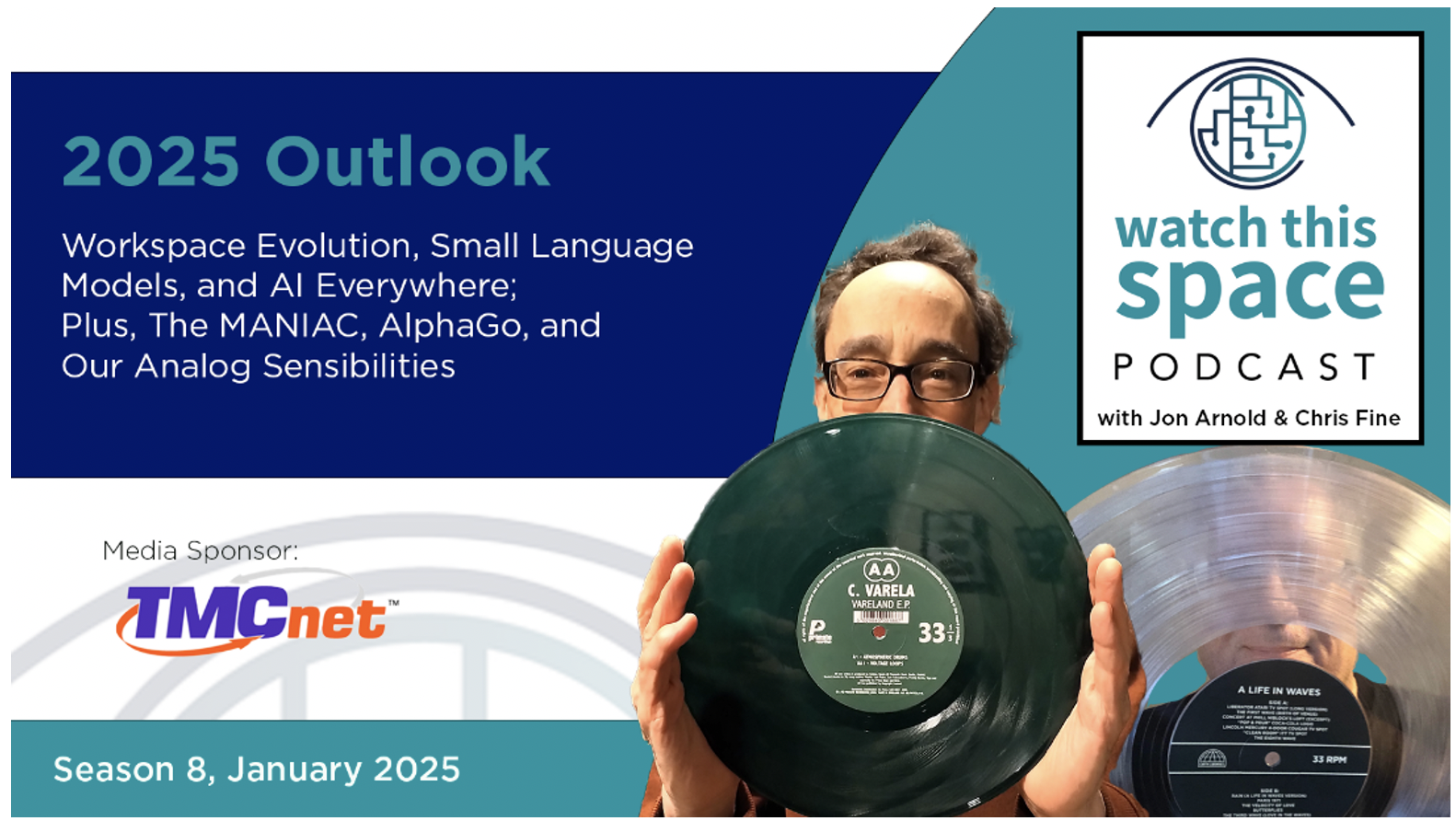
Yeah, that's what makes it special. It's good to have a break, of course, and recharge. I certainly am seeing a lot of positive signs ahead for 25, certainly on the tech front, which is never dull, and change that's always going on in our lives. I'll start with the podcast and then I'll mention something about me and then you've got some change coming up too at your end. The first thing I would say is if you're listening to this by now, you have undoubtedly noticed a new look for the podcast. This marks the debut of some visual changes to what we do with the podcast, even though it's just listen only. I've added some nice visuals for each episode, which I think will make it a little more engaging, and there's going to be more to come over the next few months.
I'm trying to mix things up a little bit to give the podcast more visibility, be easier to consume, that kind of thing. We don't do this for a living, folks, but it's a good time to make some updates, especially as we go into our new eighth season. So, on my front, Chris, change, yeah, it's always good. I've had gone through a slew of home repairs in the past few months that I'm glad to be finally done with and don't have to worry too much about stuff like that, at least for now. Otherwise, all is good, but you've got some changes coming too, right?
Chris Fine
Yes, I'm busy going through all my collections of endless types of trivia and technology and sorting them out and getting ready to downsize in the new year, move out of the suburbs, move into the city. We're pretty excited about it. It's a giant project, but it'll be nice to have a simpler housing situation. But I have to sort through a lot of stuff. And that's what I'm doing right now. Decide what to keep, you know, do you need a hundred of something, right? Like, do I need a hundred of a certain type of switch? Just 'cause they're classic components and they're not made anymore; do I have to have a whole bag of them? I don't know. But take that and multiply that by a large number of things. That's what I'm doing, but the change will be good. We're looking forward to it.
Digital Natives Will Never be Hoarders and the Joys of Analog
Jon Arnold
Yeah. Well, as I said in the opening, generational change is part of what we look at with future of work and some real interesting parallels there. As analog people, you and I are not unusual in that we accumulate a lot of things over time. And with our passion hobbies of music and electronics, etcetera, you accumulate a lot of stuff that is probably of no use or interest to anybody but us. And I think it's pretty different from the digital generation that as we know, the streaming mentality, why would you own something when you can just stream it? And they tend to be minimalistic by nature. They're not collectors and hoarders from what I can tell, at least yet. As you know, because everything is digital now it's a very different world. They may well not have this problem, although they're probably going to inherit from us once we go, whatever we still have, right?
Chris Fine
I think 1-800-GOT-JUNK is gonna have a field day when we go, 'cause they're just gonna point at everything and say, make it disappear, as the commercial goes. But I'm bringing my core vinyl and my stereo and things I can't part with. The difficulty is things that are bulky that I just can't bear to throw away, and I'm trying to find a buyer for or to donate them to a museum. So, I may have to stuff them into my storage just for a period of time, which I don't want to do, but we'll see. Every day is a decision or 10 or 100 decisions, but you know what it is.
Jon Arnold
Yeah, gee, well, that reel-to-reel tape recorder and collection sure takes up a lot of room, right?
Chris Fine
That's staying with me.
Jon Arnold
You showed me at your house, you have a collection of radio broadcasts from, what was it, Cuba in the 40s or something? That's really eclectic.
Chris Fine
Well, I have a collection of transcription discs, which are 16-inch records that they used to use to broadcast radio shows because you could get enough on a side. Because if you remember, most records back then were 78s and they had three minutes on a side. These are really valuable, but I don't know, I'm going to contact the Library of Congress because there's just no way these are going to be thrown away. They're going to go to a worthy place. There's off-the-air recordings of Winston Churchill and Roosevelt from World War II and homemade acetates of various things. And I just am totally keeping that, even if I have to put it in storage. But there's also other stuff that is less eclectic, so we'll see.
Jon Arnold
Well, as George Costanza said, proudly pointing to his bald head, “these are the remains of a once great civilization”.
Chris Fine
I guess you could put it that way. I hadn't thought of it that way.
Jon Arnold
Well, we think it's still great, honestly. So there.
Chris Fine
Yes, yes.
Jon Arnold
I have my cassettes and I'm not getting rid of them anytime soon.
Chris Fine
I have those too. Am going to sell them and probably reduce that collection, but I'm not getting rid of all of them. I am getting rid of most of the DVDs because I digitize them. They're all on a server, and that's how they're going to be delivered in the future household.
Jon Arnold
We have to live in a digital world now. I have a pretty well-curated super eight movie collection from when I used to make movies as a kid. And I have a lot of footage from vintage concerts from the 70s that are pretty damn good. But there's no sound. So, they're of no use to anybody, but people who just want to look at stuff. But they're pretty good. And in fact, I'm working with someone here for a very famous concert in the blues world here in the 70s. And I have some footage. And he's got people with the audio, so we're going to get together and see if we can do something with it. So, there's a retirement project.
Chris Fine
I was going to say, you know, there's been a lot of work done where somebody's got the video and somebody's got the audio from an old concert because there were a lot of tapers and engineers and amateurs that would try to tape concerts back in the day.
Jon Arnold
And so, match them up underground recordings, right?
Chris Fine
Yeah, you just got to match them up. That'd be great. It's easier to do now with digital technology.
Jon Arnold
We can find the people who have the source material. Oh, this is exciting. And yes, the analog world, folks, for some of us is still alive and well, but we have to go digital now, Chris. Let's get on track with today's episode. We're going to start kind of where we left off last episode, where we talked about some 2024 takeaways. We hope you enjoyed those, folks. But we also tried something different - we did a short story review and should probably do another one of these days. We talked about this novella With Folded Hands that you turned me on to. I thought that made for an interesting segment, and now you've got a little follow on for us on that.
Another Book Review – The Maniac by Benjamin Laboutin
Chris Fine
I do. Last month, the book club that I'm in read a really good book called The Maniac by Benjamin Laboutin. And it's really a book in two parts. The first part of the book is about Jon von Neumann, who for if anybody doesn't know, he was a brilliant physicist and mathematician, probably one of the smartest scientific and mathematical minds of the 20th century, and did many things, but among them was pioneering work in the foundations of AI, a lot of work on what constitutes thinking, and how a computer could think. That was extremely influential, and pretty much any kind of computer today owes something to Jon von Neumann.
The second part, so the first part of the book kind of laid the foundations of what von Neumann said about AI before there was AI. Then the second part was about the story of how AI came to dominate the chess world and then the world of Go. If you remember a few years ago, an AI system designed by Google actually defeated the world champion of Go, a guy named Lee Sedol. And Go is the world's most complicated game. It's just not even in the same universe as chess, and chess is complicated enough. But anyway, remember at the end of our discussion of With Folded Hands, one of the things that was said was that what's the point if this AI, if these humanoids have mastered everything so much, I feel hopeless. Why should I play the violin? I'm sitting here with folded hands.
Imagine this, I'm reading this book, and then toward the end of the book, after the champion was defeated in Go, he said “I used to have this sense of pride”, he said a couple of weeks later after losing his third game against Handel when he was interviewed on a popular talk show that recapped his entire career. After this man lost to the AI, he also started losing against regular people, though whatever it was out of him.
“I thought I was the best, or at least one of the best. But then, artificial intelligence put the final nail in my coffin. It doesn't matter how much, it's simply unbeatable. In that situation, it doesn't matter how much you try. I don't see the point. I started playing when I was five. Back then, it was all about courtesy and manners. It was more like learning an art form than a game. As I grew up, Go started to be seen as a mind game, but what I learned was an art. Go is a work of art made by two people. Now it's totally different. After the advent of AI, the concept of Go itself has changed. It's a devastating force. AlphaGo, which was the name of the AI that beat him, did not beat me. It crushed me. After that, I continued playing, but I'd already decided to retire. With the debut of AI, I've realized that I cannot be at the top, even if I make a spectacular comeback and return to being the number one player through frantic efforts. Even if I become the best that the world has ever known, there is an entity that cannot be defeated.”
How about that? That was taken from real life in what you would call perhaps an early episode of the type of AI dominance that With Folded Hands was ultimately about.
Jon Arnold
Yeah, I love it. And you're right, Chris, it's scary and it's deflating, that's for sure. We've had these conversations and there'll be more, as you say, the dominance factor is there. I remember when that whole AI thing was happening around Go, that one thing they found is that once AI could beat a human based on how it was trained by humans, the next level was how AI trained itself. That took it to an even higher level beyond what humans could do. When the AI is training the AI, we have no role in it anymore. Our points of reference don't even come into the picture.
This becomes kind of like a Tower of Babel thing. We're just taking it higher and higher to the creator, so to speak, that there's nothing really to stop it. And this is the point that I take away from all this is that when AI can be autonomous and do everything, you know, teach itself and teach it in ways that humans cannot, we can't compete with that. And that's when it stopped. We have to stop calling it artificial intelligence. What I've always been saying is it will soon become known as advanced intelligence, at which point humans have lost, that we are going to be superseded, surpassed by it. And there's a whole realm of, I know, sci-fi that writes about all of this and the singularity and this concept of centaur in the workplace, etcetera. This is all going to happen in our lifetime, whether we like it or not, I think.
Chris Fine
Well, you're right. You just made a very good point that the whole section of the book about happenings with chess and Go made, which was the way that the AI really beat this guy who was just a historically great champion of Go, was it made a move that probably no one would ever train it to make. It was a move that really started him down the path of losing and he just kept on losing because this was a move that had never historically been made and Go as you know, is thousands of years old. It's a really old game. Like when you think about chess, it's the same way where you have all the classic games and you learn all the moves and the openings and you know, the how you do the offense and the defense and everything.
I'm not an expert but essentially Go was the same. It was a really long tradition of go, and the machine, the people who programmed the AI essentially said, forget all of that. Like you went through your first iteration of learning everything and studying all the human games that were ever played. But now your objective is just to win without breaking the rules. And that's where that's how the AI threw Lee Sedol off the pedestal because he just never expected that move to be made. And the minute that move was made, he was in trouble.
To your point, that once this takes hold to a certain level in any area, it's almost innovative, right? It's going to take an approach that's really just about accomplishing the goal. So, it's going to take a similar approach to what innovative people always take, which is, I know the rules, I respect the rules, I know the past, I respect the past, but if I have to go in a different direction, I will, right?
Jon Arnold
That's human nature.
Chris Fine
Yeah, but it’s not just us though anymore, right?
Jon Arnold
Yeah.
Chris Fine
Anyway, I just wanted to read that little follow up because it jumped out at me when I was reading the book. It's like, wow, we just had this conversation about that, about the Jack Williamson story from the late 40s. I'm reading this book and this just, I couldn't believe this passage was in there. And that was why he said he retired.
Jon Arnold
Yeah. So, for posterity, maybe just say one more time the name of the book and the author.
Chris Fine
It is called The Maniac, and it's by Benjamin Labatut, I think his last name is L-A-B-A-T-U-T. And the amazing thing is he doesn't normally write in English. This was his first book written in English, and the language is absolutely stunning. And when you read the book, you almost think, if you weren't bound by all the conventions of the English language and writing, but you knew what all the rules were, what kind of a book would you write? And this is it, it's very innovative, so definitely recommend it.
Our Watch This Space 2025 Outlook
Jon Arnold
Love it. Okay, we gotta do more of these. Let's talk about 2025.
Chris Fine
Yes, we need to do that.
Jon Arnold
Let's spend a few minutes anyways on this. Yes, folks, we don't have stuff that well scripted out here, but we hope you enjoy the dialogue. I think we're just trying to be very authentic, sharing the way we see the world unfolding. Why don't you lead in, Chris, and talk a bit about your top ideas that you see as big themes for 25?
Chris Fine
I think the theme of 2025 is more stability in terms of understanding the role of the office, and the sort of the solidification and steady state of hybrid work. I think you're starting to see office space being redesigned in a real post-pandemic way, and that will continue. I see the trend of organizations not trying to refurb old space past a certain point. and moving to really new buildings in urban markets like New York. I see that continuing. In fact, there was an article in the Wall Street Journal that said that one of the big real estate operators in New York City is just doing great because they made a bet on all these new buildings. That's where the kind of top tier tenants are moving to because you can configure the space in a really up-to-date way.
And I think the trend there in terms of internal architecture is almost more hospitality-like than any kind of traditional office. The lighting is more subdued, the space is more comforting and welcoming, more oriented toward collaborative work, but also quiet work if you need it. Less cacophonous, less traffic passing by everywhere, more separation of spaces. Things like that, more different shaped and configured spaces. Make it a place where people understand its role and how that role is additive in a hybrid environment. That's where I see it with work. Then the other trend is obviously the continuing growth of AI. And at that point, I'm going to turn it over to you to get started with that one.
Jon Arnold
The comment you made before getting to the AI, Chris, made me think when you talk about a hospitality-themed approach. Again, you just talked about what the author from The Maniac was doing here, with a pretty innovative take on AI. The idea here that sometimes the innovation comes from outside and, the way you look at the problem set. So, I wouldn't be at all surprised if some of the major hotel chains start getting involved, because they know how to make a great space look and work, just like they do with restaurant design, this kind of thing. And if we ask the Herman Millers of the world who do offices - and they're really, really good at it - that's the world they come from.
This strikes me as a bit of an opportunity to come from the outside and say, how do we rethink all of this? I've been saying for a long time that I think there's a big opportunity for the Zooms and Ciscos and the Microsoft Rooms people of the world who could be branding those experiences in these business centers you can go to rent space. It's kind of like these third spaces for doing work because it can be a great place to showcase through technology.
And I think here, rebooting the workplace is a great opportunity to re-engage your workers. It's like when you go to those hotels, what they're really pushing now is for you to want the Marriott or the Hilton experience in your home. Like they have lines of merchandise that they sell. If you want to buy the bedding, have that Westin sleep experience in your home. They're trying to extend that experience because the hospitality brand is really warm and fuzzy. It would just be a logical extension to me to see the workplace take on some of those elements.
Chris Fine
Yes. And Miller Knoll, which is now Herman Miller, a combination of Miller and Knoll, has a lot of innovative research work going on about how to redesign furnishings and fixtures for this new generation of workplace. And you also have a new generation of designers and architects coming in whose aesthetic really, I think, was formed by a combination of not liking the trend toward the open offices with the long table, which was your kind of classic pre-pandemic office with the bright lights, and everybody's wearing headphones and sitting there at long tables working.
A dislike for that, having come up in it, and then a fascination with a new way to think about the design of the workplace. And that's all tied in with the technology too, which makes it ridiculously easier than it was once upon a time to have an all wireless office with all the bandwidth you need, video everywhere, collaboration spaces, electronic signage, you know, a lot of AI behind the scenes trying to make all this stuff work better. So, I think there's a new generation coming up in workplace thinking and design that's really exciting. Right.
Jon Arnold
I think so, yeah. And you know what? Last year at Future of Work Expo, we did have a designer, one of the speakers for one of the panels about workspaces. She was good, and a very important part of the equation. If the pendulum starts swinging back to that office experience, we could be not that far off from, I hate to say it but maybe shifting more towards a more corporate paternalism model where maybe they will start hosting daycare centers, make them pet friendly. So many people who live alone, right, have pets, you know, to bring your cat or your dog to work and have a safe space for that. I could see those things happening, which have nothing to do with tech, right? But catering to, as you said, you know, the millennials, the Gen Z mentality about how they view work and what that environment needs to be to work for them.
Chris Fine
I think it's already here. Some innovative companies like Google, they'll buy into the real estate in a whole neighborhood. And even if an apartment building a couple of blocks away from the office isn't officially a Google building, they'll be one of the investors. They'll bring in real estate investors who are super interested because of the Google facility that's around there. I've seen that happen with various neighborhoods in New York City. You could always kind of say, is this great or not? You know, is this not so good? But I do think just because of the reality of economics and the current state of, you know, unaffordability of housing and many other things, there is going to be some effort to try to get involved in the work-life balance.
Now, you know, we have to put in our big caveat about that, because that's a certain kind of company and a certain kind of worker, which does not constitute a lot of people, right? But I do think that you may see that happen more in the industrial manufacturing as well, where they want to attract and keep the right people, the people they want. If they have to invest more in the area or the city or whatever or the infrastructure or whatever they're going to do it. Right.
Jon Arnold
Okay, let's slide over to AI. I'm just going to have a few brief comments because we can go on and on. So, to watch for 2025, I'll just do two or three big ideas. One is, we're going to hear more about small language models. Large language models, LLMs, have kind of become part of the lingua franca in a very short period of time. Anyone who's talking about AI, that has to be part of your vocabulary. That's just the way it is. The reality is, this space - and we've mentioned this before - it's pretty much dominated by the hyperscalers, right? Amazon, Google, Azure for Microsoft. These companies are so dominant because of the cost to build these models. You know, small players can't do this very easily.
In our world of communications tech, so many companies are building their AI solutions based on these LLMs. We’re already seeing a kind of homogenization of this capability that it's almost becoming table stakes that LLMs are kind of driving so much of you know, the development of AI applications. It's hard to differentiate, right? So, and I think companies are realizing this, aside from the ongoing cost of investing in these tools and not getting the return they would hope for, they need to feel that they can compete more effectively using these tools. This is going to put more attention on the other end of this spectrum, which would be small language models.
The idea there is, of course, to build your AI applications around the language that you use every day in your company, in your region, in your language, in your vertical, right? Stuff that's very specific to the business that you're in. That allows you to create much more precise forms of language, just like we, if you're a well-read person, you're going to have a more precise vocabulary than someone who doesn't read a lot. This is a more effective way to get anything done. So, I think companies are going to start to see the need to do this. There's more sustainability, there's more benefit from having all this, than having just LLM off the shelf kind of capabilities that everybody else has.
Chris Fine
You mean very, very well trained on a smaller data set?
Jon Arnold
Yes. More relevant, and more precise to your universe, right? Your local world. You start getting into things like even like local dialects and slang and all that kind of thing. Those are the real subtleties that really localize who you are. I could see all kinds of businesses saying, yes, we need more of that. So, I think that's one trend to watch for 2025 for AI.
The other one that I’ve mentioned before is the continued cost that companies are bearing to get in the AI game is really, where are the returns? There's going to be more pushback on that. I think that's going to put more pressure on the vendors to help educate their customers and maybe provide more tools that will help them measure the impact of AI on business outcomes or processes or forms of automation, that kind of thing. I talked last year about how I think there'll be pushback on AI this year. That's the kind of economic pushback, and I do think that's going to become more real going into this year. I'll pause on those two now, Chris, for your take.
Chris Fine
I agree with all of it, Jon. I see what I see happening more and more, and it's just the AI getting to be more part of the daily fabric, right? That it becomes a very standard tool, becomes a very standard way of looking at things. I think it's gone through the same stage a lot of technology goes through, where it's kind of a feature, right? Like it's an add-on, but not integrated into the fabric of everything, right? And then that's where you get why, where's the payback? Where's the ROI, right? Because it's kind of an adjunct.
But where I think it's going, and I think there's good and bad aspects of this, is it becomes just more built into everything. It's already built in. Like if you do a search, the first thing that's gonna come back to you is AI generated. So, it just becomes more a natural part of everything. Don't think that's entirely great. I have my mixed feelings about it, but I think the payoff really starts coming when it's just incorporated into the core of things, you know, rather than add it on. The analogy that I would give is when you, let's say when TV went to HD, right? So, you suddenly have a lot more resolution in the picture. You have a lot more capability of multichannel sound. But for a period of time, you had programming that was kind of designed for the old system. So, the HD was a great add-on. It made it look better, but it was old to begin with.
And like if you played a VCR tape on an HD TV. It took a couple of years to where it just became the norm that movies and TV shows were shot in really high resolution and with all the multi-channel sound and everything else. Only then could it really take advantage of the capabilities of the system. I think we're starting to see going into 2025 that's what's happening with AI as they start from it rather than adding it on. Do you agree? Do you see that too?
Will AI Peak Soon, Like a Shooting Star?
Jon Arnold
I do. And if anything, I may start even thinking now about 2026. As fast as AI has come onto the scene, I can't think of anything that's happened this fast. When you think about how smartphone adoption and the adoption of social media sites like TikTok and Instagram, those are big hockey stick things that happened in much less time than previous tech innovations. And I think AI has outdone them all in terms of going from just a science fiction project to something that has become almost indispensable and ubiquitous in like not even two years. And as you say, once it becomes baked into everything, I just wonder, as fast as it has come into our everyday lives, certainly in the workplace, I just wonder, are we going to hit peak AI very early because it's happened so fast?
Maybe kind of like a shooting star, it peaks really early, and then we don't think about it too much anymore, so to speak. Then I'm just wondering, well, so what's the next thing going to be if AI has kind of conquered everything it's supposed to do? You just think of all the innovations that come along. I can't think of anything bigger right now, honestly, but it just makes me wonder if AI runs its course in a way very sooner than later, just because that's the nature of the technology. I just wonder, will there be something else that isn't on anybody's radar right now that we'll be talking about like this next year? I don't know. But it makes me think about it.
Chris Fine
I think there's a lot to go. I mean, yes, there's some of this first phase that was kind of a fad, lots of predictions that are taking longer to fulfill. But that's not uncommon with this kind of technology breakthrough. I'm thinking about things like genomics, right? Where, you know, where that's gone from where it started, you know, and the Internet and social media and a lot of other things. But you're right. There's always gonna be a certain level of hype, but it's probably the biggest watch this space there is, I guess would be the way I'd describe it.
When you were making that point, I was thinking I saw an interview not too long ago with Eric Schmidt of Google and Sun Microsystems fame. And he made a really interesting point because he said the next step in AI is where, really similar to what we said about Go, where the AI makes more of a determination of how it's going to tackle the problem, not just going and doing it faster based on kind of how the human being that's telling it to solve the problem kind of suggests to solve the problem. And one of the areas that Eric Schmidt commented on this was medical research, where in the past, AI was used as a big pattern matcher to go through a huge amount of research and see if it can find correlations for, let's say, a condition that isn't getting a lot of research money, but needs to be researched.
What we said was that the AI will become more like a researcher itself. So, if you aim it at a condition, it will find out what the symptoms of the condition, the history of the condition, and then will go ingest this vast amount of potentially seemingly unrelated research that may result in a treatment for the condition. And I thought that was an interesting thing because it's a different approach and it reminded me a little bit of how the Go program ended up winning.
Jon Arnold
Just to add to that, Chris, that's how I view this AI thing as well, that as interesting as it is in our world of workplace, communications, tech, I've always felt that this is actually one of the, I don't know, more boring, less interesting problem sets for AI. In terms of a bigger picture, I do think we will start seeing these kinds of breakthroughs in those broader areas of life sciences, climate change, education, urban planning, these kinds of things. I also think the capability is there, Chris, to identify and discover new problems, diseases, illnesses, genetic markers that we haven't discovered yet at all that might add a new chapter to the whole kind of world of what's possible with medicine and extending health and all of these kind of things and predicting diseases and conditions.
To me, it's very exciting that way. And when you start thinking globally, that's where I think the AI story becomes, to me, more interesting and more noble in some ways than I think than what we deal with every day, looking at contact centers and workplace productivity. They're important, but they're not nearly as important as some of these bigger issues that AI could be serving us very well for.
What Could Possibly Go Wrong with AI?
Chris Fine
Well, this starts to get into nightmare territory too. And it makes me think of another short story A Logic Named Joe that we have to cover at some point. That's about a world that's very similar to the Internet. Again, it was written in the late 40s, maybe 1950, where knowledge is stored in central repositories and computers on the edges use it to help solve problems. And one of these devices gets made slightly out of spec and its mission changes. Instead of just finding an answer to what's asked, let me be proactive and say, well, here, have you thought about this? And what's really the answer? That causes the machine to burn through all the rules that the system has about what you can and can't answer.
There's a little vignette when somebody says, well, how do I kill my spouse? And the computer comes back and says, well, are they blonde or brunette? And he says, you know, blonde. And they said, there's a poison in this kind of hair shampoo that nobody knows, but it actually only kills blonde people of a certain age. And you put a little bit of that in their food, and nobody will ever figure out what happened to them.
That's what proactive AI has the threat of doing, and you don't want that to happen. But it could also use the same kind of system if they'd asked that machine, say, what is the cure for Lyme disease? Or something like that, they would find it. They ask how to rob a bank, and the machine figures out how to get in without ever being detected and it just goes on and on and havoc ensues, you know?
Jon Arnold
Yeah.
Chris Fine
You just have to hope that doesn't all happen, right?
Jon Arnold
Yeah. AI ethics and morality. I think these are going to be the courses people go to university for soon, because this is what we're going to need. One of my favorite Groucho quotes, I'm sure you know it too, he says as he's trying to establish his credentials – “These are my principals. If you don't like them, well, I have others.”
Chris Fine
Exactly. We're getting a little giddy here.
Jon Arnold
That's almost 100 years ago, folks, but it's just as true today. Okay, so we’ve got to work our way out of this episode, and I want to do that with just a final nod to Future of Work Expo coming up February 11th through 13th. We've got a great program coming, and I have to at least acknowledge that TMC, the host of that show, is a sponsor of our podcast here. Also, many of the themes on this podcast are similar to what we're going to be talking about at the show.
I hope you will come and join us in Fort Lauderdale. We'll certainly follow it on my blog and my LinkedIn posts. The event itself has a website of its own, and you can read all about the program at www.futureofworkexpo.com. And you and I did a video interview that is very likely out by now, Chris, about the event. And I've got a series of them running on TMC's video site. So, we're doing lots of things to kind of let the world know about it. And we hope to see you in Florida.
Chris Fine
Well, I know it's going to be a great event, Jon. Absolutely.
Jon Arnold
Thank you. Yeah.
Chris Fine
I hope everybody manages to attend.
Jon Arnold
Yes. we want people there. So, lots of time. You can come. We won't turn you away.
Chris Fine
Yes, it's really a good program.
Jon Arnold
Thank you. Thank you. Yes, we've got a good collection of speakers. We always do. But check out the site if you want to see what's there because we've been adding speakers all the time. And on that note, it is time to go. We're at the end of time for today, so I want to thank you all for listening. Hope you enjoyed being here with us as we continue exploring the future of work here on Watch This Space. You can access all of our episodes at www.watchthisspace.tech, or wherever you subscribe to podcasts. And if you like what you're hearing, we'd love you to leave a review or have a rating posted. And certainly, if you have ideas for other topics in the future, we'd love to hear from you on that as well. And with that, I'm Jon Arnold.
Chris Fine
And I'm Chris Fine. Thanks for listening to Watch This Space. Jon, always a pleasure to be with you. I again, hope you had a good holiday. Good luck in the new year and stay tuned for next month for another episode of Watch This Space.