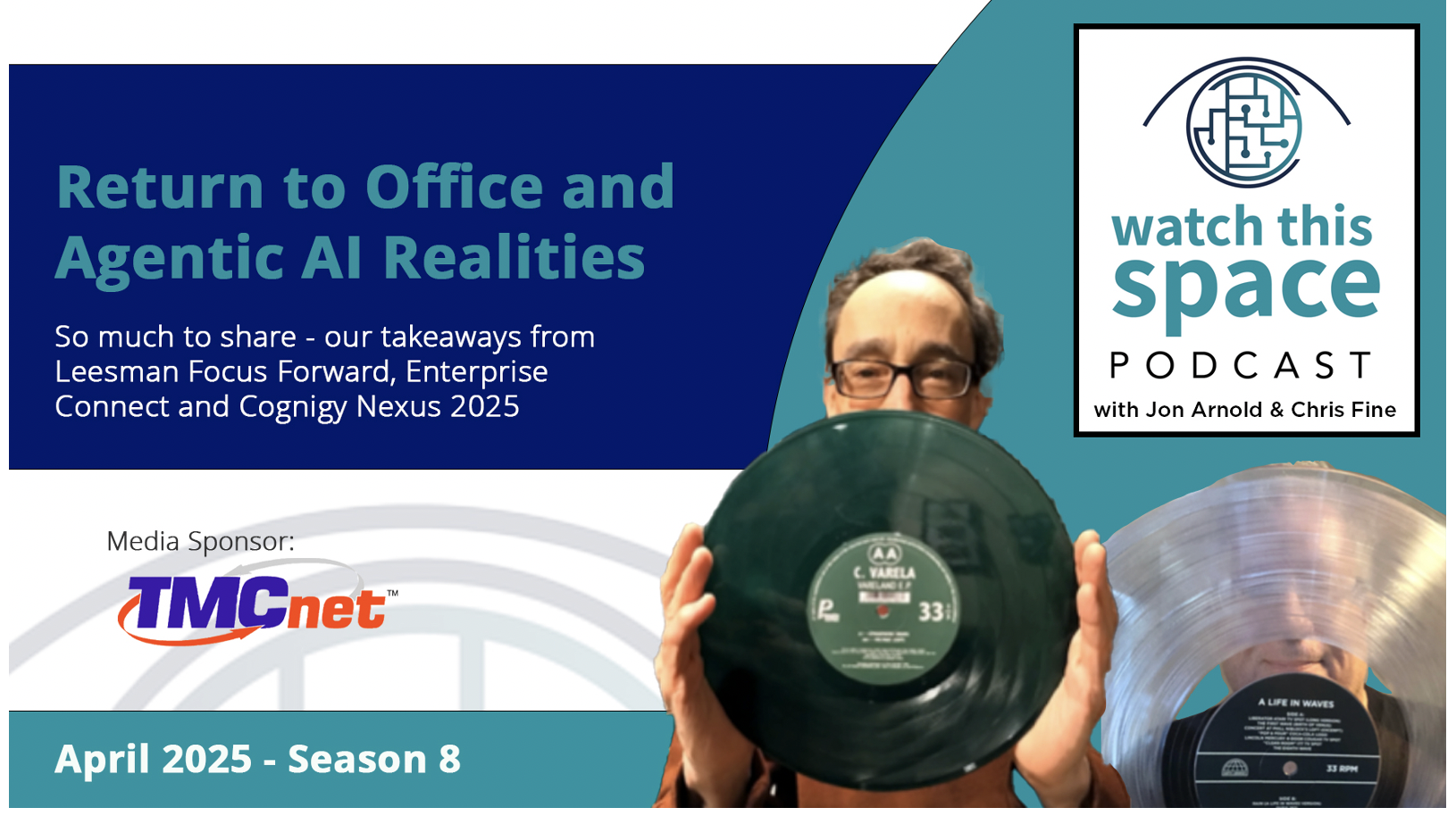
Return to Office and Agentic AI Realities - April 2025 Episode Transcription
Transcription: Return to Office and Agentic AI Realities
Jon Arnold
Welcome to Watch This Space, the podcast about future of work. Every month, we bring you insider perspectives on how digital transformation, emerging tech, and generational change are shaping the future of work. We are two analog guys, finding the groove for all of this in today's digital world. I'm Jon Arnold, and these trends are my focus as a technology analyst in my company, J Arnold and Associates.
Chris Fine
And I'm Chris Fine. I'm an independent consultant and strategist specializing in workplace technology, IoT, and security. My company's Integrative Technologies. Hello, everyone. Welcome to another Watch This Space. Hi, Jon. Always good to talk to you. How's your month been?
Jon Arnold
Pretty good, Chris. Yeah, same here. Good to be back. Good to be on another episode with you here. We're into the spring. It's still winter like in Toronto, but you know, you can feel the change out there with the longer days. And in our world, that also means longer forms of travel. So, I'm in the midst of a long run of kind of almost weekly going to different events in different places. I will cover off some of that as we go along here today. Otherwise, things have been going along as usual. And we've kind of finished off from Future Work Expo event from February but have moved on to many other things since then. And I know you have been busy too, out to a couple of things. And I think we'll probably go to that as our start off for today. And then I'll share my updates as well.
Chris’s Recap of Leesman Research Event
Chris Fine
Great, Jon, thanks. And yes, it is getting busy. I mean, I'm not anywhere in the league of travel that you have, but even I am hauling myself around a few times the next few months to various things. So that should be fun. Always good to get out and see new people and see familiar faces, learn about new things. But one thing that I did go to this week that was quite interesting, and it's a bit of a follow-up on your future of work, was an event in New York City sponsored by Leesman Index. And we've talked about Leesman many times.
They're one of the premier research houses on the workplace and workplace technology, worker attitudes, management views related to essentially the office. They always have interesting things to say. They have provided some data to you for your future work. And a couple of years ago – and we talked about this on Watch This Space - I worked with them on a project with HP Enterprise and a bespoke research report about future work and workplace technology. And that was just, they did a great job.
I always try to catch them when they're in town. What was interesting about this one, and they're doing a webinar about it, too, that you can Google and sign up for if anybody's interested, is Leesman traditionally, their claim to fame and base of power is an enormous database of extremely detailed data about worker surveys, about job satisfaction, essentially, but along many dimensions, which companies pay them to do. They then roll it up and evaluate against all their other data points that they have elsewhere into a kind of a common score of workplace quality, called the LMI, the Leesman Index. So, that's their core database.
But what they've been doing in the past few years, really since the pandemic, or it started in the middle of the pandemic, is to talk to senior people, too, mostly top real estate managers. And they have a group of about 135 of them now that they survey about twice a year. And so they are launching a new product called Focus Forward, which is really based on this data, which is fascinating. In fact, the HPE project is one of the first times they used that database when they only had a couple of surveys worth. It allows you to get a sense of what's top of mind for strategic level corporate management, and then compare that to what the workers are thinking. So that was the core subject.
They had three areas of discussion which were super interesting. One was about hybrid work and how, despite the fact that there are all these back to work mandates in the headlines, that that's actually not what's happening in most places. And they had a lot of data to back that up. And then the second one was workplace experience. And that was where there was actually the biggest disconnect between what the managers were thinking and what the workers were thinking about what's most important to them.
Then the third was the ongoing evolution of the real estate portfolio, which this audience or this survey audience is really able to talk about because they're in charge of it. I thought it was an interesting perspective. There were maybe 75 or 100 people there, all, you know, relatively senior real estate managers. It was it was a good program. And as usual, they did a good job. So that was a highlight of my week. But do you want me to tell you a couple of the things that they said?
Jon Arnold
We, as you say, we've, we, we've featured them, in various ways, over the years and certainly for the keynote that I did at Future Work Expo. I had some of their, I think it's called a Hybrid Future Report. I cited some of their research there. But it's always better when you're in person to see it face to face. So yeah, I'm keen to maybe hear a few takeaways that might have stood out for you. And certainly if you see that the sentiment is changing from, you know, say a year or so ago.
Chris Fine
Well, let me give you just a very few bullet points on those three areas. On hybrid work, it's still showing very strongly that most people are working in the office two to three days a week. And again, we always have to give our disclaimer that this is mostly what they would call knowledge workers, right? They're people who work in offices. They're not frontline responders. They're not people who are more operationally oriented. It's more knowledge workers in offices. But despite all the so-called back to work mandates, most companies have settled on some way of managing about two to three days a week for most people.
The corresponding data point for that was they asked the managers, you know, do you think your company has an established policy on this and what do you feel about it? And something like 65% of them said, well, it's a work in progress. It's not really done. We're not that happy necessarily with it, but this is what it is. So clearly, it hasn't really come to where the workplace is compelling enough or circumstances are in place to get people back in most places to the five-day so-called mandate that you see in all the headlines. So that was interesting to see what's actually going on, which is an ongoing story. And it'll be interesting to see if there's any catalyst that's really going to change that.
On the experience side, the one thing I wanted to mention was that they asked the managers basically why, what's the most important thing about the workplace? Like what purpose does it serve and what kind of work does it support and why is it important to people's job content? And the top topic or the top item cited, everybody got to cite three. The top one cited by the managers was collaboration, and that does not match what the workers are saying. The workers and the managers do agree that for collaboration, the workplace is pretty good to sit there in person. It's whatever you do, right?
But for the workers, the top priority and the top job content still is individual-focused work. For that, the home office or remote office just wins, hands down, over the workplace. So, you've got the majority of managers saying, well, we want to set this up for collaboration. But the majority of the surveyed workers saying, what we really need is individual-focused work. And I've seen a lot of anecdotal and other and some research data points that back this up, right?
That the way most offices are configured, it's actually not that good for individual focused work, even if you have to spend part of your day doing that, which everybody does almost. That's one of the reasons why you get people just going in and go for the meeting and then go home. Because in a lot of offices, particularly those that were built in the years before the pandemic, it's all open office stuff. And there aren't enough places where you can just go hide and think. That has to evolve and the managers understand that it has to evolve, but it's not there yet.
Finally on the real estate, they, you know, the general response on the managers is effectively what they call optimizing the portfolio, which effectively is reduction and it's still, it's less than it was the last couple of years, but still 20, 25% trying to cut out the cost. And what I thought was interesting with that - and I was actually going to follow up with Leesman about this - is I don't think it's all just reducing.
I think some of it is swapping into newer space, at least in markets like New York, where there's a lot of newer buildings where they have great offices in them. So I think some of this we're reducing space may be partly offset by going into new space. Those were some of the biggies, but that meant that made for a pretty interesting afternoon and there was a lot of lively discussion about it.
Jon Arnold
Wish I was there.
Chris Fine
Nobody disagreed, really, by the way.
Jon Arnold
Yeah. Yeah. And were there any like geographic trends of note?
Chris Fine
Yes. Somebody asked about that. And Leesman said that, yes, it does vary. It varies by geography and factors which they didn't really discuss here, but they do analyze, like commuting. How easy is it to get to the office? How near do you live? And also, what kind of space do you have? But one of the things that came out of the discussion was interesting. There's kind of a perception out there that young people are going to flock back to the office because they're living in small apartments, they have roommates, etc., etc.
That has not proven to be the case as much as people thought it was going to be, because they'll just go work anywhere. They don't have to come to the office necessarily, right? Their workflow laptops or phones or tablets or all of the above. You can go to any kind of a cafe or, you know, a temporary workspace or even the lobby of a hotel or your roof deck or wherever it is you want to work.
A lot of buildings, a lot of apartment buildings, at least in New York, but also the newer ones in a lot of other cities have some lounges and amenity space where you can work. Just the fact that you live in a small apartment is not necessarily driving you back to work. So there was a good bit of back and forth about demographics and geographics and not so much about differences in industry, which we covered in the HPE study and bigger Leesman studies do that. But yes, there was some of that. And it's always interesting to look at the variation.
Jon Arnold
And I know we could spend a lot more time on this stuff. And we've talked about also a few times the role of third spaces that give that balance, because not everyone can work from home. And especially, I'm sure, in Asian markets where people live in very tight quarters, typically just not conducive to that kind of thing.
Chris Fine
Yeah, and I think what's changed - and maybe we leave it at that - but what's changed, I took this away, I'm not sure, I would have to look back at the data to see how compelling it is, but I felt that there was something of a decline in company-provided third spaces versus just upgrading the workplace itself, the office itself, and then letting people either be there or at home. I felt that it was a slight decline in that. So that was interesting.
Jon’s Recap of Enterprise Connect
Jon Arnold
Well, that's great. So we'll go from New York to Orlando.
Chris Fine
Yes, yes, we had a big event. So let's take it away.
Jon Arnold
Short hop, same time zone, which I'll be happy about. And so I had, so there were actually two important events last week, but I could only do one of them in real time. So that is Enterprise Connect, which I typically call the Super Bowl event of enterprise communications. And it's been running a very long time, and much like IT Expo, it has been there kind of like almost forever. This is the biggest and most important event for certainly the tier one vendors, the Microsofts and Zooms and Ciscos of the world.
This is where the community does the most in-depth gathering for the four days that we're there. It is a show that started out, if you don't know folks, basically as a telephony show for the PBX. It used to be called VoiceCon, and it was very much about voice communications. And at the time, telephony was defined by the PBX. And obviously, since then, it's evolved with a few concentric circles around cloud and unified communications and now UCaaS. And yeah, the word you mentioned earlier, Chris, about collaboration. This is what drives a lot of the industry right now. In more recent times, the show has also taken on a focus for the contact center customer experience space, in part because the UCaaS space has become fairly mature in the sense that the leading vendors are well-established, and Microsoft in particular with Teams is very dominant.
The sector is really not doing a lot that's different other than becoming more AI focused. The growth really in the enterprise world for these technologies has been the contact center for a couple of years now because that's a bigger problem set that has more immediate needs and implications. This show has kind of been forced to add that element to the programming mix, and it's making it a little more blurry as what the focus of the show really is. But it's still a must be, must do, must be seen at event for the major players in the space. That extends, of course, to the partners, and extends to us in the analyst community. Ideally, it extends to the buyers who should be flocking to shows like this to help drive their decision-making. But that's turned out to be a bit of a challenge, Chris. The buyers aren't coming like they used to. Really? Wow. Yeah, and we could spend a lot of time maybe speculating on why that is.
But shows like this that are very much driven by the traffic on the show floor, that's a big part of the recipe. There's a lot of education needed in this marketplace, and that's where the real value of this event, I think, comes in because of all the sessions, mostly run by the vendors, but also us in the analyst community. We're, you know, speaking on a lot of these and leading a lot of the panels. But yeah, a lot to be learned, and so much is changing, as we know, especially through the AI lens. It's just every week to something new and different. And it's a pretty big treadmill to kind of keep on top of.
The event does a good job of, showcasing these technologies, but it's a little frustrating, I think, for the, certainly the exhibitors who spend a lot of money to be there hoping to find new customers. It's become more challenging to bring those customers out. So that's a high level take on the show itself. I mentioned, Chris, that, the UCaaS space has become fairly, mature is a bit of a misleading word, but, the vendors are established, the product offering is well understood, and a lot of the vendors have very similar type of offerings. There wasn't a lot of excitement in terms of breakthroughs or innovations in the UCaaS space and collaboration space. The buzz was mostly about, you know, yes, predictably AI and in particular, agentic AI, which I've been tapping as one of the big trends of 2025. And for better or worse, Chris, and I'll let you have your say on this in a second, because I think we're like-minded here.
You know, the excitement around AI is everyone wants to be in, nobody wants to miss out. But when it's a vendor-led phenomenon, which it typically is, there's a lot of focus on the newest, the latest, the greatest. You got to have it and you got to have it now. But yet when you start talking about these new generations of AI, namely agentic AI, but also generative AI, It's hard to put a fence around this to define what it really is, what's the real business benefit of this, how does it actually work? And so there's a risk of just adding another acronym to the mix here and making this space a little less appealing in the sense of, geez, there's just so much going on. I don't even know where to start.
Chris Fine
I guess one place you could start, and I'm kind of just thinking about this in real time, is you could look at use cases where you could argue that if properly implemented, AI, agentic or otherwise, would really do a better job. Right. Like, is there anything where that's true? What, you know, versus a versus an agent versus a human agent? And how many, you know, you could, the thing that comes to mind is probably routine kind of queries.
But my experience just as a consumer, which of course may or may not be typical, is that they're not quite there yet. They're getting there, but a lot, there's an awful lot of times when I end up having to do the equivalent of press zero to talk to an actual person, like trying to get through a telephone tree, you know? I don't know if that's a good comparison. So it feels like it's making progress, and sometimes you have encounters that are good, but I feel like it has a way to go. I don't know if that matches your thinking.
How Agentic AI is Impacting the Contact Center
Jon Arnold
Yeah, well, the idea of where to go is challenging because, yes, when it's well-defined, agentic AI applications can do those kind of things, as you say, but not as seamlessly as we would like to think or what we expect as humans who are used to talking to humans when doing customer service. These capabilities are evolving quickly; I will say that. There are some vendors who have some very good real-world, you know, proof points to show where it's being used and how it's making life easier in the contact center and better for the customer. So, the possibilities are there. But yes, as you say, the routine inquiries are kind of the low-hanging fruit for this right now.
The vendors are really sending a strong message that Agentic can be so much more. The big difference here with what makes Agentic interesting is the ability for a virtual agent to handle an inquiry end to end without human supervision, not just to do checkbox kind of, you know, tasks, but to actually behave like a human in terms of using reasoning. That's a hot button term that we're hearing a lot now, that term reasoning, you're going to hear that a lot in the vendor messaging now to basically present the notion that these virtual agents driven by AI are now capable of using logic and building on customer history and human behavior. They're able to draw conclusions that are ideally things that maybe customers weren't expecting or haven't thought about and make sense for them.
On the times when it's right, it is very good. But of course, it's not always that way. So the trust factor here, of course, is a long way to go on that still. But it's clear that this is where the ship is heading, right? This is where all the vendors have glommed on in a very short period of time to say, we believe that AI is good enough that it can handle problem solving at this kind of human-like level where they can draw conclusions, make decisions, based on these inputs. And it does sound a little, a little big brotherish for sure.
When the rules are well established and the guardrails are there, yes, under the right conditions, conditions, agentic AI can be a very good thing in the contact center, but also extended further out, not just there, but in the workplace, right? We're having individual workers having their own virtual assistants that have a persona that basically the worker creates and then dispatches to go out and execute certain tasks. That shows a lot of promise for kind of taking collaboration to a new level where it's more AI first rather than just AI assisted. But yeah, Chris, there's a lot of aspiration here, but we're all trying to get our heads around, you know, is this what we really want? Is this what the workplace is really going to become? And how are we going to know that this is the right thing to do until we try it?
Chris Fine
Yeah, I don't think we know. I sometimes think, and I'd be interested in your view on this, that maybe the underlying goal that's not necessarily articulated, one of the best managers I ever had used to say the widely known but seldom articulated fact, is that really what businesses may be looking for is the ability to support large volume, relatively low to middle quality interactions without people involved and just customers like it or lump it, you know? So I think of things like, you know, dealing with many institutions you could think of, you know, the post office, I don't wanna pick on them specifically 'cause they have some good people, and Lord knows they get enough abuse.
But you know, how, like, are they gonna spend the money to have high quality interactions at customer support - versus just being able to handle the quantity of interactions with lower quality, and that's just the way it is. Sometimes I think that's where it's going, where the kind of intuitive support that you get from a real human being who's really trained, that just doesn't scale.
You can't find enough agents who you're going to pay what they pay, who are really that way, so why wouldn't you mechanize it? Maybe that's where it's going, I think. If they could find a way to make it intuitive and reasoning and logic and really provide a higher level of support, then I think some organizations would do that. But I'm not sure that's the core of it. Do you see what I'm saying?
Jon Arnold
Yeah. To me, it reflects this kind of silver bullet mentality around AI being the solution to a lot of our problems. We're putting a lot of faith in it as the future, and there's no doubt that, that's where a lot of people want to see things go. And it's got a feeling now, maybe more so than last year, I would say that it's kind of inevitable that, every vendor is becoming an AI first story, and that's understandable. It doesn't diminish the importance of human interaction in the mix. And that's kind of an important sub-theme to all this, that they're very much aware that we still have to keep the human touch in the picture here.
Where this goes, the market will decide ultimately, right, how much of this they're going to actually pay for and deploy. But, when you talk to the vendors, who are way ahead of where the customers are typically willing and able to deploy, the capabilities that they have are pretty impressive, that they've really leveraged a lot of these tools. Because the thing with AI too, it's very important kind of underlying theme here is that because AI has the ability to almost like train itself because it draws from all the data and just processes things so much faster than humans can, the ability to drive innovation is just at a whole other level now to do it faster and cheaper.
That opens the door for a lot more new capabilities that we just didn't have. I briefed with several of the vendors there – a notable one, Chris, was a brief I had with Google about their whole AI story, primarily in CX for contact center. What they are seeing in the market is what customers are asking for is they want, they're almost leading with the inquiry about “how can we make AI work for us”? Where are the applications that will make us more automated and more AI-based? In particular, they want to leverage generative AI because it's a way to automate a lot of the communication and the responses that come during the customer service experience.
What they're looking for is basically technology partners who are very much AI first, rather than being customer service or contact center first. In other words, when you think about companies that are, very much out of the AI world, it's companies like Google, right, who are not by nature contact center vendors. When you look at the established players in the contact center space, right, that's how they started. AI has come second. It's come later into the game.
Chris Fine
Right. We're trying to get it to imitate the old model rather than say, if we're starting with something new, what would we do?
Jon Arnold
Yeah. And if this is where buyers are seeing value and are willing to put their money, this actually puts Google, you know, I don't know who else is like this, but certainly puts them in a very good position to really become very credible players in the space. If that's what's going to define value, who does it better than them? So that was a very interesting kind of, I don't know, takeaway for me that I wouldn't have thought of Google that way before. But if this is where the market is going, this tells you what's changing in terms of what constitutes a good buying decision.
Chris Fine
Yeah, and I, you know, I do think we're going to get there because it's inevitable, right, to make the economics of it and the technology power are advancing. so rapidly that it is going to end up powering a lot of things. And, you know, to be honest, Jon, I think if you talk to end consumers or end users of CX, right, whether they be business or individual consumer, that, you know, they would welcome or many people would welcome a method or approach, whether it was mechanistic or not, that just gave you better support. Right. Like if you could prove that it did, if you could, if your customer sat scores really went up and the scores on the interactions really went up, then I think the end customers would support that, don't you?
Jon Arnold
Yes. What makes this space so fascinating to me is that, you know, there's a gap between the buyers and the sellers. And the technology is moving faster than in terms of AI. It's moving faster than anybody is able to really manage. And there's this kind of Pollyanna-ish set of outcomes that people want from this, and they want it as soon as possible. One of the overriding things I see here that I'd be a little worried about is because it's becoming available so quickly, it will be, could become commoditized very quickly. In other words, that like when you talk about things like large language models, everyone has access to this technology now and the cost curves are coming down as you'd expect.
So, it's becoming, a harder thing to differentiate on, much like how we've seen UCaaS become commodified. There is a risk here that this is moving along so quickly that as the costs come down, it will be kind of almost like table stakes for everybody to have and be harder to differentiate on it. I think this just speaks to the need to fundamentally, you know, rethink what AI should do for you because the easy solution is to look for cost savings and automation. But the transformative potential here is a bigger story. Related to that is who you're selling it to, right? Because AI, when you start thinking about contact center, it's not a point solution.
I mean, every line of business in an organization is looking at AI in one way or another. And so decisions around this for one thing, like customer service, it's hard to do this or shouldn't be done in a bubble as isolated from everything else in the organization. This is where, you know, AI strategy comes into the picture of saying, well, yes, we know what the technology can do, but bigger picture, where does it fit to the overall priorities to make the organization itself, you know, more effective, more agile, you know, more responsive to changing you know, changing environment.
Chris Fine
Yeah, I haven't seen the absolute killer app yet, but I see it closing in on a bunch of them that could happen. I don't know yet. But, you know, you mentioned Google, right? So Google is applying AI all the time, every day. I don't know if you every time you do a search, the first thing you get back is AI generated. And it's not useless. But I, you know, I wanted to mention with regard to collaboration, you're right. It's becoming, the word is consolidated rather than commoditized, right? Because it's just consolidated around some huge vendors who give a lot of it away as part of sort of a broader enterprise license or what you're paying for something else and you get this thrown in some, you know, not the equipment itself necessarily, but like the service.
I think having said that about the workplace and the disconnect with collaboration, it feels like organizations still really have to invest in this. And better technology does have an opportunity because you just can't avoid it, right? I mean, even if people are not always in the office, even if people are in different places, and even if there's a different culture or an organization's in a different type of business, don't you think that this is just kind of table stakes? It needs to get better than it is in many places, the collaboration facilities. Despite all of its woes that you mentioned, don't you think it's still an area of investment that enterprises have to do?
Thoughts on Cognigy and Agentic AI
Jon Arnold
Yeah. And that's the operative word, I think, is have to, because it's just moving so quickly. Even though the benefits aren't earth shaking, everyone can see the potential. The last thing you want to be doing is being the last in line. So, I mentioned, Google was a good example. I briefed with several other companies like Cisco and NiCE along the way here. Oh, sorry. The other ones I'm thinking of would be like Cognigy. So, Google, aside from them, I did meet with several other vendors at the show and getting their updates on things. Companies like Zoom and Cisco, Cognigy, there's quite a few and they're all doing really good work in this space.
There's no doubt that the capabilities are pretty, you know, market ready. They're not going to do everything for you. But just like you say, as enterprises need to invest in AI, obviously the vendors are doing it already because they do see the potential here for where it's going to go. When you start thinking about, things that were like, seem like, magic just a year ago, like, real time translation and the meeting summaries, they've all kind of become standard features now, which are all have a lot of value for sure. But, rising above this, though, I mentioned like an AI strategy thing.
Companies like NiCE are already thinking along these lines. And the narrative that they're using, we're going to see more of this. They're talking more about orchestration. That's going to be a big theme I think you'll see as people start to try to tie all these pieces together. In other words, whether it's collaboration in the office or customer service in the contact center, AI is touching so many pieces now that to pull it all together and really extract distinct value for a particular customer or particular worker on a project team, the AI pieces have to be able to work across multiple systems, multiple touch points, multiple data sets and knowledge bases, and then make kind of pull it all together and make it relevant, kind of almost in real time for the end user, for the person who's going to be using this information and providing kind of digital assist or this co-pilot idea of being by your side along the way to help you.
If you're trying to utilize all this information and you might miss a few pieces, the digital assistant right by your side will bring that into the conversation. This is kind of part of how the orchestration affects everything from like before you have to need it to when you need it until after once you've already used it, how you kind of follow up on maybe next steps, right? All the things that flow from that, whether it's for yourself or other members of a team. This is a more strategic kind of look at the technology.
Just to close out, Chris, I did want to pivot just briefly to another event I was at. I was at Cognigy's Nexus 2025 event in Dusseldorf, an event I was at last year as well. There aren't too many analysts who are getting to this event, but I'm one of them. When you see a vendor who's really laser focused on conversational AI, agentic AI, and also to see what they're doing with real customers, it's a real good validation of the kind of success you can have with AI. Rather than just aspirational stuff or what it could do, a company like Cognigy, which to me is kind of at the front of the line for a lot of these things, demonstrating their ability to automate processes and interactions both with assistance to live agents, but also agentically automating a whole process end to end.
They had some really great proof points from pretty big name customers across many verticals that are getting, you know, tangible outcomes, tangible benefits, and measurable impact on the whole process, whether you pick a particular step in the customer journey or the net impact overall to operations. It was a very good front row seat to see what it looks like when it's working. And the rest of the world still has to catch up to a lot of this stuff, but definitely a company to watch for where this agentic stuff is going.
And also, Chris, to be fair, in the EU, I think they might be a little further ahead in some of these applications in terms of being willing and able to deploy some of these capabilities because I haven't seen this level of integration with these technologies as much in the US yet. It's coming for sure. But the proof points, I'm seeing more evidence of it there than over here directly in the US.
Chris Fine
Well, it sounds like it was a good month. Glad we had a chance to talk about the AI. I'm sure we'll talk more. It sounds like things are rapidly improving, and so it's going to be a question of who deploys it and just it makes such a difference that it gets in all the headlines and that becomes a new standard. Maybe that'll happen soon.
Jon Arnold
I think so. Yeah, I do. And I'm not trying to undermine what's happening in the US, because there are great things happening here. But I just see less evidence of really tangible results so far, or maybe just that the vendors aren't telling the stories enough. But wherever it's happening, it's happening. And I think that's the main, if there's going to be one of these watch this space takeaways for the listeners today is that it is a real thing. By the time we even just do the next episode, there'll be more success points to validate where this is going. I think that's a good kind of wrap up for the month. Certainly the Leesman stuff, Chris, is really important because the workspace is where these tools get used, right?
Chris Fine
Well, it's always good to see research data on people who are actual stakeholders. You know, sometimes you and I get very focused on vendors, but it's nice to see some data that's about, you know, people who are kind of on the other end of all this stuff. We're trying to manage it, right.
Jon Arnold
Yeah. As you say about a killer app, you know, we don't quite have that yet, but I think that will emerge. You know, we're still very much in an experimental stage with this stuff. And the only concern, of course, is if the results really get tepid and we just don't see much financial benefit from this stuff, that the appetite might wane. But, I'm not seeing that yet. There's good reasons to be pushing back in terms of guardrails, et cetera, in the marketplace. But the overall, you know, the overall sentiment is pretty clear. You know, this is where it's going and you got to be with it, not without it.
Chris Fine
I mean, if history is any judge, then mechanization and automation usually ultimately wins. You know, it gets overhyped at first. It's the old hype cycle, but it finds its place, right?
Jon Arnold
Yeah, I think that's a good way to look at it. And coming from the analog world, I think we understand that pretty well.
Chris Fine
Exactly. Comparable, I was thinking, is analog equipment, you know, like if you're trying to play records or something, you would always try to get the mechanism more precise and everything else. Whereas what they did with DVD players is they actually made them cheaper and cheaper, but they worked because they put more software in the chips to understand what the errors were that the cheap mechanisms would encounter. And they put more redundant data on the disk so that it didn't matter if it's had reading errors, you wouldn't see it on the picture.
So, you know, that was a case where rethinking the problem and mechanization and automation took over, right, versus the fundamental precision or quality of the equipment. And If you have the ability to process enough statistical data and large input data sets, you know, maybe it's similar, right? You see where all the patterns are if you're in AI and you realize what you actually need to focus on. I think that's what they're aiming for, right?
When you have like a problem set with a huge amount of data, can the software, can the systems go in and say, well, you know what, this is what's relevant. And it doesn't necessarily mean you have to do this better, you just have to call attention to the right things. I don't know if that makes any sense, but that's my kind of parting thought for today.
Jon Arnold
Yeah, I'm with you on that, Chris. So, you know, analog has its place and more importantly to us, I think it's the way of thinking about things that leads to the value that digital solutions ultimately bring. Because you got to, everything starts with a mechanical or mechanized piece. And then once you automate it, then you can scale to get the results the way, automation can provide. And I think that's being applied now to the workplace and the processes around customer service, et cetera. And, you know, of course, the trick is to keep the human element in there. So far it is. And let's just hope it stays that way.
Chris Fine
Definitely.
Jon Arnold
Okay, so that's time for today, folks. And we'd like to thank you for listening. We hope you enjoyed our podcast here and that you'll continue with us as we explore the future of work on Watch This Space. You can access all of our episodes at www.watchthisspace.tech, or wherever you subscribe to your podcasts. And if you like what you're hearing, we'd love it if you left a review or a rating. And if you have suggestions for future episodes, we're all ears. And with that, I'm Jon Arnold.
Chris Fine
I'm Chris Fine. Thanks again, everyone, for listening to another episode. And we will speak to you next month with another edition of Watch This Space.