Shaw Communications - Getting Convergence Right

Earlier this week, I was on BNN TV talking about Shaw Communications and their pending acquisition of CanWest. Add to this their planned entry in to the mobile market, and Shaw is anything but a regional cable operator.

The more I thought about this, the more threads I saw related to the broader service provider landscape. Convergence has had more misses than hits, but with Shaw, I think the stars are lining up in their favor. I've explored these themes a bit further in my current Service Provider Views column on TMCnet. There's certainly a lot more to talk about, and I just might do that in future columns. For now, though, I'll leave you with this column, which is running now on their website. I'm all ears for some dialog around this, so please chime in if you like.

Focus.com Launch Coming Next Week

There are many industry portals out there, some of which I've been supporting for a while. Focus.com is one of these, and I've been working with them for a few months now. Their site has been in beta mode until recently, and the current iteration is pretty much market-ready.

I'm posting now to help get the word out that their public launch will be next week. Part of this includes a launch party, which I'd love to attend, but it's just not practical for me to go to San Francisco right now.

I've recently become a Focus Adviser, so I'm fairly active in contributing content as well as supporting their online community. The portal really is a bottomless pit of insight from very engaged people across the full spectrum. While there is the odd vendor pitch amidst the commentary, the caliber of content is very high, and you can come away learning something on just about any aspect of IT or communications. If you haven't visited the portal, you really should do so, and it's a very safe bet to say that once you do, you be back often.

Shaw Communications - More Canadian Wireless Disruption

I've written about the Canadian wireless market a fair bit, and the plot continues to thicken. The latest twist comes from Shaw Communications, the major cable operator serving Western Canada.

They have held off - wisely, in my view - coming to market with a wireless offering, following their spectrum acquisition from last year's AWS auction. The move is on now, though, and it comes during an interesting time in that they just made a $2 billion deal to acquire CanWest, one of our largest broadcast networks. If this sounds like another dreamy convergence play, you might be right - but I don't think so.

Lots of great story lines here, and I'll be writing more extensively about it this week. Until then, though, you can get visual version of these events from a television interview I did this morning on BNN TV - Business Network News. You can view the clip here during the next few days. It only runs on their site a short while, and if you miss it, I'll have an archived version shortly.

M5 - This is What Your Business Sounds Like

Last night I attended M5's 10th anniversary event. Very nicely done, and it was great to see such a strong turnout, especially among their customer base. The event had a very local feel, since M5 is based in NYC, as are many of their customers. CEO Dan Hoffman gave a stong presentation that covered all the bases. He talked about where the company has come from over their history, and how their vision hasn't changed. They had a nice video segment where various employees talked about their favorite customers, and it's clear they have a pretty loyal base on both fronts.

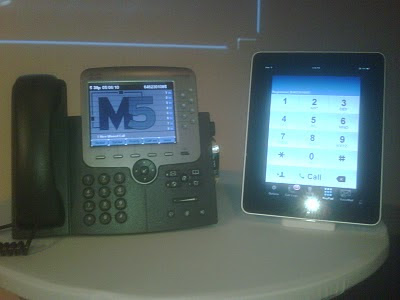
Dan also tied in the event to launch of their next phase of development. He had an iPad on display along with one of their standard Cisco IP phones, which is reference to their recent VoIP integration news with the iPad.

What really stood out for me in his presentation was M5's focus on voice, and how it's still so central to everyday business activities. When the company started, one of the disconnects he saw was how dis-integrated phone systems were to everything else at work. Phone systems were just too clunky, costly and inflexible for such an important function. He made a pretty strong case for the quality and flexibility that comes with hosted VoIP, and summed it up nicely by saying "this is what your business sounds like".

Being customer-centric is a big part of M5's success, and his point is when you put yourself in your customer's shoes, it's not hard to see - or hear - how the limitations of a legacy phone system can reflect poorly on how the outside world perceives your business. His examples showed how the intelligence that VoIP brings by tying in with business applications makes for a more productive and professional end user experience.

One that I particularly liked was the way you can set up new voice greetings on the fly that reflect near real-time situations. The Iceland volcano was used as an example, where callers would have a prompt option for those whose plans had been disrupted by this event. The key here is that businesses can now be very responsive to changing situations, and easily incorporate that into the front door of their business. Simply put, your business sounds much better to customers when your voice prompts refect their reality, and you can solve their problems first time around.

Dan spent a fait bit of time talking about their next iteration of hosted VoIP, which is more applications-centric and customer-centric. He's not calling it Unified Communications - which is fine, since M5 is still mostly about voice and telephony - but he's taking the hosted VoIP concept a bit further by making it more integral with other business applications.

I'm certainly a big fan of UC, but it's clear to me there's still a pretty large segment of the market - especially SMBs - who rely primarily on voice, and simply want a better way to do telephony. Absolutely nothing wrong with that, and with milestones like 10 years and 1,000+ customers, M5 must be doing something right, and I'm glad I could be there to see this first hand. Congrats, Dan and company on ten-oh, and just like making your first million is the hardest, I've got a feeling they're going to see the hockey stick ramp-up rate in the next few years.


Dan Hoffman


Literally, how cool is this? At the vodka bar, a Cisco phone embedded in ice.


The M5 house band - love it - these guys were great.

M5's Turning 10

M5 Networks is a company I've followed for a long time, and their CEO, Dan Hoffman has been there since I started covering VoIP in 2001. They've been a pioneer in the SMB hosted VoIP space, and have been at the head of the pack ever since. M5 understands this space as well as anybody, and they've done a great job creating a locally-based model - New York City - and replicating coverage across the U.S., with well over 900 customers to date.

I'm writing about them because M5 is turning 10 now, and that's a pretty big number in our space. Most of the companies we think about as leaders today didn't exist back then, or were not that active in VoIP. Many, many others have come and gone, but M5 is going as strong as ever. I'll be attending their anniversary event on Thursday in NYC, and am really looking forward to sharing the experience and re-connecting with Dan. Photos and postings to come.

Mobile VoIP Webinar with GIPS, May 20

I'll be moderating a webinar on mobile VoIP in a couple of weeks, and I just got the URL for it. It's being sponsored by GIPS - Global IP Solutions - a company I've known for a long time and did some work for last year.

It's a pretty big topic, and the focus here will be on how HD voice supported by GIPS and a smartphone apps suite from Media5 (previously Mediatrix - Canadian!) can help carriers grow their mobile ARPU. It's a strong story, and I'm looking forward to the webinar. I hope you can join us, and you can get all the details and registration information here.

Baseball - Not Even the Sox can Help the Blue Jays

I went to the Red Sox/Blue Jays game with my older son Max last night. The Sox won a ridiculous 13-12 game here the night before, and this game was the exact opposite - a very well-pitched National League style 2-1 game. Very dull, but the Sox win again - their 6th in a row by 1 run - and we've now climbed into a 3rd place tie with the Jays. Happy days.

Nothing beats a family outing to the ballpark, and these days just about anyone can do that here in Toronto. I love living here, but the city tries too hard to be NYC-North and loves to talk about how this is such a big world-class city. In many ways it is, but the state of baseball here is abysmal. Things were just OK til Roy Halladay moved on to Philly, but it's gone off the cliff. Attendance is at all-time lows, and they can't even break 15,000 for the Red Sox. That's not good.

Toronto is definitely a major league caliber sports town, but c'mon. The Jays have a lock on our sports dollar right now. There's no NBA or NHL playoff action in this town, so they have zero competition - and this is the best they can draw? Yeesh. Just try getting a ticket right now for the Sox or Celtics or Bruins. All those teams are playing and Boston is a smaller city than TO. Just doesn't add up.

Sorry for mini-rant, folks. There was a time when the Jays were a perennial sell-out, drawing a full house - 50,000+ - every game. It's sad to see such an empty and quiet - really quiet - stadium, and it's hard to see what's going to change it. Winning is always the best solution, but even with aces like Halladay or even Roger Clemens pitching, they were hard pressed to draw 25,000 fans. No doubt, fans have gotten tired of waiting and endless re-building. It's even harder to take when you see the great job Tampa Bay has done in the past few years going from worst to first with a crappy stadium, indifferent fans, a small market and a small market payroll. The Blue Jays don't have these problems, and they've been totally passed by now by the Rays. Ugh.

Anyhow, there photos tell the story pretty well. I always love going to see baseball, but this ain't much fun.


Chasing the Clouds, Part 2

Last week I wrote about some trends I'm seeing in cloud communications for my Service Provider Views column on TMCnet. There's a lot to consider here, and I've just written Part 2.

Basically, as voice shifts to both the Web and the desktop, phone systems become less relevant, and the possibilities for voice to be totally cloud-based become more interesting. "Chasing the Clouds, Part 2" is running now, and you can read it here.

If you haven't been to my TMCnet column page lately, I should mention that they've now added icons to subscribe to these feeds either by email or RSS. There's also a comment box at the end of the article, and I'd love to hear your thoughts there.

Mitel's IPO - Quiet Re-Entry

Last Thursday, Mitel re-entered the public market, a move that has been coming since January. I was away that day and since getting back, I've been wondering about the relatively modest buzz around the news.

I'm not really sure what this means, but aside from a few posts and short articles saying little more than the basic news, I just haven't seen or heard much out there. Being Canadian, I have good reason to wave the flag, and if all I do here is create some new awareness of their IPO, I've done my job. I'm a long-time fan of Mitel, and the IPO is another step along the way for them to become a major player in the ever-evolving business communications space.

This isn't the place for an assessment of the IPO's financial merit, but the timing is about right. When they acquired Inter-Tel, that company actually went from being public to private. As I've written previously, the idea was to consolidate and integrate the two companies privately, where the fine tuning wouldn't be scrutinized by investors. Now that's done, and the markets are looking stronger now.

On paper, that makes sense, but their IPO happened to come out on a crowded day with many other IPOs, and that likely cut into their coverage. Price-wise, the stock listed below expectations, and is currently down a bit from its opening price of $14. These things are bound to happen with IPOs, and I wouldn't worry too much about the price right now. The intention is to pay down some debt and be liquid enough to make acquisitions and keep up with the competition, which is considerable. Mitel doesn't have a strong track record of profitability, but they're certainly viable, and should now be in a good position to generate positive earnings.

The IPO sends a message to the top tier competitors - namely Cisco and Avaya/Nortel - that they're a strong alternative for their customers, and it's another way to put some distance between themselves and the crowded space of middle/smaller players vying for this business. And then there's the cloud thing - Google, but also Microsoft. I've been writing about this a fair bit lately, and I think it's going to become a major battleground for all business communications vendors in 2010. Mitel has been moving in this direction for some time, and partnerships with VMware and Sun go a long way to keeping them competitive here. Not to mention their recent moves in mobility, especially Mitel Mobile, which looks to be pretty unique among vendors in this space.

For now, I'm going to ignore the stock price and focus more on how the IPO helps raise Mitel's profile with customers and channels as well as put a deeper stake in the ground with their competitors. There's a lot to like about this company, and if the IPO can help with the latter here, the price and profits will take care of themselves.

Reminder About Tomorrow's Webinar on Cloud Communications

Last call to join us for tomorrow's webinar - "Voice in the Clouds". It's hosted by Focus.com and runs from 1pm - 2pm EST. I'll be presenting an overview of the cloud communications opportunity, and then the sponsor - RingCentral - will provide a deeper dive on cloud-based solutions that are working today for SMBs.

Registration is free and you can sign up here. Based on what I'm seeing on the portal, we're expecting a strong turnout, and I hope you can join us.

Chasing the Clouds - More Things to Consider

It's been a very cloud-centric week for me and blogging has taken a back seat. On that note, please pardon the mess here - the re-do of my blog is a work in progress, but things are in the works - won't be long for the changes to take shape.

My latest TMCnet Service Provider Views column is about what I'm seeing in the overall cloud communications milieu. There are more questions than answers, and this is Part 1 of what some of that looks like to me.

Cloud Communications Alliance Launched

This morning marked the launch of the Cloud Communications Alliance. This consortium was founded by 8 hosted opertors, and they feel the time has come for serious cloud communications. To do this, they know they need some scale, and that's what CCA gives them, along with a whole lot more.

By working together, they have the means to create a national HD network, and that sets the stage for a lot of innovation and new business models around cloud communications, especially Unified Communications. The press release went out this morning, and I've written a more detailed analysis about CCA that's running now on the UC Strategies portal.

Industry Roundup Podcasts with Peter Radizeski

I've known Peter Radizeski for some time, and we often cross paths at industry and vendor events. Like me, he's an indie, and his company RAD-INFO helps service providers with marketing and business strategy. We have similar views on telecom, and he recently suggested we do some podcasts to share them with our followers. Good idea.

We did a couple last week, and I have the links now. Nothing fancy - just two guys doing their thing - but if you share our views, we hope you'll give them a listen. Our first podcast is basically about the state of Unified Communications, and the second podcast covers the broad world of cyber security, but more specifically my take on the Shadow Network story I had been writing about a few days before.

If you like what you hear, please let us know. We plan to do these on fairly regular basis, and if there are any topics you'd like us talk about, we're all ears.

My Blog's New Home

This is the first of a few posts coming about my new blog home.

I've been quiet the past few days, and have been working on migrating my blog to a new site, which a lot of people using Blogger have had to do this month. As you can see, the core content ported over yesterday, but that's all there is right now.

Over the next few days, I'll add back the rest, and will be updating the look and feel of the blog. For now, the important thing is for you to update your address books with my new URL: http://jonarnold-analyst.blogspot.com/

My old blog site will continue to run for the foreseeable future, and anyone landing there will be re-directed here. From now on, though, I'll only be posting here, so once you have this address, there won't be any need to track the other site.

Upcoming Webinar on Cloud Voice Services - Join Me and RingCentral

I've recently started contributing regularly to the Focus.com portal, and am now a Focus Adviser, which gives me a bit more profile than the regular contributors. Aside from being a community hub for buyer's guides, expert commentary and chat threads, Focus.com also hosts webinars.

I'll be presenting on one of these later this month - Tuesday, April 27 at 1pm EST. Titled "Voice in the Clouds", this webinar is focused on cloud voice services, and I'll be joined by RingCentral, who is a provider of these services. This is my first shout-out about it, and if this topic is of interest, you can read more about it and register here. Hope you can join us.

Is The PBX Dead? UC Strategies Discusses

How's that for a hot topic? Anyone who has followed me for a while may recall a lively dialog I started at the end of 2008, with a similar question - is VoIP dead? That one sure had legs, and the PBX topic is really no different.

Well, that was the topic for this week's UC Strategies podcast, and if anyone should have qualified opinions, it's this group. Everyone has their own take on this, and the podcast is a great listen. I provided the opening comments, and there was lots of back and forth on the utility of a PBX. However, we're all pretty much of the same mind that the PBX as we know it is simply out of kilter with how the communications landscape is evolving.

You can access the podcast here, and while you're on the site, there's a nice related article from Dave Michels that you'll enjoy too.

Branham 300 Highlights

The Branham 300 came out today, and is a good barometer of Canadian tech. I've been following it for a few years now, and while the usual suspects don't change much, it's always good to see how they're faring on a relative basis. For me, though, it's more about the emerging companies and rising stars - those are the ones that catch my eye. The various lists around their annual update are published in Backbone magazine, and you can review those here.

I just wanted to share a few thoughts, but by all means, spend some time exploring the lists in detail - there are lots of interesting companies here.

First - as always - Canada is a small, highly concentrated market. As such, their Top 250 list of tech companies is led by the telcos and cablecos. However, RIM is the overall leader at $11.9 billion in 2009 revenues, well ahead of #2, BCE at $8.3 billion. For what it's worth, Nortel ranked #5 at $4.5 billion, and this may well be the last we'll see of them. Last year they were #1 on this list, but now RIM is really our only top tier/world-beating tech company.

In terms of revenues, things fall off pretty quickly after RIM. Only 11 companies in the top 250 are at $1 billion, and only 18 are above $500 million. Stepping down the line, only 45 are above $100 million, and only 80 are above $50 million. In terms of the rest, roughly half the list - 120 companies - are under $25 million. Any wonder why so little funding finds its way into this market?

Aside from RIM, two other telecom players are worth noting at the high end of the list - Aastra and Mitel. Both are in the area of $800 million, so with a couple more good years, they should soon join the $1 billion club.

Otherwise, some of the other telecom/IP companies on this list that are in my orbit include Vecima Networks, Peer 1, Platform Computing, Unis Lumin, Sigma Systems, Impact Mobile, Sangoma, PIKA and CounterPath. Wearing my Smart Grid hat, it's nice to see Redline Communications, RuggedCom and Matrikon on the list as well.

In case you're wondering, the global players aren't on that list - they have one of their own - the Top IT 25 Multinationals. IBM Canada is tops there at $4.9 billion, with HP Canada following at $4.3 billion. Five others are in the $1 billion club - Siemens, Xerox, Microsoft, Cisco and Apple.

Finally, I wanted to note the Top 25 Up and Comers. No sales figures here, just an alpha listing. Nice to see some Wesley Clover/Mitel presence here - Benbria, Magor and Teldio. Among the new wireless players in Canada, Mobilicity (DAVE Wireless) made the list. On that note, interestingly, I don't see Globalive in this report - anywhere. However, not surprisingly, mobile is one of the strongest themes in this particular list. By region, roughly half these companies are Ontario-based, and a third are from B.C. Only one from Quebec in this list - that is a surprise - would have expected more here. C'est la vie.

Metaswitch Q2 Update

Today, Metaswitch had their Q2 update call, and I just wanted to share some highlights. Readers of my blog will know this is a company I've followed for a long time, and it's always good to see a continuing growth story.

Being private, Metaswitch is not obligated to conduct these quarterly calls, but when things are going well, why not? I've noted before that it's unusual for a private company to share performance metrics, and they certainly provide validation, both in current terms and to support recent upward trends.

That said, the call is conducted within a small circle, and I can't share those numbers here. Furthermore, there wasn't much hard news, so I don't really have much to say. However, I can tell you that the Q2 numbers are good - sales are up - both Q-to-Q and Y-over-Y - as are margins. They continue to acquire customers, and are doing so in a variety of ways. On the call they talked about both Tier 1 and below, as well as all types of operators - wireline, mobile and cable. Their footprint continues to expand regionally, and they cited recent wins in both the CALA and APAC markets.

An underlying theme was industry consolidation, with Genband's acquisition of Nortel cited as a recent example. The message here is that Metaswitch is a stable, strong and proven partner, and this is being proven out with their continued market success. I have no reason to doubt this trend will continue, and they mentioned that their upcoming Forum customer event will have record attendance. It really is a great showcase for their market traction, and I'm looking forward to experiencing it first-hand next month.

Shadow Network Revealed - Taking Cybercrime to a WNL

Canada sure is on a roll. The Vancouver Olympics were great, we got Gold in hockey, the loonie is now at par with the greenback, and now this. We all know how the Web can be used for evil just as well as for good, but as they say on MAD TV, this takes it WNL - to a whole, nutha, level.

Today we have news about Shadow Network, the latest big reveal about just how far cybercrime is going, with a lot of insidious links to China. There are a number of threads here, so just bear with me. Shadow Network is the name for an extensive series of sleuth-like discoveries made by the University of Toronto along with Ottawa-based security experts SecDev, and U.S.-based Shadowserver Foundation. The findings are summarized in a report that was just released today. It's titled "Shadows in the Cloud", and you can download it here (after a quick registration on Scribd - if you don't have that already).

If this is news, and you have concerns about cybercrime and online privacy - and you damned well should - you'll definitely want to explore this. Quickly...

First - the above link is to the front page story in today's Globe & Mail.

Second - from this link, you can read a profile of the guys behind these discoveries - particularly Canadians Nart Villeneuve, Greg Walton and Prof. Ron Deibert. This stuff reads right out of a spy novel, and I don't think Ian Fleming could have done a better job.

Third - this story builds on an equally jarring discovery this group made almost exactly a year ago. This was called GhostNet, and I've written about it a few times, especially here.

When you look at what's happening with Shadow Network and GhostNet, it's pretty hard to feel safe on the Web, especially if you have reasons to be critical of some things that go on in China. I'm not trying to single out one country in particular - we know bad stuff happens everywhere - but it's particularly interesting given Google's recent pullback from China. I wrote about this recently, especially about what this milieu could mean for service providers of all stripes.

You can proclaim all day long that Google left on principle and did not wish to continue catering to China's censorship demands. That's all true, but I suspect the reasoning is just as much related - if not more - to the security hacks Google experienced in China. That's not just bad for business, but breaches like this can fatally undermine their intellectual property - and in the Internet world, that's the foundation of the business. Needless to say, they weren't about to let that continue - would you?

Finally, all of this hits closer to home in a very timely way. As we speak, the blogerati and twitterati are furiously talking up today's Net Neutrality news. As you no doubt know by now, the FCC has lost its case against Comcast, and the cablecos - and other facilities-based operators - are free to manage their networks as they see fit. Needless to say, this has negative implications for competitors who bring traffic over their pipes, and it won't be long now before "traffic shaping" becomes another four letter word.

This may seem a bit of a stretch, but Net Neutrality and Shadow Network are really not that far apart. In theory, nobody owns the Internet, but clearly powerful and/or devious players can make this a very uneven playing field. This is a far cry from the Arpanet vision, and the dark side of human nature seems to be getting the upper hand right now. Let's hope it doesn't stay that way, and that the good guys behind Shadow Network keep up the good work. Go Canada!