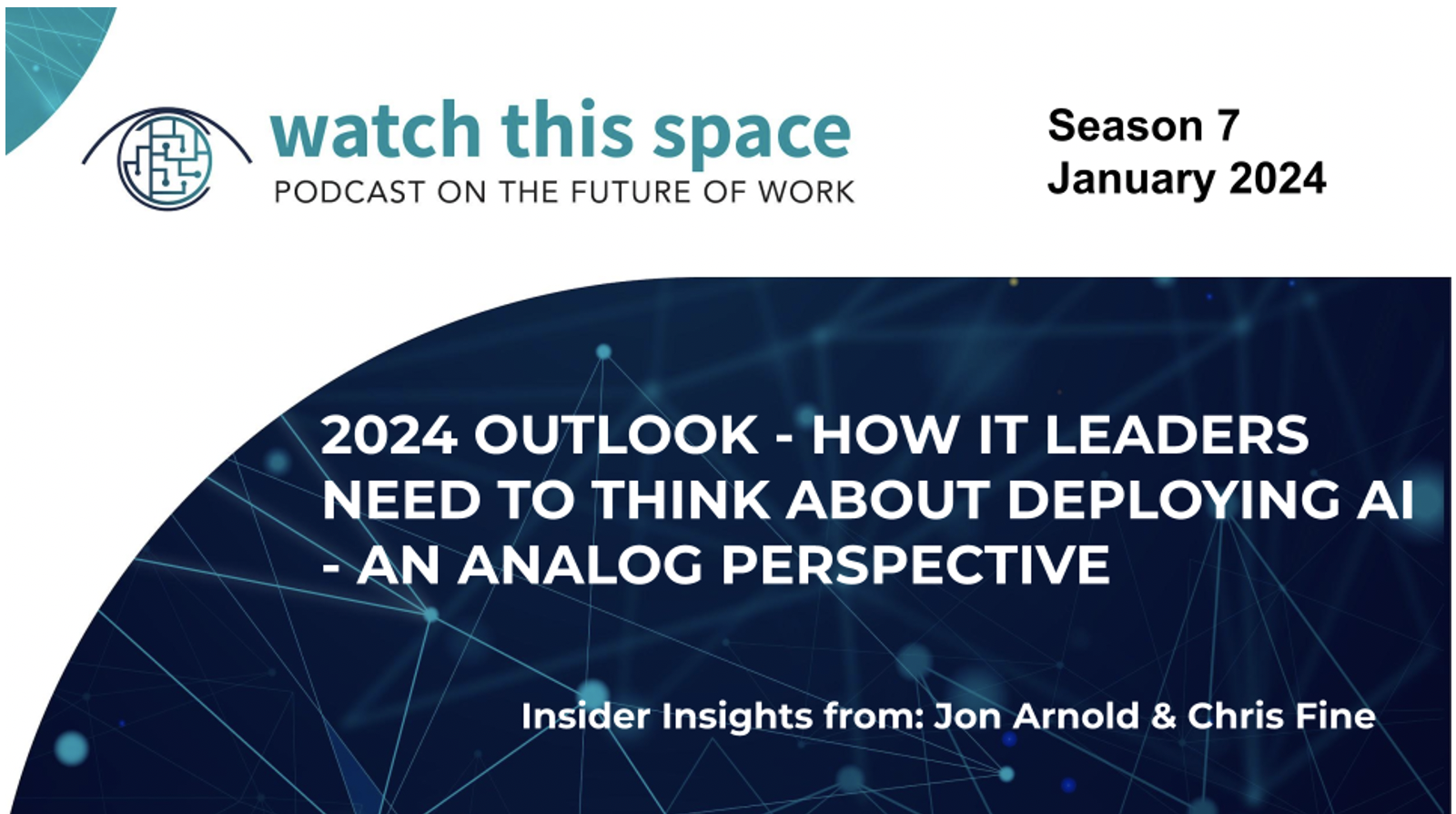
2024 Outlook - How IT Leaders Need to Think About Deploying AI - an Analog Perspective
/
Audio links for original podcast:
· Here, on the dedicated Watch This Space website
· Here, on the Podcast section of my J Arnold & Associates website
Jon Arnold
Welcome to Watch This Space, the podcast about future of work. Every month, we bring you insider perspectives on how digital transformation, emerging tech, and generational change are shaping the future of work. We are two analog guys finding the groove for all of this in today's digital world. I'm Jon Arnold, and these trends are my focus as an independent technology analyst at my company, J Arnold and Associates.
Chris Fine
Chris Fine. I'm A consultant and strategist specializing in workplace technology, IoT security, and a few other areas. My company is Integrative Technologies. Hi, everyone. Welcome to another episode. Hi, Jon. Great to be with you again. How was your month?
Jon Arnold
Pretty good, and it is great to be back. No travel for me, which has been great. I got to tell you, Chris, as we all know from recent podcasts, I've been on the go a lot and it's great to be home for a while and kind of get back to regular routines. You know, coming out of pandemic when we were just doing all virtual stuff, you're really boxed into your place of work. But nothing beats being in front of people real time for sure. But travel is tough when you're doing it ongoing. So that's that. And you've been happily ensconced in the New Jersey, New York vicinity, right?
Chris Fine
Yes, I've had a couple of times to go into New York City, which I've enjoyed and work related, but basically, I've just been working, Zooming and Teamsing and everything else from my usual home environment, working in a virtual team. It's always a good, it's pretty good experience overall, thanks. And now it's winding down a little bit toward the end of the year. And you won't hear this broadcast until after the turn of the year, right? So we need to be thinking 2024.
Jon Arnold
Exactly. So, yes. So happy 2024 to our listeners. And that means, Chris, we are going into season seven. Still looking for those elusive sponsors. And we're just a phone call away. But we keep doing what we're doing, Chris, because as we say, we are analog guys, and the digital world gets more and more complex, compressed, faster. And I like to think we bring some levity and perspective from maybe a slower, more reflective time where you can actually absorb what you're doing and kind of look at the bigger picture, right?
Chris Fine
True. And it's funny, the more digital it gets, sometimes the more analog trends you see too. Like in the hipper areas of this area, there's the record cafes, right? Where it's actually taken from Japan, where there's some amazing places in Tokyo where you can go. It's really high-end stereo equipment and an amazing record collection. And you have super great whiskey and listen to listen to music on this amazing stuff. And they're a little bit less high end maybe here, but starting to see more and more of them. So that's for every digital, there's a little bit of analog.
Jon Arnold
That is my retirement project right there. I will open a salon and yes, that's what we're going to do. Okay.
Chris Fine
We're done. All right. Plans in place, right?
Jon Arnold
Yeah.
Chris Fine
But yes, yes, the digital world does seem to be more and more complete in a way, right? Or, I don't know, pervasive all the time, you know, inevitable. You know, I think that it's just grown that much more with hybrid work too, right? Because basically everything involved with hybrid work has some digital aspect to it or some technological aspect to it.
Jon Arnold
You know, I think I might have found one of the few remnants of our analog world, Chris, and you'll relate to this, and I'm sure all of our aging listeners will too. I just got my Will and powers of attorney updated, been meaning to do this for a long time. And to kind of like finalize, I have to go into a lawyer's office and all the docs have to be signed and witnessed. All the process that is the foundation of our legal system and verifying identity via your personal signature. And it's kind of something you have to do. The digital generation may not think along these lines.
I had to ask my lawyer, like, for people who can't read or write cursive, what do they do now? I mean, some worlds move faster than others when it comes to going into the digital realm. And law is one of the holdouts. They're going that way, obviously. It's been, but slower. And you go into any legal office and they're always awash with paper files, and of course, all the law books in their library that they have to have. It just reminds you that the whole world isn't quite digital all yet, but it's getting close. But it just takes you back to say, yeah, there was a time when everything was this way.
Chris Fine
Well, yes, I mean, you had to get everything done with a witness or signed or whatever. But what I find very ironic is that sometimes I run into processes that really shouldn't require anything like that do. Like, for example, I went to go apply to my, get my aging person discount card for the transit system, for the PATH system, which people may know runs from New Jersey to New York. And I had to go get that notarized. I had to go get that affirmed and I had to send in a printed application to get that just so they were sure I was as old as I am, right? Whereas I can do bank transactions all day with, in my mind, relatively, any of us could do this, but relatively not the same level of affirmation for things that are much more meaningful and impactful. It's funny because sometimes you see it, sometimes you don't. It's very irregular.
Jon Arnold
Yeah, for sure. I think that sets us up nicely for what we talked about ahead of recording today. And that's what are we going to look for and our listeners to be watching for into 2024 in this world of communications technology. AI is always I shouldn't say always, but it is now at the front edge of everything. And comms, communications, whatever you want to define that as, is definitely being driven by AI, probably far more ways than we realize, right?
Chris Fine
Possibly. I think there's a huge frontier for it, opportunity. And I think that you could pick use cases that you could apply AI to all over the place. in communications and networking. I think we'll start to see more and more of it. And I think in also in related areas like cybersecurity, that this may bring, I am, as people may know from listening to this podcast, I am not a full-throated AI enthusiast in all cases, but I do think that communications is a process where it could actually be very useful. I'm hoping to see that done in a good way that improves the quality of service, right?
Jon Arnold
I mean, some of the applications that are becoming fairly routine now, which would have been miraculous not that long ago, real time transcription, real time translation in the workplace, right, for the collaboration world. And now the layering on that would be meeting notes, meeting summaries, basically almost to the point of having a digital assistant tell you what the highlights of the meeting were that you missed, that kind of thing. In other words, things that are very, you know, positive for productivity purposes. And you could say, hey, you know what? Yeah, I had to step out for 10 minutes during the meeting, but I got updated the second I got back to my desk. I read all the notes. I knew who said what.
That's pretty good. Like, those are good applications, I find, of AI. But I guess when you step back and say, well, how is all this magic happening? Then you have to think, it's because everything I'm saying, touching, looking at, right? Using my fingers on the keyboard for every single element there is digital, which means it now becomes a data stream, which now means it's being tracked and monitored and ultimately converted into new forms of, you know, for sake of a better word, business value that the organization can use to monitor productivity, but also other things too, like how attentive you are, whether you're at your desk, how long you're working, who you're talking to, what is being conversed about, you know, et cetera, et cetera. So it's double-edged, right, as we know, as we know. But it's becoming more and more real, right?
Chris Fine
It is. I think we've kind of touched on two things here, right? One is AI and one is information privacy and the whole idea of your rights to your data. And I think both of these are topics we really want to look for even more activity in 2024. And you brought up something interesting when you mentioned all the applications you were thinking of related to productivity and collaboration, the transcription, et cetera, et cetera. So I think that's going to go a lot further. And if you look at things like Microsoft's Copilot, which was part of their original involvement with OpenAI, and the same sort of technology that led to ChatGPT, I think that that's going to start playing a really big role.
People make fun of it. They think it's going to be like Clippy the paper clip, if you remember that horrible, annoying thing, right? But it's not. It's going to be much more anticipating what you're trying to do and helping you do it. And I think so in those instances, I think it could definitely help. Not to have to be an Excel maven to use Excel, for example, or you want to format a document, like it needs to look like this, you give it a brochure and you say it's got to kind of look like this.
And it just kind of does it based on raw input of text. That just that kind of stuff, it just takes so much time to do. Or if you say I want a PowerPoint presentation to have a certain look and feel, you know, that stuff, that really adds up. That's a productive use of the technology. But I was also talking about things like network management and anomaly detection and optimization of flows in a network and optimization of service and all kinds of stuff like that, where it's actually really difficult for people to do. And it's always a problem, you know, anticipating an outage, right? Seeing things that are going to lead to an outage much faster than people can recognize them. I think that there's a huge opportunity for that and it's going to increase, it's going to make that, again, not being a full-throated AI proponent, but those are two more applications where I think we're going to see it and I think it's going to help.
Jon Arnold
Absolutely. And you go up and down the line for any vertical sector and there's a really good use cases for this. We may have talked about this before, Chris. I was at a utility conference in August speaking to them about how to think about AI and what is this ChatGPT thing. Getting exposed to these newer technologies in what are relatively traditional spaces, highly regulated utilities are not known to be the leading-edge adopters of technology. But when you start talking about that bigger picture, you know, their networks are really no different than data networks inside an organization, right? They are connecting all of these endpoints together, in this case, you know, the generation and distribution of power.
And yes, we always have to keep in mind, folks, what AI is really, really good at, which is kind of why people are using it and should be using it, its ability to detect patterns at scale as you say, better and faster than humans can, when you start thinking about the use cases of that, say, in medical research, right, for drug discovery, it's far more than what humans can handle. And that's a good use of this, for utilities that can detect or anticipate conditions that are arising in this node of the network where we could see an outage. Now you can take preventative steps and remote diagnostics and, of course, remote analysis to treat it or prevent it or minimize. Those are really good use cases for sure. But they're the same use cases that, authoritarian governments, have no hesitation to use to identify people who are outside of the bounds. And the scenarios there can get pretty dark pretty quickly, which that's a whole other level of concern with these technologies.
Chris Fine
There's always two faces to it, right? I don't think you can stop the development of technology. So I think you have to try to apply policy and investment to make sure that the good applies more than the bad. Let me put it that way. Right. You know, for example, on the power grid, it's a great example. So If you look at every blackout, major blackout, as a kid who grew up near New York, I've been fascinated with blackouts since 1965.
Jon Arnold
1965, right?
Chris Fine
And so, and I've been in all of them, 1977 and 2003, I had to walk down 47 flights of stairs. So I'm fascinated with them. And if you look at any one of them, you'll see that there was some activity where, because it was too fast for human beings, Because of the limited amount of logic available in the network, it was inevitable that it was going to happen. Something happens somewhere, and the only thing they can do is basically cut off the lines. That's what they do in order to prevent the damage from spreading. And yet you can imagine, and you can't program computers really to do that in a traditional sense to deal with that because there's too many what ifs. right? It has to be learning.
You need a system that can learn what normal is. And that's true with any kind of network flow. I think the need for this is going to get greater and greater because where it's all going with our utilities is micro grids that are connected together. If you think the complexity of managing some big thing that's kind of the electrical equivalent of the old telephone network where you control everything and it's just a question of where a squirrel falls or where a lightning bolt strikes, that's nothing compared to having a grid in every neighborhood with solar and electric cars that discharge back into the grid and charge from the grid and local areas of control. It's just not even in the same ballpark. You need a whole different kind of technology to apply to manage all of that, and that's where AI comes in among other places, you know.
Jon Arnold
I want to tie this to communications in a sec, but I also just wanted to mention the things you're saying there, Chris, is for, again, for our listeners to be watching for in 2024. These things are happening, A, they're happening quickly and B, on a large scale. It's part of, you know, we've talked off and on about this concept of digital transformation, how pervasive it's becoming. But it's also bringing us to this state of what is called hyperconnectivity, which is something I'm sure most of us are familiar with. But our world is becoming so connected now. And this also kind of takes us into the world of IoT, Internet of Things, where it's not just humans who are interconnected. connected, we've actually kind of done that already. There aren't too many people who cannot somehow get connected over internet channels anymore. For the most part, of course, there are lots of emerging markets not, but for our large part of the world, we are very connected at this point.
Now, of course, with digital transformation and AI, excuse me, AI has a lot to do with it. The development of, more powerful, cheaper, more ubiquitous sensors that get put into everything now means all these devices are now part of what is becoming hyperconnectivity. When you layer in 5G, which is going to become 5.5G, and then ultimately 6G over the next few years, adding the mobility layer to this of the kind of speeds that we've never seen before, that extent of hyperconnectivity gets so massive. There isn't anything that we can pretty much say or do or look at that won't be captured and go into this gigantic pool, these data lakes that they call them, et cetera, et cetera. That's where hyperconnectivity takes us. And as you say, Chris, these things get really, really powerful very quickly. Once these kind of super networks are in place, there's really no going back, right? When you think about analog inputs or analog outputs, they just don't even fit into this world.
Chris Fine
It's true. I mean, I look, I think if we were to put a 2024 prediction on it, I think both AI and IoT are just going to become more and more part of the fabric. You know, they're not going to be like the 1st 50 computers were back in the day, right? It's they're going to get tied into more and more of kind of the day-to-day. I think IoT has a huge role to play in the future of work in the office. And it's, you know, today and going into 2024, IoT and integration with software, and whether it be AI or not, is too much of A tinker toy type of project. It needs to be packaged and made standard so that it can be rolled out almost like building any other part of a building and then connecting it up. And so I think my prediction for all of this is it's just going to become more and more part of the fabric and more and more normal to see it.
Jon Arnold
Yeah. If you're an IT decision maker or leader or influencer, to me, this means you're going to be needing to have, if not already, very different conversations with your networking vendors, Extreme Networks, Cisco, Juniper, HP, Aruba, right, Chris? Because this is not about routers and switches anymore, right? This is managing these massive data flows that your organization now has to somehow, not just manage, but this is where the AI comes in, but actually extract intelligence and value, et cetera, et cetera, that your organization can actually utilize, right? It's not just keeping the network running. It's how do you get the most out of the data that's running over your systems, right?
Chris Fine
Yes, and if you're the IT person and you're not thinking about it, rest assured your boss is. So I think also it's incumbent on the vendors who are customers or our lawyers or whatever to think this way too. You know, if you sell some gizmo to IT, whether it's computer, server, storage, networking, software, whatever, you have to make the business case for it. You got to understand how it impacts the functioning of the customer's business and what sort of macro corporate processes it's related to and what transformations it enables. Not just is it a slightly better flow or, you know what I mean? So it's got to be done on both sides. And I think Again, a 2024 trend, I think more and more of the enterprise, certainly, but most of the kinds of institutional technology conversations are going to be more about use cases and business processes that technology enables versus just the technology itself.
Jon Arnold
Yeah, so optimizing network efficiency, resource management, those are important. Those are operational things. But it's that underlying value that you have to make accessible to people who need it in your organization. You start thinking about R&D requirements, training, new product development, and of course, customer service near and dear to our hearts. How do you support your customers? And of course, managing the HR piece to this and managing your employees. All of this pushes us into the worlds of privacy and cybersecurity. These are big picture things that are very tightly tied to making all of this work.
Chris Fine
And are going to be more and more front and center as if they aren't already, with the world being as it is and the vulnerabilities, the vulnerabilities that systems have and networks have and data has. So I think that's just going to be more and more of a focus of concentration. It's going to be tied more and more into the legal and regulatory framework. It may not start in the US. It may be more and more Europe and elsewhere, and then the US may follow. But I think the issue of privacy and security are going to become just even more important than they are right now.
Jon Arnold
Again, coming back to AI, which is creating and enabling, on the darker side, of course, all of the deep fakes and things around that are so easy to manipulate. As we see, ransomware is huge. Corporations are being targeted when those vulnerabilities are detected, and you start seeing it in not just corporate world, but, you know, hospitals, education systems, governments, when they become compromised, It's so messy when you start to have to deal with these attacks. Not only is it just coming directly through your networks, but again, with this digital transformation that we're all living with, this also means that your employees are doing more and more of their work as we want to get to, Chris, remotely, working from home, potentially with less secure environments there.
Doing more and more of their work over that or touching on social media channels, even things like LinkedIn. These are all entry points outside of your domain that can very easily turn into breaches and data compromising of all kinds that corporations, organizations, profit or nonprofit all have to be wary of because as we know, there's a lot of bad actors out there. There's a lot of things we're seeing in the political realm that tells you a lot of bad actors have no compunction to go wherever they can make money and they'll find the vulnerabilities. So no organization is immune from these things. I just think we're at a stage where in 2024, these things are just will continue. Just they are real now, but I think the scale of the threats become bigger the further AI and these technologies are pushing into and reshaping organizations of how they do things.
Chris Fine
I agree with you. I also think there's a related concept that's super important, which is trust, right? For 2024, I think trust in general is going or lack thereof, or how do you define it and how do you maintain it? It's going to be even a bigger theme than it's been. it's really going to come to the fore, because there's going to be more and more processes that revolve around real crises of geopolitics, of economy, of people's lives, where a lot of formerly kind of analog world elements of trust are gone. And the question is, what and how can you trust I think is a very, very ripe area for opportunity and contemplation in 2024.
Jon Arnold
Yeah, So many things are going to be needed to verify and validate. I've mentioned in earlier podcasts an initiative called CAI, Content Authenticity Initiative, that a lot of big American media institutions have gotten behind, and I think Adobe is a big player there. Microsoft, and just the idea that we have to have better tools to validate and protect digital content as it's being created. Doesn't matter whether it's audio, video, text-based, they're all vulnerable to the bad actors. I think people are generally in their consumer lives, they have been very trusting, of course, over the years, giving over so much of their privacy without realizing it.
When you're working from home and you're not in an office environment much of the time, you know, those habits can extend to workplace. And before you know it, you're making so many things accessible, vulnerable, whatever you want to call it, to bad actors, et cetera, et cetera. So you're right, Chris, we've got to have a better handle on trust and what it really means. If you're an IT guy making these decisions, governance, all these issues, it is a big new world for sure. And we don't really have the regulatory framework in place yet that you can feel comfortable with. Europe, EU is further ahead, of course, in this area. And if I was you, I'd be trying to steal some best practices for what is going on in more advanced digital economies.
Chris Fine
Agreed. And I think the other thing we mentioned, because you noticed that we avoided going into a conversation about customer service, and we're now going to shave 10 minutes off this podcast. But the last thing we were talking about was future of work. I'm very interested in your thoughts about this, but I would throw out, I just think that the pre-pandemic world is now conclusively gone.
I think that some of the consequences of that are really going to sink in the real estate market and in the way organizations are governed and the way HR is done and a lot of other resources are applied, technology is designed. I think that it's been long enough that even the holdouts are likely to declare that the 100-year history of the five day a week people work is dead. Unless you need to be there five days a week because you physically have to perform some kind of task, you're not going to be there. And it's such a big thing that I think it's only really taken till now to start to have people believe that it's not going to go back to what it was. I think you're going to start to see even more impact from that in 2024.
Jon Arnold
I'm with you there. For our listeners, if you wonder why we don't argue very much, it makes good copy, I guess. But we are pretty like-minded, Chris. And I think what we're really interested in is providing our listeners with practical, grounded, insights that we see in our everyday work. So it doesn't bother me that we have a lot of concurrence on this stuff.
Chris Fine
Sometimes we'll disagree, but generally, I mean, we also travel in similar worlds. And so we kind of see the same kinds of themes. But I did want to mention, just as a footnote to what to the future of work thing is that I do think full-time remote work is going to continue to be a minority. And I don't think most, a lot of people really want that. I think people are very happy to be in a two, three day a week hybrid world in most jobs. And again, the usual disclaimer, this does not apply to many, many, many other jobs where you do really need to be on site. And we shouldn't believe, we shouldn't make blanket statements about work without saying that. But I do think that it's going to be, for most people, two, three days going somewhere. And it's going to be not so, not necessarily a long somewhere, like not a long commute, someplace closer, because any place can be equipped to serve as an office.
You don't have to have dedicated space. And I think corporations will learn how to manage virtual teams even better, come together two, three, four times a year, whatever they need to do. That will all work itself out. The comparable that I could draw was really when automation started to come to change work, when computers were introduced to the workplace and other, even back to the industrial revolution, seismic changes. But at some point, the prevailing interests realize that this is the way it's going to be and they will ultimately, all the stakeholders will adapt. I think we're just now at that point where everybody's saying, yeah, this is what it's going to be.
Jon Arnold
I think that'll take us out nicely here for today, Chris, because we're a lot of the stuff is going that we're seeing more and more of is the technologies themselves as they quickly evolve are making more scenarios for remote work possible. Stuff that we couldn't have done maybe two years ago, we can do today. And six months from now, there'll be more advances that will make more elements of the workforce able to work remotely. So I think that pie will continue to grow.
I had intended to talk a bit about metaverse and AR, VR stuff. Those are part of the families of technology that are making these virtual environments. And the big word here is immersive environments, you know, very practical and engaging, especially for the digital generation. I think that arc is just going to continue to move towards making those remote environments more effective, more comfortable, and just part of the bigger picture.
Chris Fine
When you combine all that with AI, they're not going to look like cartoons either.
Jon Arnold
We hope not. Yeah. Getting into these 2D and 3D renderings, it's better than just looking at legless little avatars bouncing around. And I think the tie in there, Chris, to where we're going, of course, is the Future of Work Expo that I'm chairing coming up in Florida in February. And you'll be there. Jeff Pulver will be there. And many companies that are in this space I've got a few dozen of them. They're going to have speakers there.
So if you're interested out there, folks, it's futureofworkexpo.com, if you want to find out more about that. Of course, you can read more about it on my blog or newsletter, whatever. I think with that, Chris, we are on time for today and we are putting a close to our first episode of season seven in 2024. With that, we'll thank you for your listening time and interest, and we hope you'll continue with us as we explore the future of work here on Watch This Space. You can find our episodes at www.watchthisspace.tech or wherever you subscribe to your podcasts. And if you like what you're hearing, we'd love a review or a rating and certainly suggestions for future topics. With that, I'm Jon Arnold.
Chris Fine
And I'm Chris Fine. And before I say goodbye, I have to tell you that modest Jon Arnold does an amazing job curating the future of work. Very happy to be part of it. He brings in a really impressive array of speakers and topics. So it's definitely worth looking into. If you sit through these and listen to us, you'll find a lot of the same themes in-person at that event. And so I'm Chris Fine, and I wish, I hope everybody had a nice New Year's, which you will have had by the time you hear this. We appreciate very much our listenership, and we will be back next month with another edition of Watch This Space.
Companies mentioned:
Adobe, Aruba, Cisco, Extreme Networks, HP, Juniper, Microsoft