JAA’s Analyst Blog is an award-winning and industry go-to that chronicles Jon’s involvement and thought leadership in a variety of subjects in the fields of telecom and technology sector. Call today for more information - (416) 907-8659
JAA'S Analyst Blog - Current Posts
Since the relaunch, JAA's traffic has been really growing, as is our following, and your support is greatly appreciated! For those who have signed up for the blog via RSS, we hope you continue following, and sharing with others is also appreciated.
You should also know that the majority of JAA's thought leadership is published on sites other than this blog, and the best way to follow my broader coverage is to subscribe to my monthly newsletter.
A short note for navigating this section - scroll below for the most recent posts, and then for more, click on the Blog Archive box, where you can view all of my posts, going back to the beginning in March 2005.
I got back from the CTCA's conference last night, and wanted to get my takeaways posted before the weekend while my memory is still intact. This is the CTCA's 30th anniversary - wow - but also the last as the association will now be folded into the SCTC.
While not focused specifically on UC, a lot of the content from the conference was relevant, and certainly of value to anyone either buying or selling in this space. What started as telephony has become communications, and now that's being usurped by collaboration, all of which is on track to fall under one giant cloud. If that's the swamp you're trying to navigate, I think you'll find my post relevant, and while you're on the UCStrategies portal, I encourage you to poke around. I'm one of many contributors, and if this isn't your go-to site for all things UC&C, it should be once you've spent some time there.
It's been a busy week, having attended the Canadian Telecom Summit on Monday and the CTCA's 30th anniversary conference the past two days (post is coming). Next up is Indy for Interactions 2015. This is the annual customer/partner/analyst event for Interactive Intelligence, and it keeps getting bigger every year - a pretty good reflection of how well they're doing.
Interactions is always a great event for learning and networking, and on the fun side we'll get to see the Indy 500 Speedway on Tuesday - that's a first for me. Even more fun will be the after-party at the Slippery Noodle. I'll be guesting again on piano with the SIPtones, who did a great set there last year - see and watch for yourself, and if you watch carefully, you'll see me playing on a few songs in this compilation. Hope to see you there - gotta get back to practising now...
Later this morning, I'll be driving up to Mono, Ontario - am told it's about an hour outside of Toronto. That's where this year's CTCA conference is being held. The theme is "Partnering for Value", and that makes sense given that telecom consultants provide distinct value for their customers. Of course, business decision-makers face very different challenges these days, and providing relevant technology value is the big challenge facing CTCA's members.
I became an affiliate member recently, and as an analyst, I'm an outlier, but this community sure helps me better understand what's happening in the market. Likewise, they don't engage much with analysts, so I provide them a different perspective on industry trends. To that point, I'll be speaking on a panel tomorrow, moderated by long-time colleague Henry Dortmans. The session is at 10:45, with the focus being the "Future of our Industry". Definitely looking forward to it.
If you still wish to attend, there's room - plus, the resort is first-rate I'm told - and here's the agenda.
I'm getting my fill of Canadian telecom this week, having attended the Canadian Telecom Summit on Monday. On Sunday, I shift gears for next week's Interactive Intelligence conference, and then I get to stay put for while.
Yesterday I attended the long-running Canadian Telecom Summit here in Toronto, and it was time well spent. This is their 14th year, and founders Mark Goldberg and Michael Sone have made CTS hands-down the best industry event for our space. Canada has several small events - I'll be speaking at one of them later this week (see my blog tomorrow) - but this is the only one I know of that draws from across the industry.
My schedule is too messy right now to stay for the full event, but there was plenty of great content from Day 1, and if you didn't catch my live tweets yesterday, here are the highlights that resonated for me.
Nitin Kawale, President of Enterprise Business at Rogers
Following a long run at Cisco Canada, Nitin seems the right man for this role at Rogers, and his messaging was spot on for getting CTS underway. He spoke passionately about the need to for businesses to invest in today's communications technologies - not just to enrich Rogers and his ex-employer - but to make employees more productive and better at collaboration, especially under the guise of being customer-centric. These are familiar themes in the UC space, but his focus was on tying this on a broader scale, where all these gains roll up to make our economy stronger, which in turn gives us a better standard of living. Noble intentions, but he really hit on the underlying holdback - businesses cannot drive innovation by continuing to support and invest in legacy technology, especially fixed line telephony. No argument there.
Here's Nitin in conversation with Mark Goldberg after his talk.
Big Data and Analytics panel
No photo here, but the speakers did a great job framing the issues in a balanced manner. David Ritter from Boston Consulting Group set the stage by breaking down these concepts, explaining why they matter and translating all this into business value. If you don't have a handle on these ideas, then you really don't understand what all the fuss is about.
Also of note was Ann Cavoukian's discussion about her Privacy by Design framework. I've written about her work in the Smart Grid space and was glad to see her in this environment. Basically, the heads-up for carriers is to understand that privacy is a give-and-take issue with consumers. Providers need to be transparent, which means they must articulate how they treat privacy, but also in language consumers will understand. Equally important is the need to "embed privacy in advance" - to be proactive and not do it after the fact. Otherwise, we get the unintended consequences of privacy breaches that everyone dreads.
Cybersecurity panel
Another solid group session with speakers from Radware, Juniper, Bell, Telus and KPMG. Familiar messaging overall for me, but lots of prime examples showing how businesses are still falling way short. Juniper's Paul Obsitnik talked about the need for a holistic approach, not just for getting the right technologies in place, but also educating employees about the threats as well as the role they have to play to mitigate them. Amplifying that, Bell's Vivek Khindria talked about the "human firewall being your first line of defense". I couldn't agree more.
David Bray, CIO of the FCC
Regulation and telecom policy has always been a hallmark of CTS, and David Bray provided a great perspective, not just about U.S. realities, but also global issues arising from the growing impact of the Internet. Cybersecurity is very real in his world, and noted that for the Department of Defense, 85% of incoming email is spam. These threats are accelerating as the Web proliferates, and he noted that the 2014 tally of globally networked devices will double from 7 billion to 14 billion by the end of 2015. The magnitude is getting really hard to grasp now, and his bigger concern is the borderless nature of these technologies.
Governments at all levels - but especially federal/national - will have a harder time being effective, not just to provide public service, but to protect citizens and government itself from cybercrime, which seems to evolve at a faster pace than anyone knows how to address. His overall theme of finding "terra firma" was pretty powerful, as the Web has long stopped being a fun place to explore and learn without thinking twice. With so little safe ground out there, we risk seeing the Web turned into a lawless no-man's land, and right now, it's hard to see if this Pandora's Box can ever be made right again. Kinda bleak, but very engaging stuff.
I'll be attending two conferences next week, and both happen to be local. We don't have much in the way of telecom events in Canada, and by far the biggest is the long-running Canadian Telecom Summit here in Toronto. I can only get to the first day, so I'll be there all day Monday, and if you happen to be there, let me know.
It's a great program, and if you're still considering going, make up your mind today. Here's the CTS website, and maybe I'll see you there.
Over the course
of this five-part series, I’ve talked about the value of collaboration for
making enterprises more successful and the role played by communications
technologies to make this possible. Conversely, I’ve also looked at the
challenges facing IT to fully leverage today’s collaboration solutions along
with how the dynamics of enterprises act as inhibitors against these
intentions.
The nature of
large enterprises and collaboration technologies are each complex in their own
ways, and IT must manage both, and that brings us to the final post in my
Collaboration Insights series. Vendors offering collaboration solutions are
really just one piece of the puzzle that IT needs to pull together into an
overall plan.
On a broader
scale, IT has to sell the virtues of collaboration across the organization. Not
only does management need to be sold on the business case, but employees need
to buy into the personal productivity benefits, plus line of business managers
need to buy into this as a better way to drive team-based results.
Dealing with
Shadow IT
To further
understand how daunting this can be, consider present day realities. I could
write many posts along this track, but will touch on one common example here –
Shadow IT. Despite best intentions to serve the overall needs of the
enterprise, IT often runs up against gaps that simply cannot be filled, either
at all or on a timely basis. These are the conditions that give rise to Shadow
IT, and while this can lead to effective solutions, they don’t always align
well with enterprise-wide priorities such as collaboration.
While there
certainly is merit for innovation coming from anywhere inside the organization,
Shadow IT initiatives within a specific department or business unit can
undermine IT’s efforts to serve the business as a whole. Rather than leave this
unchecked, IT can take a more inclusive approach to welcome these forms of
innovation and look for opportunities to make them part of an enterprise-wide
collaboration platform.
The key here is
to clarify that Shadow IT projects are condoned, but that IT wants to be
informed throughout the process. This approach actually empowers both parties;
namely validating Shadow IT as a conduit for innovation, and positioning
enterprise IT as being more engaging and less controlling.
Ultimately, this
puts IT in the role of a leader rather than a follower, making it easier to
step up and own collaboration. Strategically, IT is in the best position to do
this, since collaboration should be a horizontal solution for everyone, not
just a specific department or line of business. My last post touched on this in terms of making collaboration strategic,
and I’ll now extend that for IT to have a vision to drive this strategy.
Creating a collaboration vision
By nature, each LOB has its own agenda and corporate targets
to achieve. Regardless of how independent LOBs may be, there will always be a
need to work together – to collaborate – with a common objective. Just like how
employees must work together, things become more challenging when the numbers
grow. Two LOBs may not require much help, but when several LOBs must pool
resources, ideas, data, etc., they really need a common platform. This scenario
goes well beyond what Shadow IT can address, and serves as a prime example of
the enterprise-wide collaboration vision that IT needs to both create and own.
The real value-add here comes from IT showing how this
vision makes it easier for LOBs to collaborate, as well as for individual
employees. While LOBs need to operate independently, they must also see how the
whole is greater than the sum of its parts for making the business more
successful. This is the power of seamless collaboration, where the platform is
easy for everyone to use and does not get in the way of achieving shared
outcomes.
For IT to sell this vision convincingly, they need to choose
collaboration technology partners that have the same vision and understand how
to support it. That’s where IT has some of homework to
do, but when that piece is covered, IT will be empowered, knowing that they can
deliver this capability enterprise-wide.
Not only does this bring LOBs closer together, building
consensus on how best to collaborate – without threatening their internal
workings – but it diminishes the need for Shadow IT initiatives that conflict
with or undermine collaboration solutions. That’s a winning approach for IT to
own collaboration and play a more strategic role as the business comes to rely
more on technology-driven trends to drive growth.
Last week I attended part of this event in Orlando, and here are my takeaways - better late than never. I've been in moving mode all month, and that explains my short visit to Genband, as well as the delay getting this posted. I try to share my thoughts here when attending industry events, and this time around, I need to add a couple of caveats.
First, I only had one full day for keynotes and sessions, so it's not a complete picture. Am pretty sure I saw the richest presentations in terms of messaging, but it was all about the industry and Genband's business. I didn't see or hear anything about their financial performance, go-to-market/channel plans, or how they're going to monetize Kandy. In short, from what I saw, there was very strong content about both sales and vision for how the comms space is being transformed, and pretty good content about marketing as well as demos for how various customers are using Kandy.
Second, the event was in a bigger venue this year, but it's hard to say if the audience was really larger. Anyhow, the main room was spaced out more this time, and even though analysts/media had front row seating again, we were set off pretty far to the right and back from the stage. I don't have a great camera - that's another story - and taking photos was just not an option short of walking up closer. They had roving professional photographers doing this all day long, so I'll leave that to them. As such, I just have one photo to share from the venue.
Finally, for reference, here's my post from last year's event, which does have more photos - and if you didn't know any better, they could have passed for Perspectives 2015. :-)
1. "Protect what you have, invest for the future"
This was the mise en scene CEO David Walsh used to position Genband's customers for success in today's world of rapid, constant change. Fear is a great motivator, and the show opened with a high energy perfomance piece by actor Steve Connell (@steveconnell). It was pretty OTT - pun intended - but a great way to set the tone early that carriers need to adapt or die. This could have been the preamble to a pro sports event - "you play the game to win, not to lose" and "learn how to play the game better" - but totally on message for the challenges facing all carriers now.
David Walsh has his own style of presenting and he did a great job talking about how every aspect of our daily lives is being transformed by technology, and that "boundaries are being broken every day". He is genuinely imploring carriers to think this way as the status quo doesn't work any more. Naturally, Genband is the perfect partner to help them do that - both to protect their customer base with innovative applications, and to transition away from outmoded legacy networks to the cloud.
2. Green telephony
He also touched on this last year, but here he clearly articulated the virtues of going to the cloud. If you strip away all the drivers around making money and just focused on the environmental impact, there's a very powerful story here. He cited a string of facts and figures around heating and power consumption (and costs), then showing the magnitude of change with the cloud. If fighting global warming and saving the planet are key criteria for your decision-making, Genband totally gets it.
Just as effective, however, were the data points he shared about the economic impact, and this will resonate even stronger with anyone trying to build a business case to move on from the PSTN. He cited how there are 30,000 Central Offices in the U.S., and there's a huge real estate opportunity waiting to happen as telcos reduce their footprint when converting to IP. The PSTN remains a $100 billion business in the U.S., and telcos are still spending $1.3B annually to keep it going.
His main message from this is that if all those savings and opportunities were channeled properly, there's more than enough money to fund the move away from legacy to the cloud. Clearly, this is a vision problem, not a financial problem, and if all carriers invested in their future this way, everyone would be better off - carriers, customers and the planet.
3. Ecosystems create value
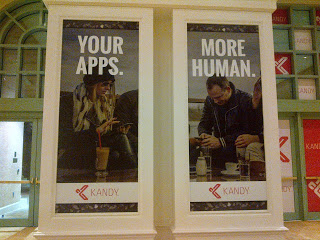
Now we get to Kandy, which is really the focus of their business now. We heard a lot about embedded communications being the key to survival for carriers, and if they don't get on board with the cloud and WebRTC, OTTs will continue taking their traffic, revenues and customers. All that's left will be a hardware-based network, and that won't get you much these days. On that note, I thought these posters in the hallway told the story pretty well. Today's customers want a personalized experience with apps they can use anywhere, any time and with anyone. That's kind of how we like to communicate as people, and not let technology get in the way.
Kandy is the solution by providing carriers a rich platform and ecosystem for delivering this experience and providing apps that customers will not only use, but will be happy to pay for. We certainly saw some great vertical market examples, so I have no doubt about what Kandy can do. It's just not clear to me what the revenue opportunity is for Genband and if it's enough to keep them playing at a high level.
4."We aim low and succeed"
Every conference has a special speaker, and Genband sure picked a good on in Sir Ken Robinson. I was hardly alone in not knowing him, but now I will avidly say you should follow him (@SirKenRobinson) and check out his writings on creativity and the education system. Great stuff here, and the "aim low and succeed" mentality really says it all. He spoke at length about how we're not really encouraged to be creative or even believe that we can be. With his classic British tongue-in-cheek delivery, Sir Ken made the point by telling how the music teacher of both Paul McCartney and George Harrison told them they had no musical talent back in their Liverpool days. Oops.
It's really about fostering a culture to encourage everyone to explore their creativity - it's not just the domain of artists. While his frame of reference is the education system - and how it's been failing us this way for generations - it applies equally well in the business world. Large organizations tend to stifle creativity for all the wrong reasons, and when you connect the dots back to what Kandy is doing, there's an important message here for carriers. As David Walsh noted, let Kandy do all the heavy lifting, which frees you up to focus on what customers really need - that's where and how carriers can be creative and create the new value needed to protect their base.
So, don't underestimate your imagination and creative energy - it's in all of us, but you need to deploy all your senses to fully tap it. As Sherlock Holmes would say, seeing and observing are very different, and when you take advantage of all the tools around you, that's when amazing happens. To inspire you, here is a great clip that Sir Ken shared with us - if this doesn't wake you up to what's possible, then you're spending way too much time staring at screens rather than the world around you.
Finally, as is the Genband way, we got our fill of classic rock later that night. This year it was Kansas, who are still going strong - wow. Was never a fan, but they sure put on a great show, and sound just as good as what I remember hearing way back when. I really enjoyed seeing them, and this makes for a good coda - again, pun intended - to my post.
Playing music is my big passion, and seeing them was a good reminder of how music is unique in its ability to produce collective creativity. When you create something special as a group - as Kansas did - you keep it going as long as the energy and passsion is there. As an aside, this holds some truth for the management team David Walsh has put together, as trust and familiarity is a big part of keeping the creative process going. The big picture message, however, is that organizations - telcos - have tons of creative potential, and with the right culture, it can keep them competitive for years to come.
Coming back to Sir Ken, he talked about how this collective creativity differs from individual creativity, and sticking with the music theme, he noted how the music of the Beatles was greater than the sum of its parts. Sure, they all had good/great solo careers, but those will always be overshadowed by what they achieved together. That's another topic I'd love to riff on, but we'll leave it at that let's just stay calm and carry on my wayward son. How's that for tying all these threads together?
I've been operating fairly locally lately, but have a short trip next week. From Monday-Wednesday, I'll be Genband'sPerspectives 15 conference in Orlando. It's still pretty cool here in Toronto, so no complaints about heading south.
The company continues to push ahead, especially in the cloud applications space, and it will interesting to see what kind of traction their PaaS offering, Kandy, is getting. Genband is hardly alone among vendors transitioning from legacy-based hardware to the new worlds of software and the cloud, and Kandy will be a good barometer of that.
As a benchmark, here are my takeaways from last year's event, and I'll update that as best I can while in Orlando. If you care to follow on twitter, my handle is @arnoldjon, and the event hashtag is #GBP15.
Time zooms along, and while I haven't been travelling much lately, I have five industry events over the next five weeks. Am doing a shout-out now for the CTCA's annual spring conference, being held this year at Hockley Valley Resort. It's a great time to be there - about an hour north of Toronto - and unlike last year, there won't be any ice still on the lakes - but the Stanley Cup playoffs will probably still be going! Canada, eh.
If you follow me, you may recall that I keynoted at last year's conference, and this time around I'm sharing the stage with a few others. On the second day, I'm part of a "blue ribbon panel" - gotta like that - on the "future of our industry", which includes fellow UCStrategies Expert Steve Leaden. Not only does Steve know his IT/telephony, but he keeps great time on the drums for the SIPtones. I'll be guesting with them the week after on keyboards at the Interactive Intelligence event, but I digress. More about that later.
Also since last year, I've finally joined CTCA as an Affiliate Member, so am doing my part here to promote both the association and the conference. We'd love to see more attendees, so to learn more, here's the current conference program outline. Updates are coming, but there's plenty there to help you decide about coming up to Hockley Valley, and from there, the main website provides full details on registration and how to get there.
Not as busy as March, but still plenty of things keeping me busy. Here's a digest of my top posts from April in case you don't follow the various sites I'm published on.
Got back late last night from Austin, and took away some strong messages from Cisco's collab event the past couple of days. I addressed two of these in my current contribution to the UCStrategies portal, and it's just been posted, so I hope you run over to read it now.
Basically, I see UC facing similar challenges to the contact center, and for the latter, Cisco has lot on the ball now, especially with their focus on omnichannel. They are definitely being strategic in this space, and while UC is part of the story there, UC has its own issues finding a niche as a standalone solution. My post talks about two things Cisco is doing with contact centers that all UC vendors could stand to apply to their plans. That's my teaser, and for the rest of the story, head over to the UCS portal.
This is the second post about adoption
barriers, with both being part of my broader series titled Collaboration
Insights. Overall, this is the fourth post in a five part series, where I’ve
been examining issues and opportunities to help enterprises move forward with
collaboration technologies.
No matter which way you turn, there are challenges, but
vendors are doing a pretty good job of developing solutions that speak what
businesses need from their teams, as well as how people are communicating with
today’s technologies. There’s a lot of complexity for sure, but the biggest
barriers are internal, both in terms of your culture and how you think about
collaboration. The latter point is where this post picks up the thread.
Next steps – thinking boldly and differently
When you can position collaboration as an enabler for these
kinds of business outcomes, it becomes very strategic. Clearly, these are desirable outcomes for any
business, but are difficult to measure, which is exactly the holdup with the
collaboration concept. However, this difficulty won’t stop management from
allocating resources to achieve these outcomes, and by demonstrating the
strategic role that collaboration can play, the adoption barriers will become
much lower. Not only that, but if IT can craft such a vision for collaboration,
then IT will likely get to “own” it.
To do that, IT may have to think differently, and that’s the
impetus for this series. If you believe that “owning” collaboration is the best
way to drive adoption across the enterprise, then you better be able to
deliver. Creating such a solution is not normally the forte of IT, so the onus
then falls to the vendor community. If the path I’m advocating is new to you,
then you might need to reconsider your existing vendor relationships.
Most vendors do not have organically-developed collaboration
platforms; rather, they are an outgrowth from point applications they have been
selling forever. Standalone applications are not the answer here, and if that’s
their core DNA, you’ll need to carefully evaluate how well they understand your
need for collaboration to drive business outcomes. Otherwise, to keep your
business, they may try to make your needs conform to their offerings, but
that’s the opposite of what your vision requires.
Another aspect of thinking differently pertains to how you
would manage this. Presuming you have found the right vendor with the right
solution, you may face internal operating constraints, especially for your
network. If you’re accustomed to owning and managing your IT resources, you may
expect the same for collaboration platforms.
Given the complexity of today’s technology – and considering
the strategic benefits outlined above – you may also have to accept that your
collaboration platform is better managed from the cloud, especially if your
resources are being pared back. Now you start thinking in terms of the PaaS or
IaaS model, where the ability to integrate various communications applications
comes from offsite, but is still very much within your purview. Along with this
comes a shift from Capex to Opex, which could actually make your vision easier
to sell to management.
Now, this becomes a strategic IT consideration, where you
leave the complexity to the vendor, and focus instead on making a tighter
connection across the organization between your collaboration solution and how
it can drive business outcomes. That may be a big leap from your current
situation, and again, will impact the kind of vendor you’ll need to partner
with.
You may think I’m asking a lot here, but the stakes are
high, and the results are worth it for everyone involved. If this is what you
believe collaboration can do for your business, then you have to make it
strategic for management and you have to be strategic when considering the
vendors.
Conclusion
Part 1 talked about seeing the whole as more than the sum of
its parts when it comes to collaboration applications. This is not easy to do,
and poses an adoption barrier for truly effective collaboration solution. As
long as each application lives in its own domain, they will remain great point
solutions, but not part of something bigger – something that’s strategic rather
than tactical. The key take away from that post was for IT to make
collaboration strategic, and doing so involves tying this to business outcomes.
These are the results that management values, and their buy-in is necessary for
this strategic vision.
This post builds on that by addressing the need to think
differently. Status quo thinking is likely a key reason why collaboration
solutions have had limited impact to date. Making communications easier is not
enough to become strategic; collaboration needs to drive business outcomes and
to sell that vision, IT needs to think differently. Of course this entails
risk, but the upside is worth it, not just for the business but for IT’s future
as well.
For clarity, please note that this Collaboration Insights series is
sponsored by Cisco Canada, but the content is my own, and by design is
vendor-neutral.
GetVoIP.com is a pretty handy resource for decision-makers looking for solutions in our space. They serve as an independent information clearinghouse of sorts, where buyers can find the right offerings and determine the best ways to compare what's out there. They rely on analysts like me for industry-based perspectives on core communications needs that all businesses need to stay current with - UC, hosted VoIP, SIP trunking, contact centers, etc.
I've written for them occasionally, and one way they support the buyers is to profile the top thought leaders. Everyone has an opinion on the Web - but in most cases, nobody is asking for it (which doesn't seem to deter most people) - with the result being an impossible ocean of viewpoints that decision makers could draw upon for guidance. To make that a bit more manageable, GetVoIP puts out their top lists from time to time, with the most recent being for UC.
In case you haven't come across this yet on social media, I'm blogging about it here. I'm happy to report that I'm in their "Top 50" list, and if you had the time to peruse the whole group, you'll probably end up making some really good decisions. And if you play your cards right, it won't cost you a penny.
Of course, analysts like me are always available for hire if you need more strategic expertise, and I'm just an email or phone call away from taking your business to the next level. For now, though, my one piece of free advice is to check out the list, and keep regular tabs on GetVoIP.
The stars haven't lined up for me lately to get on a UCStrategies podcast, but they did last week, where the topic was the mid-market opportunity for UC. We certainly spend a lot of time on both sides of that space, with smaller scale SMBs being price-driven, and larger scale enterprises dealing with complex network environments.
The mid-market is really neither of these, and once you understand their needs, there's a distinct opportunity for UC vendors and channels. Avaya has been focusing there lately, Lync has a strong play, and vendors like Mitel, ShoreTel and NEC are right at home serving these customers.
We covered the ground during out podcast session, which was led by Phil Edholm. All told, 10 of us weighed in with our views, and my comments start at the 24:29 mark. The replay has now been posted to the UCS portal, including start times for each speaker if you just want to catch what specific UC Experts had to say.
Another shout-out here for my next Ziff Davis B2B webinar. They've been keeping me busy lately, and this time around, I'll be addressing the hosted VoIP opportunity for SMBs. Their webinars are always well-attended, and am expecting more of the same next Tuesday.
Well, sort of. Everyone needs to put thought leadership out there to enhance their brand, and few things grab attention more than looking into the future. It's always fun to speculate, but at the rate things keep changing, I'd be happy predicting accurately six months out.
Anyhow, this is one of the ways analysts stay busy, and Mitel recently polled a bunch of us for our thoughts. As you know, Mitel recently went through some serious re-branding, and it's still early to say where/how it's paying off. Well, they've pulled all this together, and the results have just been published in an e-book format.
I'm in there, along with several others you likely follow, so this provides a nice cross-section of views, including off-the-floor predictions from Enterprise Connect 2015 attendees. That's a lot of free advice, and the price you pay is viewing some promotion at the end showing case studies of how Mitel customers are solving problems using all the wonderful technology we've been crystal balling about.
Fair enough, but overall, it's a good read, and of course, a great way for analysts like me to share our views on where technology is going. You can download the e-book here, and if you want to chat further, drop me a line any time.
This is the third post in my
Collaboration Insights series, and since effective collaboration eludes so many
companies, I wanted to examine the barriers to adoption. Despite the widespread
availability of so many applications that enable collaboration, the results
often fall short. While it’s easy to blame this on the technology being complex
and/or costly, or limitations on the network/IT side, there are other factors
at play. One such factor is tying collaboration to business outcomes, something
you might not have considered.
Generally speaking, the easier
something is to use, the more often people will use it. The same is also true
when the benefit is clearly understood. Think about the telephone – everyone
knows how to use it, and the benefits are clear. The same can be said for most
communications applications, such as email, messaging, many forms of
conferencing and even fax. They’re all easy to use, and each has a distinct
benefit – or use case – that drives their usage.
With today’s technologies, there’s
no reason why collaboration can’t be the same. Vendors understand the
importance of making these platforms easy to use, although some do it better
than others. The bigger challenge, however, lies in the benefit, as
collaboration results are hard to measure. After all, collaboration is the
collective result of using various communications applications in an integrated
fashion.
Bigger than the sum of its parts
You can’t conclude that a
collaboration session was a success because the call quality on the voice
connection was great, or the presence engine made it easy to pull the team
together, or the conferencing features made it easy for everyone to join a
meeting despite using different endpoints and networks. All of these play a
role, but you can’t equate success with any one in particular.
In this regard, collaboration is bigger than the sum of its
parts, and that creates specific barriers to adoption. As noted in
my last post, the point applications that comprise a collaboration platform
each have their own standalone worlds within an enterprise. Telephony is
managed by one team, fax by another, video conferencing elsewhere, mobility
somewhere else, etc. Each is in a silo, with distinct performance metrics and
budgets managed independent of the other communications applications.
Each point application is owned, so to speak, by a team with
a budget, and that budget is based on hitting specific metrics. This is very
much a legacy model that keeps silos in place, but has no real strategic value
to the business. The value is very high tactically,
and that’s actually an adoption barrier for today’s collaboration solutions.
Collaboration is strategic, end of story
When you think of collaboration this way, it’s easy to
understand why adoption is challenging. Collaboration isn’t tangible like the
point applications that comprise a solution, and as such, nobody really “owns”
it. The IT group may own the collaboration platform that they acquire from a
vendor, but the results that come from collaboration are all driven by end
users. Since end users don’t have an economic stake in that platform, they
don’t have much incentive to use it, which creates a barrier to adoption.
This is where business outcomes come into play, providing a
path for IT to tie these loose ends together. The first step is to start
thinking of collaboration as being strategic. Point applications are tactical,
and don’t play well together inside the enterprise, which runs counter to the
collaboration concept. Strategic resources need to be evaluated differently,
using benchmarks that are strategic, not tactical.
The next step is to demonstrate how collaboration can drive
business outcomes that have strategic value to the business. Strategic
benchmarks can be based on
P&L-style metrics, but when management is focused on creating strategic
value for the business, other things will carry more weight, such as:
·Faster time to market for new products/services
·Better quality products that last longer,
perform better, don’t break down, etc.
·Easier to do business with – both for customers
and partners
·Improved customer satisfaction by providing
great experiences and personalized service
·Happier employees by supporting their preferred work
style – better morale, performance and retention
·Driving innovation to improve processes,
workflows, product quality, customer experiences, etc.
·Inspiring invention to create breakthroughs for
competitive differentiation
This is what you need to do to make collaboration strategic,
but there’s more to the story. When it comes to breaking down adoption
barriers, you also need to think differently. Old habits are hard to break, and
that will only happen when you can show there’s a better way with today’s
technologies. You’ll need a vision, and that’s where I’ll extend this topic in
my next post in this series.
For clarity, please note that this Collaboration Insights series is
sponsored by Cisco Canada, but the content is my own, and by design is
vendor-neutral.
Just a quick update post - am driving to London, Ontario shortly for a one-day seminar focused on Unified Communications. Industry colleague Emily Nielsen is behind this - her firm, Nielesen IT Consulting is running this in partnership with MISA Ontario and Middlesex County. The event is small - I'm told the room is at capacity - but will have a strong regional flavor. It's mostly for the public sector, and that vertical is ripe for what UC can offer.
Emily and I are co-presenting tomorrow morning about the reasons to move ahead with UC, along with a reality check covering the challenges. Despite living in Toronto, I don't get in front of Canadian audiences all that often, so am looking forward to hearing what's really on their minds. Plus, London is home to Western University, my undergrad alma mater, and if time allows, I'd love to visit the campus - it's been a while!
Maybe my busiest month ever in terms of the amount and variety of writing that's out there for public consumption. More of the same coming in April, so plenty of research and writing work to keep me busy. So, here's a digest of the best examples I think you'll enjoy if you didn't catch them first time around.
I've been doing a few things around last week's Energy Thought Summit in Austin - some that's strictly smart grid, and some that weaves into the UC/collaboration space. Let me get to the latest item, and then I'll steer you to a few other things to provide the bigger picture.
I just wrote a post-ETS piece about education, and how this was a strong, but subtle theme running throughout the event. There's a big concern that not enough kids are going into the science and engineering disciplines - both in grade school and beyond - and this is the lifeblood driving the energy economy, especially among utilities. My article is running now on the ETS Insights portal, and if you're wondering where tomorrow's energy leaders will come from, I think you'll enjoy it.
Given my core focus communications tech, my perspectives on smart grid/energy are a bit different from those that live in that space 24/7. Since ETS is done now for a while, I thought it would be useful to pull all the various things I've been doing lately around that space to add a few layers to the above post.
First, from today's earlier blog post, my thoughts on smart grid parallels to the UC space on UCStrategies
Whatever you care to read, I greatly appreciate your time, and if this sparks any idea or dialog, I'm all ears.
J Arnold & Associates
J Arnold & Associates is an Independent Technology Research and Analyst, helping businesses understand the strategic value of communications technology as they adapt to the digital transformation of work