Aculab Cloud and BLI Messaging case study – a match made in the cloud

As you may know, Aculab is a recent sponsor of my blog, which is one of many channels they are partnering with to promote their recently-launched Cloud offering. For me, this is an interesting opportunity to stay close to how a vendor goes to market with cloud, and my role is to support their efforts in a reasonably objective manner. I’m not here to do direct shout-outs for Aculab, but instead to provide higher level support to help the market understand the cloud value proposition.

One way of doing this is with a case study, and that’s the focus of this post. You can certainly read this at face value to understand how Aculab Cloud is being deployed by this particular customer – BLI Messaging. That’s fine, but what I really want you to do is step back and look at the use-case scenario and the business value that cloud provides.

With that preamble out of the way, let’s get to it. BLI Messaging is a pretty interesting company. They’ve been in the outbound messaging business over 20 years, and have a lot of history working with Aculab’s Prosody X cards. Just like Aculab, they know legacy, so there’s a very familiar frame of reference for anyone who remembers rotary dial, touchtone and dialup. All of these served their intended purpose very well for a long time, but nobody talks about these any more, and anyone under 30 will simply give you a blank stare.

I’m pretty sure Aculab saw the same thing coming, and five years from now, those 30 somethings will give you their world-weary “well, duh” response when talking about putting telecom applications up in the cloud. Sure, there’s a generational thing going on here, but the cloud is clearly carrying the day lately, and it seems like the logical destination for almost everything to do with communications.

Don’t get me wrong – I’m not here to say the cloud is the killer app (remember that term?) that renders all forms of hardware obsolete. I have my share of concerns about the cloud – security and privacy in particular – but there are many cases where it simply is a better way to go. After doing some research and interviews with BLI Messaging, I’m definitely of the view this is one of those cases. No doubt this is a good showcase for Aculab, but I think it plays even better to the intrinsic strengths of what the cloud has to offer.

Let’s just look briefly at the business – BLI Messaging provides high volume, time sensitive messaging and notification broadcasting for a wide range of clients. With just that simple overview, am sure you can see where this is going. Think about simple scenarios like school closures, polling station hours on Election Day, or public health announcements for flu shots. Outbound messaging and notification is a special type of business, and BLI Messaging has been doing this a long time across various modes – telecom, fax, email, text, etc.

Some applications are more time sensitive than others, but the key is being able to deliver the message to the target audience in an efficient manner. For that to happen, a lot of back end processes have to go right, and that’s where partners like Aculab come into the picture.

In the legacy, hardware-based world, more advance planning and programming was required, and notifications took longer to get done. Furthermore, these applications were difficult and costly to scale, making it more challenging to change plans in mid-stream. Notifications were certainly getting done, but not in the most optimal, responsive manner.

Both Aculab and BLI Messaging recognized these limitations, and moving to the cloud last November together has been a good idea all around. Thinking about Aculab’s customer, BLI Messaging is in a business that highly values responsiveness and scale. While many messaging requirements have manageable lead times, the ones that really define success require short notice, high volume communication. To do that, BLI Messaging needs a platform with a solid, scalable back end that lets them focus on quickly developing the applications that address the needs of their customers.

With Aculab hosting the virtual infrastructure in their cloud, BLI Messaging doesn’t have to worry about scaling. They only pay for the network capacity consumed – no more, no less. In the legacy world they would typically oversubscribe to buy more capacity than needed to ensure that all messages could be delivered. This got the job done, but sometimes added unnecessary cost. In that regard, the cloud model is more cost effective, and cuts out the Capex that previously would have been tied up in BLI Messaging’s own data center.

Furthermore, the cloud shifts the bottleneck from onsite hardware out to the carrier networks. The customer is no longer tied to the hardware interface now that it runs in the cloud. Capacity issues now rest with routing among carriers, and this is where the cloud and IP networks really add value. If there is a last minute need to ramp up the volume of messages, BLI Messaging can dynamically move traffic from one carrier or reseller to another if there’s congestion. Not only that, but traffic can seamlessly be shifted within a carrier’s network if problems arise. For example, if a carrier’s Chicago POP is down due to a power outage, the traffic can be routed to their operational POP in Dallas.

The key here is having flexibility to move on the fly and meet short order customer requirements. Sometimes there’s an urgency for business purposes, but there are also more pressing requirements that emerge without warning such as serious traffic incidents, community health alerts, school/campus lockdowns, extreme weather warnings, etc.

In short, Aculab Cloud allows BLI Messaging to be more responsive and proactive with customer requirements. The cloud also lets them focus on where they add the most value – developing messaging applications that help solve real business or communications issues. One example that came from my research with BLI Messaging is patient compliance in healthcare. Practitioners face a variety of challenges around the simple fact that patients don’t always follow their prescribed treatments and medication schedules.

Think about the value that comes from sending automated voice or text messages to individual patients with reminders to take their medication or attend their physiotherapy session. An advanced application would take this one step further by triggering an alert back to the physician who could initiate remedial action, especially if the patient is in danger. When done on a large scale, there can be a substantial ripple effect of benefits throughout the patient care value chain.

Moving beyond healthcare, how about adding mobility to the messaging equation? Think about the near real-time possibilities for GPS-enabled notifications. Once you get past the opt-in feature, a world of opportunity opens up here for messaging, both for purely commercial purposes as well as public service announcements. Advances in mobility aside, it’s the dynamic, scalable and rapid response ability of the cloud that really makes mobility an exciting space for companies like BLI Messaging.

Bottom line, with Aculab Cloud, BLI Messaging can pitch bigger customers and provide higher value applications, especially those that are time sensitive. In today’s 24/7, 140 character instant information world, this capability can be a real differentiator. Theirs is very much an on-demand business, and that’s exactly what the cloud works best for. Time to market is important, especially with the short shelf life of notifications, so the faster BLI Messaging can execute, the happier their customers will be. Pretty simple. Messaging may not be the first thing that comes to mind with cloud, but it totally makes sense to me, and if you’re with me on this, then I’ve done my job here.

Busy in a good way

Blogging has been off and on lately, but that's because I'm busy, with some new projects and writing gigs.

If you saw my ShoreTel/M5 analysis a couple of weeks back, that helps explain my busy-ness. I've never had a post get this much readership, and if I could somehow sustain those numbers here, I'd have a pretty lucrative blog!

Following that, last week's post about the opportunity I'm seeing now in cloud-based video conferencing has also kept me busy, and you'll be hearing more about that space here in due time.

Starting next week, you'll start to see some new content here around collaboration that I'm doing now as part of a broader thought leadership program for a major vendor.

I'm also about to start a monthly column with a publisher you all know. For now, all I can say is that it's titled Rethinking Communications - my first piece has been written and it will run in their May issue. Stay tuned.

Otherwise, I have some new custom projects on the go, and as the deliverables become public, you'll hear about them here.

Also, I'm pushing into a new focus area - helping companies monetize their patents and intellectual property (the other IP). It's a natural fit for the circles I travel in, and if this is on your to-do list, I'd be happy to tell you more.

Back to work...

Enterprise Connect Preview/Big Data

On this week's UCStrategies podcast, the topic was what to expect at Enterprise Connect, coming later this month in Orlando. I won't be attending, but many of my UCS colleagues will be presenting there, so the podcast was a good opportunity to share all this in one place.

It's a major event in the UC space, and all the Tier 1 players will be there. UC is one of several themes they'll be covering, and you'll get a good sense of the landscape from listening to the podcast. While I had nothing to add about the sessions, I was able to contribute some broader thoughts towards the end of the podcast.

Basically, I brought Big Data into the discussion, as I'm seeing this as an emerging need for enterprises get a handle on. I think it's a huge opportunity, especially for UC, which can add a lot of value if used in the right way for Big Data. We're generating far more information than anyone knows what to do with, and the real-time nature of UC puts it right in the middle of where the most vibrant communication is happening in the enterprise. My sense is there will be some discussion of Big Data at Enterprise Connect, but I'll bet it will be right up there with cloud and mobility next year. You heard it here first!

The podcast has been posted now, and was hosted by Marty Parker - here you go, enjoy.

ShoreTel/M5 was good news for voice, but perhaps even better for cloud-based video - why the time is right

I recently posted about ShoreTel’s acquisition of M5 Networks (which is still getting tons of readership!), which may signal the strongest validation yet for cloud-based VoIP as an alternative to premises-based telephony systems. The deal is good news for both companies, and even better news for the broader cloud communications space. ShoreTel’s move spells out a few realities that I think are becoming important drivers for everyone – vendors, service providers, businesses – especially SMBs, and the investment community.

First is the fact that ShoreTel had a simple make or buy decision on its hands. They have a healthy premises-based business, but have read the tea leaves, and recognized the need for a cloud-based offering sooner than later. ShoreTel is not known as innovator, so they did the smart thing and bought the best company on the market. Not only does that give them an instant entrée for cloud services, but they now have M5’s rich expertise in-house, which will now be their engine to keep the offering fresh. That’s a pretty good model for competitive differentiation, and is far more of a sure thing than trying to build it internally and hope the market buys it.

On top of that, the investment community now has a valuation benchmark based on what the market will bear for cloud-based communications at this early of its lifecycle. If ShoreTel can makes things work with M5 – and it’s theirs to lose, really – the pressure will be on for competitors to keep up, and with so few cloud VoIP players of substance out there, the deal values will jack up just to get into the game. That’s when things will get a bit crazy for everyone but ShoreTel, whose first-mover gambit may prove to be a bargain. Nice storyline, huh?

In case you’re wondering where I’m going with this, it’s not about VoIP. As promising as things sound for cloud-based VoIP, telephony, voice, etc., there’s an even better opportunity shaping up for video. Since attending the ITExpo in Miami, and a few other things since, I’m of the mind that ShoreTel/M5 is setting the stage for a similar run in video. Not quite yet, but when the stars line up, the story will unfold pretty much the same way.

We all know that video is complex, and people aren’t generally comfortable using it as an everyday mode like telephony. Fair enough, but desktop video – especially when SIP-based – has come a long way, and is ready for prime-time. Indirectly, we can thank smartphones and tablets for that, as their off-the-charts adoption has helped make video more mainstream. In a business setting, however, the stakes are higher, as interoperability creates even more challenges than ease of use.

To date, legacy video has been expensive, complex, reservation-based and proprietary. In an ideal IP-based environment, the exact opposite for each is true, and businesses are starting to get a taste of that with a few early stage cloud-based offerings. ShoreTel/M5 is really just another step along the way for validating the cloud as a viable platform for business communications and collaboration solutions. Every telecom and UC-focused vendor is trying to develop some form of a hosted or cloud-based offering; some incorporate video, but it is never the lead application.

This leaves room for cloud offerings built specifically around video, which is now mature enough to manage as a standalone offering. The great thing about cloud is how easily you can offer on-demand services, which video is very well suited for. Just like M5 is a leading example of cloud-based VoIP, there are offerings carving out the same niche in video. There are two pureplays on my radar here – Vidtel and BlueJeans – and either – or both – could have a similar exit to M5 if things go well. More importantly, this market is moving so quickly now, and should that happen, I can guarantee you it won’t take 10 years like it did with M5.

While it won’t take as long, video does have different technology issues and business drivers than voice. Unlike VoIP, video is really hard to give away and still make money. There are too many variables in terms of network compatibility/traversal, codec support, endpoint support, quality of experience, etc. That said, there certainly are lots of other vendors who are gaining traction with varying degrees of cloud-based video conferencing services for SMBs and enterprises – such as Nefsis, Vidyo and Glowpoint.

With the lines blurring between personal and business services, you also need to think about consumer-focused plays like TokBox and ooVoo. I don’t see them taking much business away from the other vendors any time soon, but these days, we’re seeing a lot of consumer-based applications finding their way into the business space. Just a thought.

Anyhow, what I’m getting at are business models. Clearly, there are viable ways to offer cloud-based video services, and awareness is quickly building in the business market. As mentioned, video has more wrinkles than voice, and in terms of having success, I think the basic technology is secondary to the business models and paths to market.

As with voice, video must compete with the free offerings that serve the bottom end of the market. The likes of Skype and Google can and will serve that market, simply by virtue of being a click away for their hundreds of millions of users. Nobody can compete with that and make money, so let’s just take that as a given. These offerings are fine for ad hoc sessions, but most businesses want something that’s higher quality, more scalable and more reliable – and plenty of them are willing to pay for it.

At the top end, of course, we have premises-based systems, with immersive telepresence being the gold standard. It’s a fantastic experience, but so is driving a Porsche, and that’s not a realistic option for most businesses. Cisco may be doing big business with telepresence, but there’s a huge middle earth that can’t justify the cost, but also want something better than free. That’s the opportunity that the likes of BlueJeans and Vidtel are chasing, and I think 2012 is going to be an inflection point here.

Just like the early days of VoIP when AT&T and Vonage spent heavily to create awareness and interest, the buzz coming from both the top and bottom ends of the video market will be good for everybody. Smaller vendors will benefit from the boost in awareness, and as video becomes more demand-driven, the business models will become more stable.

Coming back to paths to market, the pureplays – Vidtel, BlueJeans, etc. – are actually one of three basic options. Of the other two, one is vendor-based and the other is operator-based. Briefly, along with Cisco, we have the usual suspects such as Polycom and Lifesize. They all provide a great user experience, but of course are expensive, and while all advocate being open, they work best with an end-to-end setup. On the operator side, it seems like everyone is getting into the act. Notable examples include 8x8 and Telesphere, and of course the customers of BroadSoft and Metaswitch can all go down this road now.

Higher up the food chain, there’s OVCC – the Open Visual Communications Consortium. This is a great way for the likes of AT&T, Verizon, BT, Orange, etc. to tap into this market, but there’s also a strong vendor element to OVCC, led by Polycom, Acme Packet and Dialogic. A cynic would say, pick your poison, as both of these broader-based options have varying degrees of vendor lock-in.

A true cloud-based service is vendor-agnostic, and works across all platforms and endpoint scenarios. That’s exactly where Vidtel and BlueJeans are zeroed in, and this should prove to be pretty fertile ground. No doubt, lots of businesses will go with the name brand vendors and carriers, especially if they’re just dipping their toes into the cloud. Fair enough, but there’s a growing segment who are ready to go further and want the full range of choice that a cloud pureplay can provide. In other words, being able to use video with different endpoint vendors, fixed or mobile devices, Web-based platforms like Skype, and connecting between IP and legacy networks, protocols and codecs (SIP, H.323, H.264, etc.).

It’s early days yet, but each company is pursuing different paths to market, and I think this should be closely followed as a barometer for what’s the best way to drive the adoption of cloud-based video. In short, Vidtel is relying on channels, whereas BlueJeans is mostly going direct and getting businesses to sign up with them on their own. This is the classic fork-in-the-road scenario from telecom, and there is definitely a place for both here – and that may turn out to be true for video.

Following these paths, Vidtel relies on partners to leverage their relationships and footprint with business customers. This group is a mix of video-centric VARs, video vendors (remember, Vidtel and BlueJeans are cloud platforms – they provide the network and virtual infrastructure – not the endpoints) and service providers who want to add video to their portfolio – ideally on a private label basis. BlueJeans, on the other hand, is building business one win at a time. By using various forms of advertising, they can quickly build up a customer base that’s theirs.

Ultimately, I think the market will decide which model works best. I think it really comes down to trust, and that’s where I think channels have the upper hand. If they have good relationships in place, adding video isn’t a big leap, especially if it’s under their own brand. As far as I know, BlueJeans does not support private labeling, as they prefer to own the customer – which creates natural conflicts if/when channels are involved. Vidtel avoids this issue, and being a smaller player, is happy to go with the flow and take their wins any way they can. On that note, it’s worth mentioning that Vidtel’s pricing is lower than BlueJeans, which itself can be another driver for adoption. Not only that, but this provides more room for channels to add an attractive margin and still be competitive on price.

Another consideration in favor of the channel is their ability – and desire – to integrate video with UC platforms. This can be a great way to strengthen the customer relationship and give them as much of a collaboration solution as they like. Furthermore, Vidtel supports both H.323 and SIP, giving channels more flexibility to work with clients who have a mix of legacy and IP in their network.

This is much harder to do when taking the best-of-breed approach by going direct with BlueJeans, at which point you’re on your own to bolt this on to whatever UC or collaboration platform you’re using. On the other hand, if what you want is an affordable, easy to use cloud-based video service, it’s hard to go wrong with either offering, and no doubt, BlueJeans will serve this niche especially well.

For either vendor, the appeal is pretty simple. Businesses can adopt video with their existing infrastructure, and not have to worry about making all the pieces work, regardless of which endpoint vendors they have, or which carriers they use. Relative to what businesses will spend going with the likes of Cisco or Polycom, both BlueJeans and Vidtel offer great value, and more flexibility to work out of the box with pretty much any current environment. So, for now, let’s watch as the big players seed the market with their push into the cloud, and hopefully along the way, the value proposition of these pureplays will bubble up and gain their fair share of this wide open opportunity.

Disclosure – I am an Advisor to Vidtel, but feel this post has been both fair and objective. I have been careful not to show bias here, and have deliberately stayed away from any in-depth analysis of the companies discussed herein. My main intent is to highlight the broad opportunity for cloud-based video and the pros/cons of the two main routes to market. Your comments are duly welcomed.

Smart IP makes for smart cities

I happened to see the New York Times yesterday - yes, I still read newspapers - and so should you! The feature story in the Sunday Business section caught my eye right away; it was about what IBM is doing to help Rio de Janeiro become a smart city. We're hearing a lot about Big Data lately, but mostly in the context of helping enterprises or institutions manage the impossible web of data that's a natural byproduct of the "Internet of things".

Well, if you think that's a challenge, try doing this for an entire city. That's what this article was about, and with Rio being a big city, the scale is mind boggling. Just like we've seen the rise of the CIO in the enterprise, we're going to see an equivalent role emerge for cities, as super-smart operations centers become the nerve center to coordinate and manage the services that make cities run. I don't think the job function truly exists yet, but it's coming, much like we're seeing nations having CTOs now. With so much information to manage, there's a lot of accountability involved, and as humans, we simply need a point of contact to effectively deal with it.

If this is news to you, it's a fascinating read, especially regarding the role that tehcnology companies have to play. For Rio, IBM is the lead partner, and they have a business unit built solely around this emerging opportunity - Smarter Cities. Cisco is another familiar face that is heavily invested here, and I'm one of a handful of analysts closely following their Smart + Connected Community practice. This is a natural outgrowth for my interest in Smart Grid, which is a key element of these initiatives. I always saw Smart Grid a repeat of what telecom went through with IP, and the underlying networking and communications technologies used there also have a huge role to play in making cities smarter.

There's a fantastic opportunity here for the likes of IBM and Cisco, but of course the bigger and more complex the project, the higher the stakes. Cities know they need to be smarter, more responsive, more agile, better connected, etc. - but often lack the capital resources, technology vision and political will to make it happen. So, here come the vendors, often with a myriad of strategic partners in tow to provide a complete turnkey solution.

This is way more complicated than updating a LAN, so it very much depends on forging new partnerships that mesh the needs of both public and private sectors. To me, this borders on statesmanship - and not just good sales and marketing - especially being so new and with a very short track record of ROI. The stakes are high, but the world is urbanizing faster than we know how to manage, and it's pretty clear that cities need these capabilities. I'll be following closely here, and if you give this article read, I think you'll be too.

Changing role of IT - UCStrategies podcast

It's been a challenging week to get blogging done, but I did want to share this week's UCStrategies podcast here. The topic was how the Millennial generation and BYOD are impacting the role of IT. There's a lot going on here, and I wanted to be sure you know about the podcast.

I didn't participate, but there are plenty of good insights here from folks who work closely with IT and have first hand knowledge about how these developments are playing out. Of course, there's a huge generational shift happening, and it's no different than the divide in telecom between legacy Bellheads and today's Internet-savvy engineers.

Many of these changes are coming faster than IT is able to react, so there's a Darwinian theme to all this, which can be pretty scary. So, if that's got you on the edge of your seat, then hop over to UCStrategies now. Michael Finneran is the host, and has also provided a transcript if you'd rather just read instead.

Metaswitch launches Accession at MWC

This is Super Bowl week in the wireless world with Mobile World Congress, and everyone there is trying to get and keep your attention. I'm not at MWC, and I don't usually post about launches tied to the event, but I got an advance briefing of Accession, Metaswitch's latest value proposition for mobile operators.

It's a heady word, and a lot of interesting ideas to kick around, but the overall spin for Accession is pretty good from what I can tell. The goal is clear, and operators know they can't drop the ball with mobility - the field is shifting too fast to stand on the sidelines and watch subscribers figure things out without their carriers coaching them along. If you happen to drop by Metaswitch's booth, you'll know why I'm saying these things - otherwise, let's just punt this para and move on.

So, if you want to get into the details, go straight to the Accession website, and the easier-to-digest press release that ran this morning. There are lots of new acronyms in this tech-heavy announcement, but the standout for me is IMT - Immersive Multimedia Telephony. Ultimately, this is about delivering a mobile experience that is as close as possible to what we get on our PCs or video monitors in the conference room.

That's asking a lot, I know, but Metaswitch understands the pain points of carriers, and mobile operators have a distinct set of challenges. Mobility delivers so much more utility than most fixed environments, and wireless operators know they have to move on from simple voice to keep subscribers happy. End user expectations are so high now, and the smartphone explosion has put operators in perpetual catch-up mode to upgrade their networks and deliver the services that make these must-have devices so popular.

As such, Accession is all about enabling an IMT experience so carriers can stay relevant with their subscribers. At the end of the day, operators really just have two things that matter - a phone number to assign subscribers and their trust. That number can be incredibly valuable if you can wrap all these other services around it - much like designating your favorite website as your home page. Accession does this in many ways, and I'll just cite a few examples.

One is how their platform is RCS and IMS-based, meaning that the subscriber's phone number can seamlessly connect across various mobile networks, screens, and support the modes we're used to on the PC - messaging, IM, presence, video, etc. Nothing really new here, but Metaswitch is positioning this in a way that makes the phone number more valuable. They've had good success with Thrutu, which now has 28 options to make the in-call experience richer. This adds a lot of stickiness and value to what once was an ordinary phone call, and provides the caller with the aforementioned IMT experience.

Another way they do that is enabling the operator to centralize the storage of the subscriber's contacts. So, whenever you update your contacts, those changes are propagated to all your other devices associated with your mobile number. Now things get interesting with FMC-type handoffs from mobile device to desktop softphone - or even other mobile devices - smartphone to tablet. Related to that is what Metaswitch calls the "new twisted pair", the idea being to twin your mobile device with your softphone for any screen, anywhere communications - but with the mobile number being the driver.

These capabilities are really important, not just to play in the emerging world of LTE, but also to co-exist with the OTT interlopers who are siphoning away minutes and revenues like never before. Savvy operators need to find a way to partner with those who are really in demand with subscribers, but also to add their own value and participate in the new revenues that LTE will make possible. Again, this is where that phone number has value, since all the subscriber's data and history are attached to it. So long as operators use that data responsibly, trust will be retained. That's other key asset they have, and it makes all the difference for getting subscribers to adopt new services.

There is a lot more to consider there, but the main thing for operators is that Accession can provide all this now, without the need to invest in new/costly hardware. OTT is both a threat and opportunity, and Accession opens up new possibilities, not just for operators to keep their fingers in more revenue pies - both from subscribers and advertisers - but also in creating new business models built around private labelled offerings that could in fact be done in partnership with OTTs. With the right moves, mobile operators can get the best of both worlds here - theirs and what OTTs are getting - and on that front, Metaswitch has a good story to tell with Accession.

Obama sings the blues - really!

You wouldn't know it from my posts these days, but music and film are my big passions - too bad they don't pay the bills. I used to blog about music, art and culture, but not so much lately. If writing was all I did, I would probably have about 6 different blogs for each of these things, but let's get real...

Anyhow, blues is my soul food, and even the President gets the blues. I came across this clip on CBC Radio's excellent new set of web music channels. They get it in terms of how radio is evolving and they have great streaming content for just about every type of music. Love it.

Back to 'Bama. Being Black History Month, the White House (how's that for irony?)hosted a mega blues jam, with a who's who of rock/blues royalty. As the site explains, the full concert will be broadcast sometime soon as a PBS special - can't wait for that.

Anyhow, Chicago is Obama's adopted hometown, and as this clip shows, Buddy Guy is running this show, and gets Obama to take the mike and sing a few bars of everybody's fave blues sing-along, Sweet Home Chicago. It's the most over-done song in blues lore, but it's the go-to song when you need to send the crowd home happy, and it's just so fun to sing.

My gut tells me this should be his re-election campaign commercial. If it worked for Clinton playing sax, it just might work here. If the blues isn't the people's music and the Democrats aren't the party of the people, then times must have changed. Take it away, Barry....


Cisco, Microsoft, Skype and Video Interop - Who's Winning?

We all know how high the stakes are getting with video, and Cisco's recent call-out to Microsoft for its plans with Skype and their proprietary applications has made this a hot topic. I would argue that MSFT has the potential to get the upper hand here, and if they find a way to integrate Skype with its business offerings - namely Lync - the desktop gains a big boost in becoming the locus for video. That's not what Cisco wants to see happen, so we've got a pretty important tete-a-tete shaping up here.

This is the topic we explored on this week's UCStrategies podcast, moderated by Dave Michels, who always has interesting things to say. It was a lively session, and is running on the site now - both in podcast form and with transcript.

ShoreTel and M5 Networks - Big Bet, Big Payoff

Remember Sylantro? GoBeam? There's DNA from these long-gone companies at ShoreTel, but I think it had a lot to do with their recent move to acquire M5 Networks. If you need a primer or a refresh on the details, you can start with our podcast last week on UCStrategies and go from there. I'm not here to rehash the news, but I do want to give you my take on the deal and what I think it means for the spaces these two companies play in.

Last week I had a chance to speak with executives from both companies, and that helped me piece together the rest of the story, which I think speaks to where things are going and how you have to respond in this fast-moving business. First and foremost, kudos to ShoreTel for thinking big and thinking out of the box. I'm pretty sure they realized that organic growth and incremental moves won't cut it to stay competitive. They need to make a bigger move - and a bolder move.

Given that ShoreTel's relatively new CEO, Peter Blackmore, was ex-HP - translation, hardware - one might think they would continue on that path and try to keep growing with premise-based solutions and channel programs. Fair enough, but I'd say ShoreTel's management also knows that the upside for premise is limited and margins are getting tighter. The company may be posting solid growth, but the profits aren't there, and investors won't stick with that formula long-term. So, how best to invest and build for the right kind of growth?

As we know, cloud is the big trend, and they're betting this will be the right answer. This is where GoBeam and Sylantro come in. Both companies were pioneers in the early days of hosted/managed telephony, with the former having gone to Covad/MegaPath, and the latter folded into BroadSoft. These may not have been the most lucrative exits, but it's real nice to have that kind of experience in a company like ShoreTel.

That's where M5 enters the picture. Their roots go back to the early days of those companies, and here they are 10 years later, with over 2,000 customers. To keep things simple, what we used to call hosted/managed, is now called cloud, and I'd argue no provider understands how to make money in this business better than M5. When you look at it that way, the deal is a no-brainer and makes perfect sense.

From a business and investor point of view, the main difference between the two companies is their business models. ShoreTel's core business is premise-based phone systems - in short, a capital expense where the revenues largely come upfront. M5 is selling a service - cloud-based VoIP, where the hardware is a nominal component. This is really an annuity business that delivers recurring, predictable revenue - cashflow to fund R&D, customer support and customer acquisition. Long term, M5 has a more profitable and sustainable model, and it's a great way build both the top and bottom lines for ShoreTel.

Without a doubt, the key to this equation is customer retention, and having had a long history with M5, I can say that churn is not their problem. Customer turnover data is pretty hard to come by in this space, but I'm pretty sure M5's churn is lower than their competitors. That's another important factor to note - this is a very fragmented and regionalized business, and while M5 is a fairly small company (about 200 employees), they're probably the biggest fish in the small pond of hosted/cloud-based VoIP providers.

At first glance, you have to wonder what is a telco vendor doing buying a hosted player? It's not that long ago these were very separate businesses, but they're chasing the same customers with a lot of common technology. Remember the early days of VoIP when it seemed like a radical idea to get your home phone service from a cableco? Doesn't seem strange today, and it won't be long until the telcos concede that whole market - gladly, btw - to the MSOs. If you don't think the same thing is going to happen with business VoIP - especially among SMBs, then you're not following me closely enough (or hiring me to re-think your strategy!).

So what are both companies getting here? Well, ShoreTel buys its way into a new market with lots of upside, and gets to shake up the landscape a bit. As with a lot of tech spaces, this was a textbook make vs. buy decision, and it's just way too late in the game for ShoreTel to replicate M5 - just doesn't make sense. So, if you're entering that market, go buy the biggest and smartest player. Done. It's a bit like free agency and baseball - sometimes you have to spend big to get the best, but if you lock them in long-term, you recoup your costs via better attendance and TV revenues.

Not only that, but ShoreTel has to look both ways in their market. For the domestic market, they only lag Cisco and Avaya, and Mitel is relatively close. Below them are all kinds of players - some are big companies with small shares, and others are just too small to worry about. ShoreTel will never catch Cisco, but Avaya has question marks - even post-Skype, and neither has what M5 brings to the table. Interesting, huh? As a sidenote, M5 also gives ShoreTel a nice boost in terms of market reach, as their presence is stronger on the West coast, whereas M5 is strongest in the Northeast.

M5 gets a great exit, and it's a great validation for cloud in this space. I've been assured that their homegrown switching platform can scale to the heights ShoreTel is dreaming of, and if there is any concern, it's keeping the culture strong. M5 is renowned for being customer-centric and being a small company themselves, they understand what SMBs need. This is a pretty special quality, and if they can scale that as the business folds into ShoreTel, they should be fine. I hope Mr. Blackmore leaves them alone!

Perhaps best of all is the fact that M5 exited to a vendor - and not a service provider. If you're an SMB, this is a huge sigh of relief, as M5 could just as easily sold out for even bigger bucks to an incumbent, but that would really be selling out. Just like ShoreTel is seen as a friendly alternative to the almighty Cisco, M5 is the great white hope for SMBs who otherwise would be hostage to their incumbent telcos. You don't think that has something to do with keeping churn low?

So, kudos to ShoreTel for taking the road less travelled. It's a risk, but now they can offer customers the best of both worlds. A lot of their customers are happy with premise-based systems - they're not ready for the cloud or they don't even trust it. Same for their channels. However, they know where the market is going, and can now offer cloud when these customers are ready, which of course keeps them in-house long term.

Of course, this isn't the only path available. Just look at Alteva - another leading hosted provider I've followed for a while - and their move to Warwick Valley Telecom. Nothing wrong with that move, but the deal was much smaller, and I think the upside will be too - unless Warwick ramps up by acquiring other telcos, but that's pretty hard to do.

That brings me back to thinking bigger and bolder. I think you need to do both, certainly for what ShoreTel's current station in the market is. The deal is financially manageable for ShoreTel, and they get the benefit of immediate cashflow. Given what Alteva sold for, I really don't see many players out there who could get what M5 got. In that regard, ShoreTel has acquired a nice cache of customers, so they hit the ground running. For another vendor to counter with a me-too deal, they'll likely end up with a much smaller player - and probably overpay - which means needing to invest another whack of money to expand the customer base and make the move worthwhile. This may be an early stage market still, but that seems like a much riskier move to me. No thanks.

What's next? Well, we'll all be watching to see if this is a one-off, or if other vendors try the same thing. I also wonder how the platform vendors - namely BroadSoft and Metaswitch - will respond. This is an adjacent space, but they're all after the same customers at the end of the day. There could be a domino effect - or maybe not. Either way, I like the move - it's great for M5, and it shows savvy from ShoreTel to get to the next level. If the cloud trend holds up, they'll be a big winner, and register much higher on Avaya and Cisco's radar. Gotta like that.

Hosted...cloud - what's the diff? ShoreTel/M5 - a sign of what's to come?

On this week's UCStrategies podcast, we tried tackling these two big questions at the same time. The initial idea was to put our heads together and try to parse through the differences/confusion between hosted and cloud-based services - and from that, talk about where the opportunities lie, as well as the implications for channels.

This is a big enough topic on its own, and the idea was to touch on the recent acquisition of M5 Networks by ShoreTel as a jumping off point for what's happening in this space. I'm closer to this story than most of my colleagues at UCStrategies, and we ended up starting the podcast here. I wasn't planning on kicking off the discussion, but that's what happened, and everyone chimed in from there.

We did our best to tie these two topics together, but there's a lot more to explore on both fronts. The hosted/cloud thing will continue having a life of its own, so keep checking back at UCS for more discussion and analysis.

Regarding M5/ShoreTel, I've been speaking to execs on both sides of the deal, and will have a more focused assessment coming here on my blog in the next few days. Stay tuned - never a dull moment around here!

So, your next stop should be the UCS portal, where the podcast and transcript has now been posted. Kudos to Blair Pleasant for running the podcast and making sure everyone got their two cents in.

Is UC Losing Relevance?

This question kept popping into my mind over the past couple of weeks, during which I was involved in four telecom events. Don't get me wrong - I'm a big fan of Unified Communications, and write about it regularly in a few places. However, my basic takeway is that UC isn't keeping pace with how quickly things like BYOD and social media are seeping into our lives - and the workplace.

There's a lot invested in UC, and I'm getting a sense there's a gap growing between what vendors are bringing to market, and what end users and IT is being drawn to. It's a confusing mix for sure, and hopefully I can stir the pot a bit here and get some productive dialog going.

So, to read all about it, "Is UC Losing Relvance?" is running now on the UCStrategies portal. See you there!

Ooma Revisited - Now in Canada, and in HD!

If you’re new to my blog or the VoIP space, you may not know Ooma. On the other hand, if you go back far enough with me, hopefully you’ll recall I was one of the first to trial Ooma as well as write about them. The VoIP space has evolved since then, and while my early posts were not optimistic about Ooma’s prospects, that view was balanced by their strengths, which I believe have served them well to survive into the present.

Two things in particular stood out for me, especially compared with OTT services. First is voice quality, which I feel has always been better than any other VoIP service I’ve used; with Vonage, Primus and Skype being my primary reference points. Second is how they’ve packaged the offering – notice that I didn’t call it a product or a service. That’s where I think they’ve done a good job – they’ve managed to productize VoIP by tying it to an end device you buy in a store.

Ooma is unique that way, and their slick packaging and product design really does make you think of Apple. That’s definitely a plus in my books – not just because it makes you feel good about dishing out the cash up front to buy Ooma, but also because you’ll be more likely to recommend this cool-looking/cool-sounding thing called Ooma to friends/family, which is a pretty important driver for their growth.

Being an early adopter, I could go on about the product-based elements of Ooma, but this post is tied to more current events that I think need some amplification. First is the fact that Ooma is now offered in Canada. When I was invited to trial Ooma, the service was strictly U.S.-based, and being in Toronto, they could only assign me a DID with a U.S. area code. Last November, their Canadian service was launched, so in addition to my initial Ooma number, I now have a second number with a Toronto-based area code. Due to my long and unique relationship with Ooma, I’m pretty sure I’m the only Ooma user in Canada to have this setup with two inbound DIDs.

I haven’t posted about this until now for a few reasons. Aside from being busy with projects and conferences, I didn’t actually get my Canadian Ooma number until recently; plus, I wanted to spend some time using the service with both numbers. On that front, I can say that the call quality has remained great, and now they tout Ooma’s “HD-quality”. That moniker didn’t exist a few years ago, and I’m glad to see them using it as a differentiator. I say that for two reasons.

First, consumers need to understand that VoIP can actually be better than TDM, and at minimum, they must perceive that quality will not be compromised when switching. Today, this actually applies to two scenarios. The main one is switching from their incumbent where they’re going from TDM to VoIP, but there is also another market opportunity in play here – VoIP subscribers from other services. I find the latter a more interesting scenario since there are so many options available. Most are OTT, and being run over the public Internet, quality can be highly variable. In my experience, Ooma doesn’t have this problem (you should read up on their peer-to-peer architecture on their website as a starting point to understand why), but there’s another factor to consider as well.

Most VoIP services have no contracts, so switching costs are basically nil. This plays nicely into Ooma’s value proposition, whereby your only cost is the roughly $230 upfront layout for the Telo box. You can add some higher-end features, but the basic service is free from that point on, so knocking out the $30+ monthly cost of an OTT VoIP service should be a no-brainer.

The second factor that makes HD attractive is the comparative quality against mobile calling. You may rightly ask "who the hell uses a landline these days, dude?", but bear with me. I know people like this have very short attention spans, but put your so-called smartphone down for a sec and read on - you might actually learn something.

When Ooma first came out, mobile wasn’t as entrenched, but today, it’s really killing all forms of landline telephony. Fair enough – even I concede that mobile will eventually rule – but there are still tons of landlines out there, and in the overall scheme of things, Ooma is still a pretty good deal to have as your backup service at home. It’s more economical than TDM, and with HD, the calling experience is way better than any mobile service or on any "smart" phone. For people who routinely use their mobile phones at home – I have never understood the logic there – I’m sure they would revert to landline once they experience how good Ooma sounds in comparison.

My main message here is to get the word out that Ooma is now available in Canada. The service has been available since November – and yes, it has 911 – with distribution where you’d expect to find it – namely Best Buy, Future Shop, Canada Computers, London Drugs, select Costco locations, and Amazon.ca. As their website shows, some of these channels are in-store only, some online only, and for Costco, both options exist.

VoIP has gained more traction in the U.S., namely because there are more offerings, and of course, Vonage created awareness with its mass market advertising. We got a little of that in Canada, but not much, plus the incumbents have had a pretty good hold on the market. That’s been changing, though, as cablecos have made big inroads with VoIP, and with the recent addition of new wireless players, mobile adoption has been growing – but still lags the U.S. As such, there’s still good upside here for VoIP, and while Ooma has a distinct offering, I believe there’s an appreciable segment of the market that will see value here.

There’s one more thing to add to strengthen this story. More recently – at CES last month – they announced their HD2 cordless handset. I think call quality is the killer app for Ooma, and to maximize this opportunity, you need the right handset. Existing analog or digital home phones will work just fine, but you’ll need HD2 to get the true HD experience. Just like watching HD TV for the first time, once you experience this, it’s hard to go back. Of course, this also gives Ooma another product to sell and adds to their top line revenues, but it makes the service stickier. A top quality audio experience is the best way to keep Ooma customers, especially those who live on their wireless phones.

Not only that, but HD2 takes VoIP beyond free phone calls. The phones have a 2” color screen, which shows photo caller ID. Now the experience starts to feel more like a mobile call, plus there’s a social media tie-in by supporting Facebook profile pictures as well as displaying contact lists from IM platforms like Google and Yahoo. That’s pretty key, since happy Ooma users can now use word-of-mouth virally. I’ll take that path any day over expensive TV advertising to acquire customers as cheaply as possible.

Before you get too excited about this, though, we are in Canada after all. HD2 will be available in the U.S. next month, but won’t likely be in Canada until the spring. Just be a little patient, folks, but your time will come too in the Great White North. Hopefully, the takeup will be good, and I’ll revisit Ooma once there’s time to gauge their success. Until then, drop me a note if you’d like to call either of my Ooma numbers and experience it first-hand. I’ll be happy to oblige!

Aculab Cloud – TaaS and Re-inventing Your Business

As you may know, Aculab is a new sponsor on my blog, and in support of their newly-launched cloud service, I’ll be providing some objective posts over the course of their program. I say objective as I’ll be providing analysis to help educate the market about this new direction. Sure, I’ll talk about Aculab, but not to pitch their offering; I’m more interested in how this is an example of new ways to deploy the cloud for communications services.

Perhaps even more importantly, Aculab Cloud is a great example of how a legacy vendor is re-inventing themselves, much in the way they’re trying to help their customers do the same as they migrate from TDM to IP. Aculab has plenty of company among vendors trying to position themselves for the next curve, with Mitel and Cisco coming to mind right away. I’m not going to dwell on those here, but Cisco has taken a leadership role in using their own collaboration tools to change the way they operate as an organization, which I think is great way to show proof-of-concept. In Mitel’s case, they have bet heavily on virtualization, which I think is the right path, but it’s too early to tell how effectively it differentiates them from the competition.

All legacy telephony vendors face transformational challenges and the board business is no exception. Aculab has been a market leader in this space for a long time, but the future lies elsewhere and the cloud will play a big role. You don’t have to look far to see what happens to companies that move too late or make the wrong moves; just look at the recent demise of Kodak. There may be a lot of life left in telephony boards and the installed base is huge, but most of the innovation and new forms of value-add is – and will be – cloud-based.

In that regard, I think Aculab has the right idea here. Sure, cloud is an early stage market and adoption may take some time. However, it’s not like the company had to make a radical shift or major investment with cloud. They have a healthy board business to drive revenues, which gives them the luxury to push ahead with building a cloud solution. Not only is this a relatively low-risk way to protect the core customer base with a next-gen migration path, but it helps stave off competition from other cloud-based offerings that have little or no legacy pedigree.

Furthermore – and this is what l like the most – Aculab Cloud gives the company an entrée into new markets and opportunities that could not be effectively addressed with legacy boards. I’ve been following related spaces such as UC, mashups and social media long enough to know there’s an exciting growth opportunity for telephony and voice-based applications. The key here, of course, is the migration from TDM to IP, at which point voice becomes just another application in a data network. This brings us into the world of SIP, multi-media, Web services, open APIs, low/zero transport costs, and presence to truly leverage the value of real-time communications. I believe this is the world Aculab sees as well and you can’t go after it without a cloud-based offering.

So, what is Aculab Cloud? My job isn’t to do a show-and-tell for Aculab – you can do that by visiting their website and making inquiries from there. Or, for a quick one minute welcome video, here's a good place to start. I’m here to convey the basics, from which I think you’ll see the value proposition and you can make your own decisions from there. In short, what we’re really talking about is TaaS – telephony as a service. By now, I’m sure you’ve come across a few of these XaaS variations – SaaS, CaaS, PaaS, etc. Essentially, these are new models for virtualizing what used to be product or hardware-based solutions, and re-inventing them as services delivered over a network. Telephony boards are a classic use-case here and once the underlying voice service can be provided from the cloud, so too can the applications.

That brings us to Aculab Cloud. First off, they call it cloud for all the right reasons, and it makes life easier for both the end user of their applications as well as the service provider in the middle of all this. In other words, it’s not a hosted solution where additional servers are needed, along with the associated operational costs and IT staffing. Aculab takes care of all this, so the end user only has to be concerned with creating the application and using it on a pay-as-you-go basis. Not to mention the fact that by taking these costs out of the equation, cloud-based applications are more economical for end users.

Another important consideration is that many telephony application requirements are situational – needed only for a specific program, time of the year, type of customer, etc. Whether the duration is just a few days or longer, these situations often cause spikes in the network, and being cloud-based, Aculab can ensure that capacity is always there, and that scale is not an issue. The same cannot be said for hosted solutions.

With that concern out of the way, what kind of applications are we talking about? Well, telephony applications have been around a long time, and common examples include announcements, IVR prompts, adding callers to conferencing, call tracking, SMS notifications, placing calls, call recording, etc. Economics aside, the cloud offers many other advantages and improvements over conventional telephony application development. As with other modes of IP communications, cloud-based applications are simpler to develop – especially in terms of writing code – faster to market, require minimal bandwidth, and tie up very little capital. I’m not a programmer, but I do understand that legacy coding is archaic and complex and today’s developers use much simpler and more flexible languages.

The end result is easy-to-use APIs that help end users on two levels. First, they now have a faster, smarter, cheaper solution for developing proven telephony applications that businesses regularly use. Legacy systems will be with us a while yet, so the need for these isn’t going away. Perhaps more importantly, the cloud and IP enables the development of new applications that simply wouldn’t be found in the legacy world.

This is where things get interesting and where innovation can drive competitive differentiation. When voice – well, telephony I suppose – becomes another data application, a world of possibilities opens up. I’ve written before about voice mashups, and this is really an extension of that, but on a broader base. Being simpler and faster to deploy, cloud-based options can be used by businesses of all types. You no longer need low-level programmers or developer expertise on the payroll – what you really need is people with an intuitive understanding of how voice can be integrated or embedded in new ways to make business processes better and/or customer interactions more seamless. Once you have that, the sky is the limit, and with some creativity, voice can now be elevated to being a more value-added service.

Aculab Cloud is a forward-thinking example of that, and in my next post about them, I’ll feature how one of their customers is deploying IP-based applications in their business.

"Start Me Up" Campaign - Answering the Innovation Call

Well, I can't take credit for this one, but the timing is pretty good. Toronto-based Backbone Magazine has been stoking Canada's tech entrepreneurial spirit for over 10 years, and they just launched this campaign. Am not sure if they had to jump through any creative or legal hoops with the Rolling Stones (whose management happens to be based in Toronto) for the name, but it gets your attention.

They're doing this in partnership with The Alpha Exchange, and the focus is on innovation. If you were at last week's MobileMonday event, you'll know that my soapbox theme was innovation, especially the concern as to where it's going to come from in the Canadian wireless space.

In that regard, Start Me Up might provide the answer. It's a fairly standard startup contest - submit a business plan and the winner gets cash, national exposure, and a year's worth of media coverage in Backbone. You can read all the details here on the Backbone website, with the most important item being the cutoff date for entry - March 31.

If there's one thing that stands out here for me, is that the judges who will be evaluating the business plans are from across the tech spectrum. From what I can tell, there's just one VC on the panel, so your plan will need to speak to the entire ecosystem, and not just the money guys. Ready...go...

Know Your Alternatives, Toronto - Nicely Done!

Yesterday was the second Know Your Alternatives event, held here in Toronto, and by all accounts, I'd say the show was a success. Canada is a small market, and there's a real dearth of telecom events - it was nice to be part of something that everyone seemed to enjoy. I've been involved in my share of conference productions, and I'll first say hats off to Emily Nielsen and her team at Nielsen IT Consulting for putting this together. I think they're on to a good thing here, and hopefully it will keep evolving for next year and beyond.

All told, I'd say there were about 200 people there, and that's pretty good for Canada. Sponsor support was strong, with a good showing of tier 1 and tier 2 vendors, along with a few smaller players that were new to me. Every conference is a learning experience, and this was a good way to connect with what's happening in the Canadian telecom space.

The sessions I saw were good and they were talking about all the right kind of issues - mobility, social media, UC, SIP, contact center, IP telephony, BYOD, video, virtualization, etc. Nothing ground-breaking, but a solid update on the state of telecom here in Canada. There could have been a bit more focus on channel issues, but overall, the bases were pretty well covered.

Based what I saw and heard from talking to attendees, businesses seem content to keep using their phone systems and staying with their incumbents. They've had it good that way for a long time, and there's not a lot pushing them to change. The status quo is good on both ends, but of course we know that businesses can get more for their money with IP telephony and SIP-based applications. The reality is that we have limited competition to drive change, and there aren't a lot of forums or opportunities for businesses to learn more about what's out there.

Don't get me wrong, there are loads of businesses successfully deploying VoIP, SIP trunking, UC, video, etc., but the market simply isn't adopting these things as quickly as in the U.S. It's clear that businesses - and channels - are struggling with mobility and BYOD, and I think that's going take up most of their attention in the near term. Carriers will roll out IP services as it suits them, and with middling demand, this will take some time yet.

So, it's a mixed bag in Canada, but shows like KYA are a great forum to educate businesses about what's possible today, and in that regard, the show is very aptly named. There is more choice today than ever before, but making good IT decisions has never been more difficult. It's too bad there aren't more events like KYA, but the market is just too small to support them. This puts the onus even more on businesses to learn about where the market is going, especially to get beyond what the vendors are telling/selling them. We're not going to solve that problem today, but I hope KYA stays the course, both to keep the vendors honest, and to give businesses a fair shake to plan effectively as they move on from TDM and legacy modes of communicating.


Emily Nielsen kicking off her event with opening comments


Micheal O'Neil introducing Bell's Ari Blau for the UC in the Cloud session


Avaya's Martin Bureau, Social Media in Contact Centers


Emily moderating the wrapup Leadership Panel - with Ross Pellizzari - Avaya Canada, Donald Stewart - NEC, Pejman Roshan - ShoreTel, and Mike Ansley - Cisco


From the showfloor - Avaya showing how Aura supports multiple tablet vendors and screen environments

Rogers One Number Service Launched - UC for Consumers

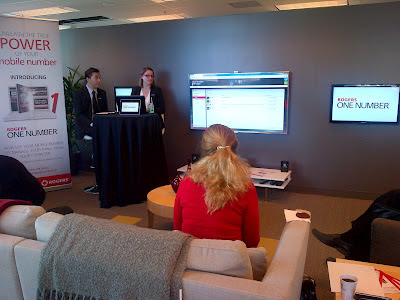
Yesterday was the official launch of the Rogers One Number service, and I was on-hand for the analyst briefing hosted at their HQ in downtown Toronto.

This was the second day in a row that Ronald Gruia from Frost & Sullivan was with me at an event - that's never happened before, and go figure, we both started working there the same day 11 years ago this week. Time flies, huh? I mention that because during the briefing we saw that the new service is dubbed RON for short. Had to smile, thinking maybe Ron is so influential they named this after him, but I don't think us analysts have quite that much currency. I digress.

So, what is Rogers One Number? Well, aside from the press release, and the Rogers One Number website (where you can sign up now), I'll steer you to my post from almost two months ago, when I got an early heads-up about it. Beyond that, I'll add some takeaways based on yesterday's briefing and demo.

First, the demo was held at their "Connected Condo", which is exactly as it sounds. They've carved out some office space at HQ, and dressed it up as a one bedroom condo to showcase how the perfect Rogers customer would live. So, you name the Rogers service, and this condo has it - TV, Internet, cordless phones, a tablet, a very cute kitchen counter mini-tablet for their Home Monitoring service, etc. We should all be so lucky, huh? My photos below provides a bit of that flavor. Anyhow, it's a great way to demonstrate residential services, and to make it even more realistic, they had an actual One Number user speak about how nicely the service ties together so many apps he uses all day long.

Second - let's get this straight. One Number is free for - and among - Rogers wireless subscribers. Based on what I've seen so far, they need to get that message across more clearly, as the mainstream market may have enough trouble just understanding the concept - and if it seems complicated, my guess is they'll assume it costs money, at which point, you'll lose them. This is a great service for early adopters, and anyone who recognizes the potential to really cut back on their wireless LD and roaming costs when calling other Rogers wireless subscribers. Once you understand what RON is, and that it's free, the value proposition is pretty strong, even for a light mobile user like myself. And, yes, I DID sign on for the service after the demo. If you do the same, let's try it out together!

Third - for now, RON is basically a bridge that makes your PC an extension of your wireless phone - and vice versa. I think of RON as UC for consumers with nice FM/FM and FMC capabilities. In my initial post, I explained what CounterPath brings with the softphone client, which is a key enabler for RON, and if it provides a reliable, high quality experience, this could be a very sticky application. To me, that's a pretty big deal for a few reasons - see below.

Sticky factor #1 - by bringing your mobile contacts into the PC environment, these modes become interchangeable. Think about that - not only is mobile call quality very uneven (and it doesn't matter how much you spend on the service!), but smartphones are pretty stupid when it comes to being used for phone calls. The latter is one of my biggest pushbacks against mobility - these devices are great mini-PCs, but the telephony experience seems like an afterthought. Anyhow, you can save a lot money making these calls on the PC, and that's good news for any mobile subscriber. Even better if you get a better calling experience, which PC-based VoIP can deliver, especially if your alternative is making a mobile call while walking down a busy street (and really, how many people doing that do you think are actually talking to somebody?)

Sticky factor #2 - if you haven't already figured out, RON is a Skype-killer. In my book, whoever owns the contact directory owns the customer, and once you import your mobile contacts, there will be less reason to use Skype - either for voice calls or video calls. This is a pretty good flanking move for Rogers, just in case any of the other IM-based/OTT services - MSN, Yahoo, Google, AIM, etc. - want to ramp up efforts to siphon minutes off the Rogers network.

Sticky factor #3 - I asked about extending RON to tablets or even Apple TV, but neither are in the mix yet. It's too early for those interfaces, but I had to ask, since those are the only screens not supported by RON. At some point I think both will happen, so if you think RON is sticky now, wait until you can use it on those screens.

Sticky factor #4 - don't forget the landline! I don't know what their business case models look like for RON, but you have to figure they'll lose some wireless LD and roaming revenue from subscribers who shift these types of calls to the PC. Fair enough, but Rogers also has quite a few Home Phone subscribers. Now that there's an official CRTC plan to phase out the PSTN in the next couple of years, all landline providers face the same endgame. Rogers, of course, has the least to lose since they don't have a legacy infrastructure, and the landline business is really gravy. Since it's VoIP, they can make some hay by grabbing more PSTN subscribers from the telcos, and with RON, they have an even stronger value proposition to get those wins. Think about how strong that bundle will look compared to what the incumbent might be offering. Coming back to the business model, however, there will also be some lost revenues to consider. If RON really works as advertised, the value proposition for Home Phone will diminish, perhaps to the point where it's simply not needed. Right?

We were told this service is the first of its kind in North America, and I can't counter that - so it must be true! Not only is this good to see coming from a Canadian operator, but from a cableco nonetheless. This is very much in line with the innovation issues we talked about the previous night at MobileMonday, and serves as another example of how changes in telecom are not being driven by the telcos. When successful innovation comes from the outside, the rules change, and they're no longer being made by those on the inside. It's hard to say if One Number is a game-changer, but in my mind, Rogers has the right idea here - now let's just see if the market gets it.


Know Your Alternatives Event on Thursday - Last Call!

If you follow me, you'll know about this week's Know Your Alternatives event here in Toronto. I've be posting about it off and on, and will be speaking on the SIP Trunking session, which runs at 11:30 during Breakout #3. I won't be hard to find, and will be there all day, so if you're coming, let's connect.

As per their Twitter feed - @KYAlternatives - today is the last day to register, so get on that now if you still need to sign up. Otherwise, I hope to see you there on Thursday!

MobileMonday roundtable - where's the innovation?

Last night was MobileMonday Toronto's annual Meet the Analysts event at the MaRS Discovery District facility. I was invited to moderate, and fortunately, the weather co-operated. Last week I was at the ITExpo in Miami, and my flight back to Toronto yesterday came off without any delays - phew!

Joining me on the panel was my Frost & Sullivan pal, Ronald Gruia, and Mike Abramsky from RBC Capital Markets. We were there to talk about our outlook for the mobile market in 2012, and we could have gone on a long time. The turnout was solid - I'd say about 200 attendess, and Jim Brown's team at MobileMonday Toronto has done a great job to organize this community.

The event was not recorded, but there was plenty of on-the-fly commentary on their Twitter feed - #momoto - so, check that out to see what you missed. I'd say the big theme last night was innovation, and my concern was where it was going to come from.

We all agreed that the incumbents are not really driving this in Canada, and a lot will have to come either from the handset vendors - as per Mike Abramsky's view - or the developer community, which was where I was going. Ronald, being a globetrotter, added an international view, citing examples where operators overseas are doing all kinds of interesting things, especially with the two-sided business model. If you don't know what that is, you'll need to start following folks like Ronald and me more closely! Otherwise, if you missed it, you missed it, but if this space is on your radar, at minimum, you should plug into MobileMonday Toronto, and maybe you can make it next time.


ITExpo - Day 1 - It's a Hit

The 2012 edition of ITExpo East kicked off yesterday here in Miami. Some of us were here on Monday too, but the main program began on Tuesday. I've been pretty busy between briefings, ad hoc meetings and moderating panels, but the vibe has been consistent so far.

Across the board, I think most people will tell you the event is working really well. The hallways are full with activity, the sessions are well attended, the content is great, and the breadth of subject matter is far too great for any human to consume. This last point is to be taken in stride, as all conferences struggle with going either wide or deep. In recent years, TMC's model has been the former, and this cuts both ways. The quality of content here is quite good, but the net is cast so wide now, that for every must-see session you attend, you're going to miss maybe 3-4 others you would just as likely want to see.

Am not sure how you address that aside from sending a team to fan out and cover all the bases. Most people don't have that luxury, so you just have to pick your spots. My day was spent either in briefings or moderating, so I didn't have a chance to see any other sessions. It's too bad, since there's really strong content for me in tracks such as Cloud Communications, SIP Trunking, 4GWE, M2M - and others. Not to mention today's must-see event later on - the Sir Terry Matthews keynote followed by StartupCamp5 Comms Edition, hosted by Embrase. I'll be there!

Well, I think you get the idea. There's a lot of great content here, and that probably helps explain why attendance is so strong. Lots of people here all day long, and you could really see it when the show floor opened late in the afternoon. Not only was the traffic active, but the exhibitor hall was pretty big. Am told there are 200+ exhibitors here, and the range is pretty impressive. Having walked the floor, there's something for everyone here, with all kinds of VoIP providers, SIP trunking offerings, telecom systems, contact centers and cloud. Not that much video, social media or mobility, but a pretty rich pallette nonetheless.

I should add that my two sessions were totally full, and I heard the turnout for other sessions was strong as well. My panels has strong speakers, and I think the time was well spent for attendees. TMC is providing its own coverage of the sessions, and you can follow that on their site. Here's their coverage of our UC Business Case session.

Overall, I think TMC will be pleased with how the sessions are going, and if this continues, I'd say the odds are good that a lot of attendees will be back. That's pretty important, as turnover is a fact of life in this business. For both of my panels, I was very suprised to learn that the vast majority of the audience were first-timers. I think it's great that TMC is attracting new blood, but it also makes me wonder where all the regulars have gone. I'm sure the weak economy has taken its toll, but am not sure if some people have moved on to other events, or simply dropped out of this space completely.

Regardless, the news from Miami so far is very good, and I'm looking for more of the same on Day 2.